

Keeping Up With Robert Frank
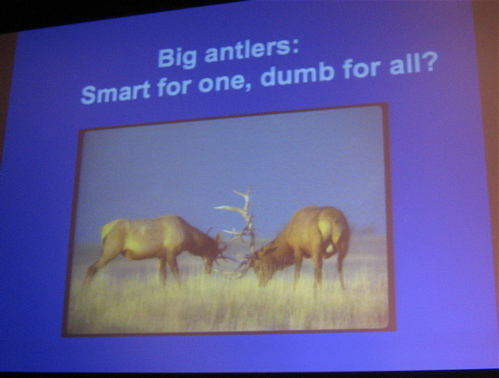
Cornell economics professor Robert H. Frank, author of Luxury Fever and other books, gave the opening lecture at the Human Behavior & Evolution Society conference I'm attending in at Penn in Philadelphia. His was a very interesting talk about absolute versus relative consumption.
Relative consumption is your consumption as compared to that of your neighbors; your satisfaction measured in a “keeping up with the Joneses.” But, he points out that, contrary to popular "wisdom," money can buy happiness, as life is simply easier and more pleasant if you're wealthy.
The problem is, according to Frank, as one segment of society gets very wealthy, lower segments of society feel pressured to acquire more outward displays of wealth (fancy cars, bigger houses) to appear to be keeping up.
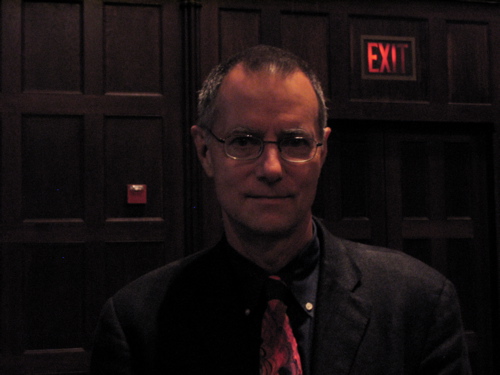
Frank told a story about his days teaching in Nepal (I think with the Peace Corps), and how he had this house with a leaky grass roof. In America, he noted, such a house would be simply unacceptable, but there, it was a better house than all the other teachers had and he was very happy with it. He also gave the example of this car:
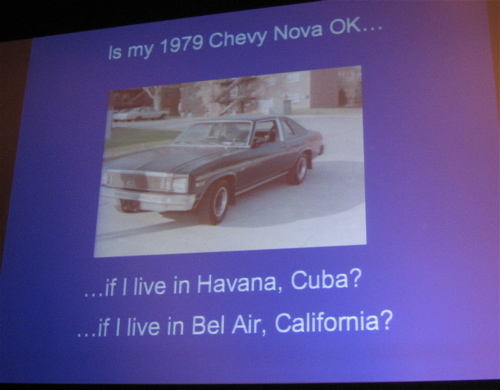
If you drive a Nova in Havana, Cuba, you've got status. In Beverly Hills, you've got a problem.
While people think concerns about relative position come from growing up in a capitalistic society, he pointed out that they seem to be hardwired nervous system components. Evolutionarily, people should care about relative position because it affects material payoffs; for example:
--food in famines
--mate access
--effort monitoring
--choosing right arena (sorry, forgot what this one means, exactly, and no time to go to my recording)
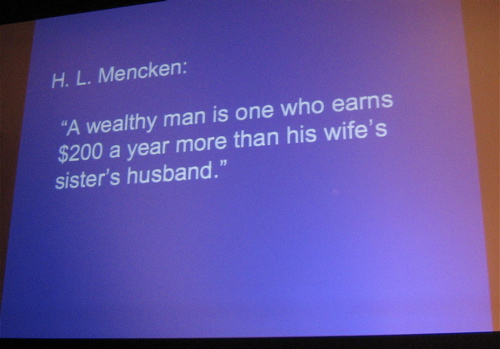
I loved this Mencken quote he put up:
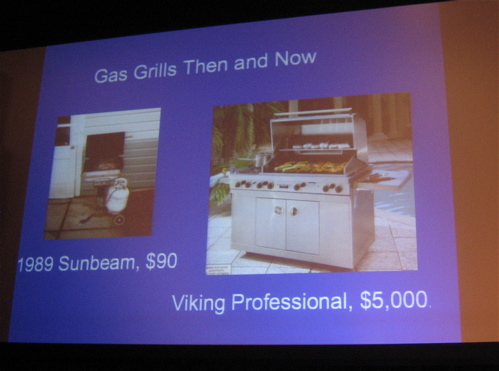
He sees the "expenditure arms race" -- the increased spending by the average person on flashy luxury items to keep up with the rich, who can afford those items -- as a serious problem, as it's financed by decreased personal savings and increased personal debt. Here's an example from his Luxury book:
I wonder if you can point out to the average person what they're doing -- the end result of spending money they don't have -- and have some success in curbing excessive spending in those who can't afford it. There is a real reason, sometimes, for appearing richer than you are, as it may help convince people you're of a higher status, and, perhaps, give you a job because of it.
But, maybe there's a rationality and evolutionary psych-based answer for this: pointing out, to the average person, the longterm cost of overspending, and suggesting to that they instead live within their means (that's the rational part), and "cheat" (that's the ev psych-inspired part) to appear wealthier and higher status when it matters.
They could, for example, shop cleverly so they appear rich and high status when it actually has tangible benefits (for a job interview), and then be mindful of what keeping up the expenditure arms race means for their savings and future when it has no tangible benefits. So...maybe buy a Hugo Boss suit when it's on sale in August, and you'll look the part of the guy who should get that job. But, live in a reasonably sized house so you aren't blowing your retirement savings.
Frank and I talked later, and I asked him about what I call ethical capitalism, mentioning the work of the English economist Pigou, who talked about businesses factoring into their profit the cost of their goods to society, instead of expecting society to pay (à la Exxon in Alaska, etc.). He recommended this book, Capitalism At The Crossroads, by Stuart L. Hart.
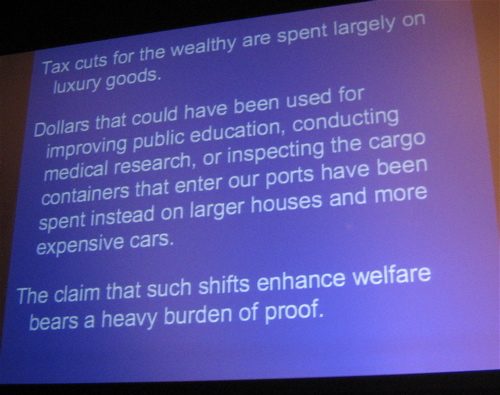
He finds it hard to believe that we're giving tax breaks to the highest earners in society when we can't afford to monitor loose nukes in Russia, or our ports, or fund Homeland Security properly in New York City.
He told me he’s basically a libertarian, but has a more expansive vision of what constitutes “harm” in the the libertarian “do no harm.” I do as well. Why, for example, should people be allowed to pollute unnecessarily and endanger the rest of us by driving these vast SUVs? He reminded me that Dave Barry called one of them “The Subdivision” (I think, instead of “The Excursion”).
He and I have the same libertarian take on personal risk. He told me his notion about people riding motorcyles without a helmet –- which is pretty much the same as mine. Here it is from a past Advice Goddess Blog entry:
I have no problem with anybody who wants to ride a motorcyle without a helmet, or walk on a tightrope between two skyscrapers -- providing they have either some special health insurance premium or a card in their wallets saying that when their brains become huevos rancheros on the sidewalk, they stay huevos rancheros on the sidewalk.
I was flattered to find that he knows (and misses) my column, which the Ithaca Journal dumped after I wrote “Sex isn’t special. Monkeys do it, and not because somebody gave them flowers or expensive jewelry.” More about that soon, as I just called the managing editor at the paper, Bruce Estes, to see if they'd pick it up again. I'd like to think Estes and other editors and publishers (such as the grudge-holding Amy Alkon haters at the LA Times) would follow Cathy Seipp's advice in her column about Alisa Valdez-Rodriguez on what papers should be running:
That Alisa can be a royal pain is obvious even just from the titles she's considering for her next book (I think she should stick with her first choice, the excellent "Girl Crush.") These include: "All-American Bitch," "Selfish," "Me, Me, Me," "Boosters, Bitches and Babes" and "Latinas Who Lunch."But that's what makes her such a great story, and you'd think that especially in these days of declining circulation, editors would jump at the chance to engage readers rather than bore them.
Beyond that, the public isn't well served when stories are assigned (or not) on the basis of who Brenda Starr and friends feel like talking to this week. Newspapers are a public trust, and those who work for them have an obligation to rise above their personal squabbles and hurt feelings.
Posted by aalkon at June 9, 2006 04:32 AM
Trackback Pings
TrackBack URL for this entry:
http://www.advicegoddess.com/mt/mt-tb.cgi/1408