
AMY ALKON, APPLIED BEHAVIORAL SCIENCE AUTHOR, SPEAKER, NATIONALLY SYNDICATED COLUMNIST

I earn from qualifying
purchases. I get
commissions for purchases
made through links I post.
IN U.S






IN CANADA

IN U.K.


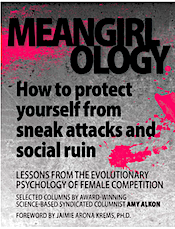
Meangirlology: How to protect yourself from sneak attacks and social ruin
Rumors. Veiled put-downs. Back-handed compliments. Sneaky attacks that are hard to pinpoint as attacks.
Why do women do this to each other?
If you're looking for someone or something to blame, look no further. The culprit is our own DNA. We might be living in a modern world, but we are still driven by ancestral-era psychology, so these tactics remain with us today.
In this curated collection of science-based columns from award-winning writer Amy Alkon, you'll take a deep dive into the inner workings of female friendship, the methods women use to fight dirty, and the murky nature of the "frenemy." What comes across as cattiness is actually evolutionary psychology at work. What appears to be an insult is mate competition in disguise.
In Meangirlology, Alkon expertly guides you through the findings of renowned psychologists such as Anne Campbell, Joyce Benenson, Jaimie Arona Krems, and Tania Reynolds to help prepare you for the sneak attacks you don't see coming from "the gentler sex."
By being aware of the evolved motivation for women to compete this way, we can spot the frenemies in our midst, deter attacks on ourselves, and be better friends to other women--and have more meaningful, satisfying female friendships.
Foreword to Meangirlology: Jaimie Arona Krems, Ph.D.
Reputation-assassinating gossip, social exclusion, dirty looks. We all know these are weapons used by women against other women, and we've all had them used against us, but we typically don't say this out loud. They take up only the negative space in conversation.
In polite female society, we say that a certain woman is "so nice," but we do not say the next part of that: "unlike that nasty C U Next Tuesday." Or we say that woman we work with is "so supportive of other women," but we do not say, "unlike that Queen Bee in the company who cannot stop talking behind everyone's backs."
Amy Alkon is thankfully unconcerned with polite society. Because those C U Next Tuesdays and Queen Bees exist, because their aggression hurts, and because we need to talk about it.
For over two decades, Amy has been immersed in the world of evolutionary social science. She regularly talks shop with researchers in psychology, anthropology, biology, economics, and primatology to understand how recurrent selection pressures have perhaps indelibly shaped the ways that women aggress. Full disclosure, I am one of these researchers. Along with a slew of other scientists--mostly women, all so much nicer than you probably think we are--I have spent much of my career asking questions about the costs, benefits, and biological underpinnings of female competition.
What we have learned could fill fifteen books, but you do not want to read those (unless you would like to toil toward a Ph.D., after which you will get paid abysmally while you work around the clock in a city that you hate because academics cannot pick where we live). If you want to know what we know about female competition, read this book instead. Because Amy has already read all the other books--and dug through the published articles, seen the data, and attended the conference talks. Her science-based responses to readers who have felt the sting of female aggression not only tell us how malicious rumors or backhanded compliments are meant to function, but they also tell us how to fight back against these ubiquitous slings and arrows. This makes Amy's book part "crying on your nerdy friend's shoulder" and part "combat guide for modern (women's) warfare."
Today, there remain a lot of question marks surrounding female competition and aggression--such as if it is especially well-designed to hurt other women and when it leads to lethal violence. But if we know nothing else for certain, we know that it is effective. It hurts. Terribly. Some of us know this from digesting the decades of research indicating that its victims can face depression, suicidal thinking, or even hormonal dysregulation that disrupts their ability to conceive. Some of us know that from personal experience (like because our pathetic, unlovable former best friends were not smart enough to delete the two-hour IM conversation they had about how much they secretly hated us while borrowing our computer).**
But regardless of our sex, gender, sexual preference, age, race, or culture, we have all been burned by female aggression. And we need to talk about it: ideally to a redheaded extreme nerd named Amy Alkon--holding a tiny Chinese Crested dog and dashing somewhere in a sequined evening gown and cowboy boots--who also knows all about female competition from both the research and experience. Here, in this vital book, Amy Alkon marshals the cutting-edge science of female competition (and friendship) to explain why women's aggression takes the shapes it does, why it can be so terrifyingly effective, and how to escape its most pernicious impacts.
Jaimie Arona Krems, Ph.D.
Evolutionary Social Psychologist