





Wonder Why Tuition Is So High?
One reason? Because schools are not just schools, but theme parks. Here's a pool at the University of Northern Iowa -- the photo of which was put into a presentation by Purdue, support for their argument for keeping up with the educational perk Joneses.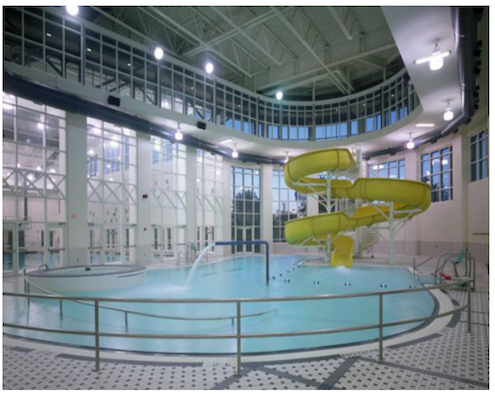
Via the WaPo, from a story by Dylan Matthews on how a bachelor's degree could cost $10K -- total.





Some suggestions are good, some not so much.
According to "Your Brain on Childhood", we don't learn as much from videos as we do from face-to-face interaction. Our brains don't retain as much. While supplementing learning with videos and computer games can be helpful, it isn't a matter of just showing students videos of a good physics teacher. Part of being a good physics teacher is the rapport you have with your students, which you don't get from watching a video.
Also, while instructors who aren't professors are good for teaching people who are going to be, say, a High School physics teacher, they aren't as good for training someone who wants to be an actual researcher at higher levels, even in the beginner classes. They don't have the depth of knowledge needed to know where to guide the students. But they're fine for students who are taking it as a general requirement or who don't want to go as far in the field.
Yes, the sports are ridiculous. Especially since sports take precedence over academics. When I taught French at the Uni level (as an adjunct instructor) students would constantly skip tests and classes for games. I was required to let them do so. It's one thing to have sports, but they shouldn't interfere with classes. The point of a University is to be academic. Sports are fun, but they should be extra.
What some of what they're describing is essentially the European model, where students go to class and live at home with their parents. There are not really any extracurriculars. It works well. It's why taxes can fund the schools (that and very high entrance standards and a lot of kids flunk out), because the cost per student is not exorbitant.
NicoleK at September 27, 2013 12:08 AM
Another thing I have noticed in america is that the teachers hardly do any work. The work week for a teacher is hardly 4 hours of teaching. I know some people have the damn excuse of saying that the preparation for the teaching and setting tests takes more time than the actual teaching itself, however, they ignore the fact that it is a one time effort and the effort in preparation and test setting goes down exponentially for a guy who is in the field for more than 3-4 years as it is essentially the same thing he is teaching year after year. So after 3 years, the effort in preparation for a topic becomes zero and setting a test becomes a simple matter of just taking all the questions of the last 3 years and re using them. Or if a guy is smart, he could get his teachers prep notes and question papers and re use them anyway. So in cases where a guy does teaching, he can easily teach 20-30 hours a week and reduce the cost on the kids. Research can be done by those who want to do it out of their own interest and they can be prepared to work more than 40-50 hours a week (spend 20 hours teaching and 30 hours on research)and if they make any discoveries from it which can make some money, then they can make the money from it rather than expecting the few who actually do research and discoveries to subsidize those who actually do research because they are mandated to and never come up with anything useful.
Also, colleges can cut cost by doing away with useless courses and only courses which are useful...who the hell needs the mandatory english lit course or the gender studies course? If govt. makes any non core course mandatory, they can have govt. provide the money for the faculty for that course and it is the govts job to make sure that their faculty do 40 hours of teaching of that crap course to a 1000 people at a time so the taxpayer money wasted is minimal.
Redrajesh at September 27, 2013 1:32 AM
You might want to re-think the polemic against mandatory English classes. Many if not most freshmen arrive needing remedial classes.
We require degrees for too many jobs, and too many are awarded degrees which signify nothing. Too many go who do not belong and most of them fail, and owe.
NicoleK is right about the students who go on to advanced degrees and research. Unfortunately, many of us (raises hand) haven't a clue about what we want to be when we grow up at that age. So it's good, I'd argue mandatory, that the professors teach the freshmen. Face it, it's the rare TA/grad student who is going to inspire you. If you want to save money, look at the overhead first (administration.)
We had an additional motivator in the draft back in my day. I'm not sure I'd have joined without it, and my life would be unrecognizeable if I had not. I'm glad I got my degree, but it's not really necessary to do my job. It's just required, now.
MarkD at September 27, 2013 4:37 AM
Redrajesh's arguments against professors is out of date in an era where we have passed the 50% mark on classes taught by adjuncts, who are typically paid $2500 per class.
His arguments about the time it takes to teach well (which includes advising, a significant time load) and the merits of research are also unrealistic but sadly common. In my field (astrophysics) there are a tiny fraction of projects that result in patents (for detector or optics technologies mainly) but a plethora of research lines that probe fundamental physics and the structure of the universe. I'm always stunned by those who reject basic research wholesale. Where do you think the science that drives applied technology development comes from?
Astra at September 27, 2013 6:01 AM
The elephant in the room is the massive expansion of administration at U.S. univerisities. These days schools seem to have hundreds of Assistant Vice Provosts for Political Correctness, making mid-six-figure salaries, and a whole support staff and organization that goes with each one. Faculty hiring since about 1980 has actually been pretty flat; the growth is all in administration.
Cousin Dave at September 27, 2013 6:59 AM
Amy Alkon
https://www.advicegoddess.com/archives/2013/09/wonder-why-tuit.html#comment-3939704">comment from Cousin DaveAbsolutely, Cousin Dave, on administrative bloat. It's disgusting. Especially the VPs of speech suppression, which is basically what they are.
See theFIRE.org for all of that.
Amy Alkon at September 27, 2013 7:06 AM
Tuition is so high because there is so much "free" money in the system. Student loans and grants give students with money to spend on tuition and living expenses, so schools raise their tuition rates to capture as much of that money as possible.
And schools can't price themselves out of the market because tuition increases are usually met with student loan level increases.
And there is little to no competition for students seeking lower tuition costs. The for-profit colleges are even more expensive, having pioneered the practice of pegging tuition rates to student loan limits (where tuition = student loan maximum). The public and private colleges are only now discovering that little trick and raising their tuition even faster to keep up and grab more of the "free" money.
Besides, try getting a "good" education from an online school or a for-profit college. To test this, see what your employer thinks about a degree from DeVry or Phoenix. Chances are that experience is the deciding factor in hiring someone from DeVry or Phoenix and education and experience are the major factors in hiring someone with a degree from Harvard or even Ohio State.
Lower the amount of "free" money in the system and students will be forced to drop out or not attend college. Fewer students will force the universities and boards of regents to reduce tuition - which will force them to reign in costs.
The fancy swimming pool is there because the money is there to pay for it. The Dean of Lesbian Diversity has a job because there is money to pay her salary. The "Simpsons as Microcosm of LIfe" class there because there is money available to pay for it. The ethnic and gender studies departments and majors are there because the money is available to pay for it. Tuition isn't going up to pay for ridiculous departments, classes, and amenities - the ridiculous departments, classes, and amenities are there because there is so much "free" money in the system right now.
All this "free" money is coming from taxpayers. The federal government guarantees student loans and pays off the ones that default. So, you may not have a kid in college, but you're paying for them to have indoor ice hockey rinks, latte bars in the rec center, and classes in television watching.
Conan the Grammarian at September 27, 2013 8:55 AM
That's "rein" in costs.
Conan the Grammarian at September 27, 2013 8:57 AM
OK soCal girl, what's your plan for getting chicks into bikinis mid-winter in Northern Iowa? Warm Jello shots, hot water t-shirt contests?
smurfy at September 27, 2013 11:17 AM
So after 3 years, the effort in preparation for a topic becomes zero and setting a test becomes a simple matter of just taking all the questions of the last 3 years and re using them.
That sounds an awful lot like someone who's never actually taught in a structured environment.
And you're assuming they'll be teaching the same set of courses in three years, which...yeah, probably not.
Yes, there is a scale of economy, once you have your material organized. Tests, quizzes and so on become a bit easier. But you still have to review your material before hand so that you know what it is that you're talking about. Having taken courses by - let us call them senior faculty - who thought they knew the material cold but didn't actually, it is basically a waste of time because they'll do a poor job and the lecture will be disjointed and rambling.
Assuming they don't go off on a tangent about fishing or their other extra curricular activities or what they did this past weekend.
And if you're teaching three courses, and trying to do some research, maybe get published or write a book, guide some gradual students thru a masters or PhD program,and those damn faculty meetings[*], oh, and yeah, trying to get promoted/tenured. That's easily a 40 hour work week.
Not to mention the number of students who expect this to be like high school but with better parties. What do you mean, I have to put actual effort into my studies in order to get good grades? I've never had to do that before!
[*] I have to attend at least some faculty meetings now. I think I'd rather play footsie with Torquemada.
I R A Darth Aggie at September 27, 2013 12:42 PM
Where do you think the science that drives applied technology development comes from?
Definitely not entirely from the universities. I am sure there are a hell of a lot of brilliant people in industry and getting people to do experiments in industry is time consuming, painful and subject to a hell of a lot of regulations which universities are not subject to. Even when some study is done using some high power electron microscope about some new compound, normally industry(private or public) does get involved. The nobels may all be received by people from academia, however they never get to do all that without the backing of industry. And all these people who get the industry backing do things funded by industry with the implicit understanding that they are good and there is potential for failure. However, what I am talking about are the researchers who are not funded by industry and just do research because the university requires them to do so. And their research is funded by the student tuition. Which is crap. If those guys can't get industry funding, they might as well just teach more hours and more people and get less pay and reduce the burden on the kids.
$2500 a class is a pretty good amount(assuming a class is just 10 lectures of 1 hour each - thats $250 an hour). That is not low by any standards. Plus for people who just want to do an undergraduate course and move on to industry, that is more than enough. They don't need to pay to fund research and a lecture by an einstein is not going to make them any more intelligent. They may get inspired to become another einstein instead of a corporate executive, but inspiration can come in many ways and kids don't need to pay someone more just because he is more intelligent when the utility value for them is the same. I mean, if I get my car fixed for simple problem by a diploma in auto servicing or a phd in mechanical engineering, the utility is the same and I am going to pay the same money since the work is the same. I am not going to pay more just because the guy who fixed my car is a phd. Similarly, for an undergraduate course, whether the person who conducts it is another undergraduate or a nobel prize winner makes no difference to me since the contents are the same.
Redrajesh at September 27, 2013 12:48 PM
And if you're teaching three courses, and trying to do some research, maybe get published or write a book, guide some gradual students thru a masters or PhD program,and those damn faculty meetings[*], oh, and yeah, trying to get promoted/tenured. That's easily a 40 hour work week.
getting published and writing a book are for profit activities from which you actually get money. So the salary is not supposed to be for that. The salary which gets paid from tuition is for teaching the courses. Anything else which makes extra money for you without coming from the students pockets, sorry buddy, you got to earn it with extra effort and not expect the kids to pitch in for you with their money.
Faculty meetings are the equivalent of management meeting which engineers in industry have to go through, so nothing great about that.
Guiding some gradual students through a phd program...again extra money from external funding which you are getting, so put in the extra work for it.
If you want to get paid for work, then maybe the pay should be according to the work you do. For instance, if teaching grad students is like $40 an hour, then whatever hours you put in the month for teaching grad students(say 12 hours a month for 1 course - so 3 courses is like 36 hours) should net you $480*3 = 1440. You want more money, teach more, do 40 hours of teaching a week and get the 1600 a week or 6400 a month. As simple as that. I really don't see why you academics have such a hard time comprehending that. Industry again leads the way in that. Driving a truck in ups pays more than sorting stuff in the mail center, but you cannot expect a guy to drive 8 hours for risk of accident. So he drives 2 hours and does 6 hours in sorting and front ending. And guess what, he does not get the pay for 8 hours of driving. He gets paid for 2 hours of driving and 6 hours of sorting though he is a licensed truck driver.
Same way, depending on the way you spend your 40 hours a week, you can very well get paid accordingly. Don't expect the undergrad kids to pony up the cash for the aid you give your phd underlings and for the industry funded research which you are doing. No industry funding for your research? - too bad...just teach more hours man. Wanna spend time to write a textbook...you get paid if your textbook gets published. Don't expect the undergrad kids to pony up the cash for the hours you spend writing your textbook. If industry ran that way, Scott Adams would have been able to write Dilbert while in the office and the office would have had to pay him his full pay even if he worked just 2 hours and spent the remaining 6 hours writing Dilbert. He worked extra hours for 9 long years to make it. That is what you academics have to do to make it, not expect the undergrad kids to pay for all your golf parties and time doing research which may or may not come up with something useful.
In short, don't expect pay for 40 hours of teaching a week when you are doing just 9 hours of it.
Redrajesh at September 27, 2013 1:09 PM
RE: MarkD "We require degrees for too many jobs..."
You could not be more correct. I am required to get a degree for my job. I was lucky I went from hourly to salaried without the degree, but I cannot get promoted any higher than entry level without it.
Overall, I have been working in this field (logistics) for 27 years. When I started, it was just beginning to be computerized. I have worked in my current position for 8 years. I've designed much of the governance, policy and procedures we use. But I still cannot get promoted without a bachelor's degree.
It is very discouraging.
KLClark at September 27, 2013 1:33 PM
Don't forget, after getting reamed for full-boat tuition (required to support the NFL and NBA farm system and the $1million-a-year university coaches and their bootlicking administration), you'll be asked to become an alumni and continue sending money for the rest of your life.
And what photo gets published to show the waste of a university budget?
The water slide, of course.
Gog_Magog_Carpet_Reclaimers at September 27, 2013 4:56 PM
Redjradesh, actually, in my experience they mix up the classes you teach. Also, every couple years there's new textbooks, new online materials, new other multimedia stuff. And grading is a huge PITA and can take a very long time, depending how many assignments you give out.
There's a difference between research universities and teaching colleges, even though all schools have elements of both.
Research is NOT a hobby, research is the primary job of tenure/tenure-track/post-doc professors. It's how they get their promotions, it's how the university gets prestige, its how things get discovered.
It isn't something that private industry can take over because the results are not immediate. (IE Number Theory was considered a cute game for hundreds of years, now it's the base of cryptography, rather important on the internet and fundamental to our current economy. But back in the day people studied it for purely intellectual reasons.).
Industry research tends to be short-term. Universities have been -essential- in creating our current standard of living.
We need academic researchers.
As an adjunct, I was paid $1400 a month for two classes. The classes met 3 hours a week, for a total of 6 hours a week. I forget how many weeks it was exactly, I believe it was 12. We did not have the option of teaching more classes because they didn't want to give us benefits. So that's almost $20 an hour if you only count teaching. But I had to hold office hours 3 hours a week (we're down to $13 an hour), and I had to grade and prep lessons (don't remember how much time per week that took). Still think my pay was great?
I loved my job, but I was basically a housewife with a hobby.
I can see the argument for having a High School teacher-like position to teach -some- intro classes, but the thing is, the teachers shouldn't just be teaching what's in the class, they also need to be a resource for the kids who want more than what's just in the course work. What most people don't know about school, is the kids who are really successful are the ones who learn more than what's in the class, and get involved in faculty research and projects.
So you can't totally split the job into pure research and pure teaching, though there are some positions that are only one or the other. It just can't be all of them.
NicoleK at September 28, 2013 6:02 AM
I am not saying that it needs to be split into pure research and pure teaching. But when you are taking money from grad students, take it for the teaching alone. Not for the research. Why the hell should the grad students pay for the research which they are not interested in? Or to put it another way, I could have a guy flipping burgers in mc'd who is a school kid or a 50 year old with a ph'd in aerospace engineering. Would I pay more for the burger because it was flipped by the ph'd in aerospace engineering? That is what I am talking about. You can do whatever research you want, but why the hell should I pay for it when all I am interested in is the course on basic physics which has had the same principles for the last 400 years since the time of Newton? You did not even discover the things which Newton discovered, you are just transmitting it to me and I don't see why the hell I need new textbooks for that in the first place except for you to make money out of the new textbooks. You do your research, but don't expect the money which I am paying for the teaching to pay for it. Get it from anywhere else(government, the endowments of millions of dollars which universities get, your friendly sponsors etc etc). Just don't expect my tution money to pay for it. And since you said that the teaching part pays just $13 an hour, it just proves the point that grad college can be damn cheap since grad college does not need anything more than teaching a standard course which can actually remain the same for 20 years or more since the basic principles and applications are not going to change at all anyway.
And regarding the work which people did purely for intellectual reasons especially hundreds of years back, they pretty much did all their work outside of the university. In those days, university was pretty much free for those who made it through the doors and the number of people who made it to university was negligible and not the entire population of the country the way it is today. I mean, Mr Newton did not come up with his theories because of a university type setup. Mr Thomas Edison did not come up with his inventions because of a University. Mr Henry Ford did not achieve success because of a university. These people who have fundamentally changed lives across the world did not do it because of a unversity.
Redrajesh at September 28, 2013 10:39 AM
NicoleK writes, about European universities: "the cost per student is not exorbitant".
Just as a random data point, the cost in Switzerland is somewhat less than $20000 per student per year (for NicoleK: this number is for "Haute école spécialisée"). That's the actual expenditure by the school. In the US model, as I understand it, colleges charge an average of around half of their actual costs as tuition (because of state funding, private legacies, etc.).
Of course, like it or not, the system here is that costs are almost entirely paid by the state - anyone can go to college for nearly nothing. Despite what NicoleK says, we are not nearly stringent enough: if you fail out, you can try again in another degree program, pretty much ad infinitum. The total years of state-funded college really ought to be limited.
bradley13 at September 28, 2013 11:19 AM
Oh, as a college professor (computer science), I just have to reply to Redrajesh, who writes: "effort in preparation and test setting goes down exponentially for a guy who is in the field for more than 3-4 years as it is essentially the same thing he is teaching year after year" and "can easily teach 20-30 hours a week".
At least in my field, Redrajesh is insane. At least, if you care about teaching well. After 3-4 years, my course contents are so old as to be useless; I update them continually. I really wish I could spend more time working with students - giving them assignments and then feedback on those assignment - because that is the most effective way of making sure they really understand the lecture material, but I don't have time. This fall, I am teaching 16 hours per week, and that is near the upper limit.
Go teach, really teach your 30 hours a week. See how many hours of actual work that represents. What's the saying? "Better to Remain Silent and Be Thought a Fool than to Speak and Remove All Doubt".
The abuse of adjunct lecturers in the US started after I left. However, from what I hear, it is really lousy: adjuncts who actually do try to teach well are working for poverty wages. Fire most of the administration, pay teachers well, and teach students stuff that matters.
bradley13 at September 28, 2013 11:34 AM
"After 3-4 years, my course contents are so old as to be useless"
Is it? Do unix commands change after 3-4 years? I don't think so. I am pretty sure even a course on integrated circuits or chip design would not be useless if it is 3-4 years old as everything would still be following the same principles and calculations. What is changing things in the world is fabrication technology which no computer science course would be covering.Wonder what course he is talking about and whether it is actually useful or not. In all probability, a course that is not even needed in the first place. Academics have this illusion that they are actually doing something useful in the first place. Working in the IT industry after doing Civil engineering, I know one thing - college was a waste of time. And it would have been a waste of time even if I had worked in the civil engineering field itself which I did for some time after coming out of college.
Redrajesh at September 28, 2013 2:26 PM
Of course the tuition has to go up because the $32B endowment isn't large enough.
Jim P. at September 28, 2013 10:29 PM
Leave a comment