





Nursery Rhymes Are HATE
The nursery rhyme, "Three Blind Mice," led to a "bias incident" at University of Wisconsin-Platteville when three students dressed up for Halloween as said three undersighted rodents.
Seriously.
Morgan Walker writes at Campus Reform:
A member of the University of Wisconsin-Platteville's Bias Incident Team accused three students of mocking people with disabilities for donning "three blind mice" Halloween costumes.The Bias Incident Team (BIT) records obtained by Heat Street suggest that the offense was made after the students posted pictures of themselves wearing the costumes on Facebook.
A member of the BIT reported the incident saying she was concerned "about their choice as it makes fun of a disability," the meeting minutes revealed.
The students, who were also university staffers, were reprimanded for wearing the "offensive" costumes and informed that "this incident is being considered a personnel issue in Residence Life."
You know who's really dehumanized? People we have to treat like fragile china. People we can't joke about. It's a point the late quadriplegic cartoonist John Callahan made, and why he made jokes about being disabled and drew countless cartoons about it.
From Heat Street, this appears to be a photo of the students in costume.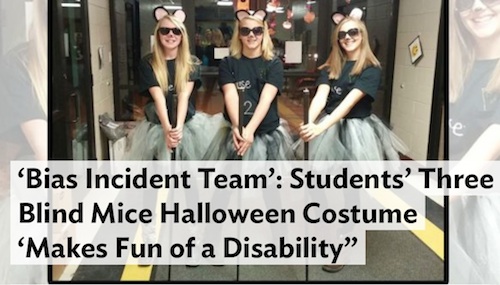 Now, does anyone really think their intention was to be hateful to blind people -- or to look cute at Halloween?
Oh, and what happened that they forgot to accuse them of worshipping animal cruelty?
Three blind mice. Three blind mice.
See how they run. See how they run.
They all ran after the farmer's wife,
Who cut off their tails with a carving knife,
Did you ever see such a sight in your life,
As three blind mice?





"Bias Incident Team." For twenty years we went along with jokes like that, because they promised popcorn with a reasonably taut comedy like Ghostbusters or Men in Black.
What could the members of that "team" possibly have done to earn authority over others?
In this great book, our author describes the critical moment of horror in a series of famous deaths, ending a list of threats with an especially chilling and isolating insight: "We were a team in name only."
In what rigorous, partnership-forging crucible could these team members have learned to trust each others judgment and performance in conditions of risk? Do they even view their ideas about the behavior of third parties, and the life-changing accusations to follow, as risks?
Crid at August 6, 2016 1:11 AM
I'm pretty sure the BIR needed to justify it's existence by finding enough incidents to prosecute. Notice they are accuser and judge at the same time.
Ben at August 6, 2016 1:38 AM
For the sake of argument, let's say these women did INTEND to offend - so what?
charles at August 6, 2016 3:26 AM
For the sake of argument, let's say these women did INTEND to offend - so what?
Privileged groups are legally protected against offense.
dee nile at August 6, 2016 4:16 AM
You have to do something useless with a useless degree. It's not like I'll be hiring you.
MarkD at August 6, 2016 4:31 AM
Of course, none of what the BIT did had to do with protecting the sensitivities of others. Three blind mice could see that plainly.
And as for Crid: "What could the members of that 'team' possibly have done to earn authority over others?"
I doubt simple accomplishments would earn you a place on the team. A desire to punish heretics might. Especially when the definition of heresy is pretty broad.
Old RPM Daddy (OldRPMDaddy at GMail dot com) at August 6, 2016 5:09 AM
Precisely. We've created our own little Committees for the Promotion of Virtue and the Prevention of Vice, allowing each committee to define virtue and vice on the fly.
The Soviet Union, the Chinese Communist Party, the French Revolution - all dictatorships - loaded their police and militaries with political commissars responsible for ensuring that no anti-Revolutionary thoughts popped up in the heads of officers or enlisted. Until 1941, the Soviet political commissar was a "second commander" of field units and on this confusion of command was laid the Nazi defeat of the Red Army in the early days of Barbarossa. Until the single command was restored in July 1941, the Red Army was an army at war with itself.
The effect on the citizenry of such oversight units is catastrophic, destroying personal integrity and dignity of the populace.
An excellent film on the subject of the abuse of political oversight authority is The Lives of Others. If you haven't seen it, see it. In it, a Stasi officer is assigned to spy on a composer for potential disloyalty, discovering over the course of the film that the only reason the composer is suspect is because the commissar lusts after the composer's wife and wants a pretext to imprison the composer.
Conan the Grammarian at August 6, 2016 5:13 AM
Nursery rhymes, by the way, have pretty dark origins.
“Three Blind Mice” is supposedly yet another ode to Bloody Mary’s reign, with the trio in question believed to be a group of Protestant bishops—Hugh Latimer, Nicholas Radley, and The Archbishop of Canterbury, Thomas Cranmer—who (unsuccessfully) conspired to overthrow the queen and were burned at the stake for their heresy. Critics suggest that the blindness in the title refers to their religious beliefs.
Conan the Grammarian at August 6, 2016 5:18 AM
Finally, alumni of colleges where all this silliness goes on are responding by cutting off donations.
http://www.nytimes.com/2016/08/05/us/college-protests-alumni-donations.html?smprod=nytcore-iphone&smid=nytcore-iphone-share&_r=2
Nick at August 6, 2016 5:36 AM
Well, I think they have a point. I mean look at "Jack and Jill." Obviously an anti-woman bias in that story.
Jack and Jill
Went up the hill
To fetch a pail of water.
Stupid Jill
Forgot the pill
And now they have a daughter!
And just why do women have sole responsibility for preventing unwanted pregnancy, I'd like to know! Is there some reason that Jack couldn't have used a condom or gotten a vasectomy?
It's always the woman's fault, isn't it? Isn't it?
I'm just so angry right now, I could spit!
Patrick at August 6, 2016 5:40 AM
If you are the one who gets pregnant, you need to count on yourself, not others, to prevent that.
Amy Alkon at August 6, 2016 6:00 AM
Don't you be bringing any of that fancy smancy logic and common sense into this Amy. Patrick is spittin mad over a problem he created for himself so he could get spittin mad. You can't take his spinnin away! It would be down right unconstitutional. After all I'm sure once you search the penumbras and emanations your tea leaves will align, at which point you get to play scrabble with the constitution and make it say whatever you want. The letters are all there. They just need a bit of jiggerin to make them work right.
Ben at August 6, 2016 7:24 AM
I find it fascinating, Amy, that you took my response seriously. I can only assume that you believe that the Jack and Jill variation I used is the actual Mother Goose version.
Patrick at August 6, 2016 8:46 AM
Those girls should do something really over-the-top. Put on pauper's clothing over those mice costumes and walk around arm-in-arm holding a tin cup, begging for alms!
If you're going to piss off the hypersensitive, go all out. I'll applaud you vociferously!
Patrick at August 6, 2016 8:52 AM
Oh, and what happened that they forgot to accuse them of worshipping animal cruelty?
______________________________
E.B. White mentioned this in "Stuart Little," as it happens - very humorously, of course.
...Mr Little said that, for one thing, there must be no references to “mice” in their conversation. He made Mrs Little tear from the nursery songbook the page about the “Three Blind Mice, See How They Run.”
“I don’t want Stuart to get a lot of notions in his head,” said Mr Little. “I should feel badly to have my son grow up fearing that a farmer’s wife was going to cut off his tail with a carving knife. It is such things that make children dream bad dreams when they go to bed at night.”
“Yes,” replied Mrs Little, “and I think we had better start thinking about the poem ‘’Twas the night before Christmas when all through the house not a creature was stirring, not even a mouse.’ I think it might embarrass Stuart to hear mice mentioned in such a belittling manner.”
(They change it to "louse.")
_____________________________________
If you are the one who gets pregnant, you need to count on yourself, not others, to prevent that.
_______________________________________
And regardless of gender, if you're old enough to understand the meaning of the words "long-term consequences," and YOU'RE the one who doesn't want a pregnancy, it's YOUR job to make sure it doesn't happen. (How often do you hear of pro athletes publicly whining about having to make sure groupies can't sabotage the men's condoms? Never, at least from what I remember. They have at least some sense.)
Not to mention that when only one artificial contraceptive is being used at a time, it shouldn't be surprising that it will fail a certain amount of the time. All the more reason to use two - and of course the couple should split the total expense.
(I wonder if there's ever been a movie or a TV show that has a scene where a young couple is arguing over whose turn it is to pay for the condoms? That COULD be a sign that their relationship has gone sour, when you think about it.)
lenona at August 6, 2016 9:15 AM
"If you are the one who gets pregnant, you need to count on yourself, not others, to prevent that."
And if you're the one who can be ordered to pay child support for 18 years, you should just trust the one who gets pregnant to protect both of you. Good plan.
Szoszolo at August 6, 2016 9:52 AM
You know what's scary about that, Lenona? I recall those passages from Stuart Little verbatim. It's been decades since I touched that book or saw a single reference to it anywhere.
I recall the character was referenced in Mrs. Doubtfire. "She" compared the youngest child to Stuart Little. That's the only reference to that I remember. I think they made some live-action animation flick about him once. But I never saw it. I thought the Stuart in the previews was creepy-looking.
Patrick at August 6, 2016 10:10 AM
Well, E.B. White's writing style, like Lewis Carroll's, does tend to stick forever in one's memory.
In the book, Stuart is BORN to the family - something that would likely happen today only in books for kids well over ten. Rumor has it that one reason White got away with it was that back then, it was assumed that only mothers and doctors really knew where babies came from anyway - not little kids!
(Reminds me of the myth of the Minotaur. BTW, for multiple reasons, I, for one, wouldn't give Edith Hamilton's "Mythology" to anyone under ten - despite her attempts to make it all "family-friendly." She never mentions what happened to Atalanta's suitors or to Psyche's sisters, for starters - but the book can still be pretty shocking to those under ten, for other grim reasons. Of course, there are more tame retellings that are still good - the D'Aulaires version, maybe.)
In the movie, Stuart's adopted. (I never saw it.)
Anne Carroll Moore headed the children's library services for the New York Public Library system, from 1906 to 1941. Here's a long article about how the book "Stuart Little" came to be and the fight over it that involved Moore (the whole thing is VERY much worth reading):
http://www.newyorker.com/magazine/2008/07/21/the-lion-and-the-mouse
Excerpts:
...What E. B. White found most depressing—and he was pretty discouraged in 1938, “this year of infinite terror”—was the looming war that threatened to make the whole planet unsuitable for anyone, while, in the world of children’s literature, “adults with blueprints of bombproof shelters sticking from their pants pockets solemnly caution their little ones against running downstairs with lollypops in their mouths.”
In his Harper’s essay, White mused, “It must be a lot of fun to write for children—reasonably easy work, perhaps even important work.” After Theodor Geisel (Dr. Seuss) pointed White’s essay out to Anne Carroll Moore, she sent White a letter. If it’s so easy, why don’t you do it? “I wish to goodness you would do a real children’s book yourself,” she wrote. “I feel sure you could, if you would, and I assure you the Library Lions would roar with all their might in its praise.”...
...Moore had come to think of recruiting E. B. White to the world of juvenilia as her final triumph—a victory over Tonstant Weader (Dorothy Parker), a victory over Katharine White. “Stuart Little” was to be Anne Carroll Moore’s lasting legacy to children’s literature. In her mind, it was her book. There was nothing for it: (Ursula) Nordstrom sent her a galley.
“I never was so disappointed in a book in my life,” Moore declared. She summoned Nordstrom to her rooms at the Grosvenor Hotel, where she warned her that the book “mustn’t be published.” To the Whites she sent a fourteen-page letter, predicting that the book would fail and that it would prove an embarrassment, and begging the author to reconsider its publication. Exactly what the letter said, and even to whom it was addressed, is much disputed. The Whites threw it away—in disgust, Katharine said—and only six pages of an incomplete copy in Moore’s hand survive. But even in this expurgated version Moore’s criticisms were severe: the story was “out of hand”; Stuart was always “staggering out of scale.” Worse, White had blurred reality and fantasy—“The two worlds were all mixed up”—and children wouldn’t be able to tell them apart. “She said something about its having been written by a sick mind,” E. B. White remembered. Everyone agrees that Moore made a threat and meant to carry it out: “I fear ‘Stuart Little’ will be very difficult to place in libraries and schools over the country.”...
...Two days after “Stuart Little” was published, an unhappy Harold Ross stopped by White’s office at The New Yorker. White recalled:
“Saw your book, White,” he growled. “You made one serious mistake.”
“What was that?” I asked.
“Why, the mouse!” he shouted. “You said he was born. God damn it, White, you should have had him adopted.”
Next, Edmund Wilson caught White in the hall. “I read that book of yours,” he began. “I found the first page quite amusing, about the mouse, you know. But I was disappointed that you didn’t develop the theme more in the manner of Kafka.”
White tried to laugh about all this—“the editor who could spot a dubious verb at forty paces, the critic who was saddened because my innocent tale of the quest for beauty failed to carry the overtones of monstrosity”—but then Malcolm Cowley, reviewing the book in the Times, proved skeptical, too: “Mr. White has a tendency to write amusing scenes instead of telling a story. To say that ‘Stuart Little’ is one of the best children’s books published this year is very modest praise for a writer of his talent.”...
...Tearing the pages out of books and rubbing out words that might worry their little one—it was just what Katharine White had been complaining about all along. In “Stuart Little,” her husband backed her up. And, in her next children’s-books column, she, in turn, vindicated him, lamenting the pitiful state of a literature “careful never to approach the child except in a childlike manner. Let us not overstimulate his mind, or scare him, or leave him in doubt, these authors and their books seem to be saying; let us affirm.”...
...Stuart Little isn’t Gregor Samsa. He’s Don Quixote, turning into Holden Caulfield.
Anne Carroll Moore tried very hard to insure that schools would ban “Stuart Little.” Some did. But some schoolteachers decided, instead, to teach the book. In February, 1946, a fifth-grade class in Glencoe, Illinois, was assigned the task of writing a different ending. One little girl managed, with felicitous economy, to get to a happy ending in just nine paragraphs...
(you MUST read the ending she wrote; I won't spoil it)
...Moore, in her rage, fallen but still kicking, seems to have used her influence to shut “Stuart Little” out of the Newbery Medal, a prize awarded by a panel of librarians, including, that year, Frances Clarke Sayers. White’s book was not even among the four runners-up...
...E. B. White published a second children’s book, “Charlotte’s Web,” in 1952. His wife said that he considered it “his only really completely satisfactory children’s book,” and it was adored, as far as I can tell, by everyone—everyone, that is, except Anne Carroll Moore, who complained that Fern’s character was “never developed.” Nordstrom, after hearing of Moore’s reservations and reading a rave by Eudora Welty in the Times, gleefully wrote to White, “Eudora Welty said the book was perfect for anyone over eight or under eighty, and that leaves Miss Moore out as she is a girl of eighty-two.”..
lenona at August 6, 2016 12:55 PM
The Mouse Problem
JD at August 6, 2016 2:03 PM
How could a costume be offensive to blind people if they can't see it?
Ken R at August 6, 2016 2:54 PM
I think it's because I'm a sponge for useless trivia, especially when it comes to television and literature from my childhood.
When I was in the army, and stationed at Ft. Huachuca, the guys in the room next to mine would like to talk quietly into the long hours of the night about things that they enjoyed as kids. Invariably, they would try to remember the name given to something and it would forever elude them, interfering with their sleep.
One night, I was doing bed check as CQ with the Drill Sergeant on Duty, and they asked the Drill Sergeant, "What was the name of those tall lizard guys on 'Land of the Lost.'"
He didn't know. Remembering the creatures they were describing, I hissed like one, and asked, "You mean those guys?"
"YES!" they said.
"Sleestak," I said, without even having to think about it. "Remember the warning that someone wrote on the temple entrance? 'Beware the Sleestak'"?
Since then, they would come to me at any time of the day or night, with their stupid questions about children's books, movies or television. Somehow, I always knew without even having to think about it.
I remember being shaken awake, and before I even knew where I was, I heard this question, "What was the rat's name on 'Charlotte's Web'?"
"Templeton," I said, still not fully knowing where I was. "He was voiced by Paul Lynne in the animated movie."
"Templeton!" he yelled, and ran off exuberantly.
"How does he always know this stuff?" they used to ask each other.
Patrick at August 6, 2016 3:28 PM
This is an intense piece, even if you don't usually go for such stuff:
Consider especially that "For most Americans who remember that terrible day" is an already- and quickly-diminishing number: High school graduates in these years certainly will not. What will they make —what part will they want to play— in America's consideration of events like this?I pray to God they don't listen to Hillary.
Crid at August 6, 2016 3:50 PM
Wrong page. G'dammit. I'm leaving it... Tough.
Crid at August 6, 2016 3:52 PM
Glad you cleared that up Crud.
Bob in texas at August 6, 2016 4:30 PM
Spell check is really getting on my nerves.
Bob in texas at August 6, 2016 4:31 PM
I think the human race is about to devour itself.
Conan the Grammarian at August 6, 2016 5:54 PM
Inertia only lasts for so long. If we don't maintain out civilization we won't have one. People have tried to tear it apart for long enough it may have hit the breaking point.
Ben at August 6, 2016 7:57 PM
More on SL:
Years ago (before 2000?) a critic somewhat condescendingly pointed out, though not in these exact words, that when Stuart first falls for Margalo, any smart reader - well, adult, anyway - can see E.B. White is setting him up for bitter disappointment, given their, um, "incompatibility."
Also, here's something by Steven D. Greydanus, who reviews "Charlotte's Web" and "Trumpet of the Swan" as well.
http://www.decentfilms.com/articles/ebwhite.html
He makes it clear he doesn't really like SL anyway - but I have to admit many a child may well put SL at the bottom of White's trilogy, for these reasons:
"The end of the book finds Stuart alone, driving randomly north with no particular hope of finding his beloved bird, who by this time seems more a symbol of something or other than a figure in the story. Evoking the desperate philosophy that 'to travel hopefully is better than to arrive,' White concludes optimistically that Stuart felt sure he was going in the 'right' direction (not necessarily to find Margalo, but in some vaguer sense). The narrative simply trails off, with no true climax or dramatic resolution.
"What’s the driving vision here? That life is full of disappointments and unfulfilled dreams, but you have to go on anyway? Perhaps, but what about Stuart’s almost unbroken emotional isolation, his self-sufficiency, his lack of any need to learn or grow? One might almost think the story a tragedy of a doomed outsider, if it weren’t so whimsical and didn’t end with such an optimistic sentiment.
"Call me crazy — tell me to lighten up and remember that it’s just a children’s book — but I find Stuart Little depressingly anti-humanistic. What’s more, I think my fourth-grade dislike for the book was rooted in essentially the same factors (though of course I wouldn’t have been able to diagram them as I have here)."
(end of excerpts)
Side note: I mentioned in Booksleuth once that it hit me that when Judy Blume wrote "Tiger Eyes," it made sense that she would have Uncle Walter (a nuclear physicist) read "Stuart Little" to seven-year-old Jason, since White's semi-pessimistic book fits Walter's cold, somewhat gloomy personality very well.
lenona at August 7, 2016 7:56 AM
So, maybe the students could have dressed as the emperor who "had new clothes."
justme at August 7, 2016 8:37 PM
Reminds me of the story (perhaps apocryphal) about the baseball game where, after a particularly bad call, the organist played "Three Blind Mice". The umpire responded by ejecting the organist from the game.
Cousin Dave at August 8, 2016 8:15 AM
Leave a comment