





The Insulting Notion That Grammar Is Too Much To Ask Of Disabled People
I never took a grammar class. I have an innate knowledge of a good deal of grammar and spelling from reading a fuckton of books as a kid.
However, I was in a special program at school, so I went out and labeled trees while other kids were taking grammar -- learning what the subjunctive is, among other things.
These days, I'm wildly lucky to have a grammar ninja at my disposal -- David Yontz, who copyedits my science-based syndicated advice column. He also caught all my mistakes and unclear ways of saying things in "Good Manners for Nice People Who Sometimes Say F*ck."
Despite ADHD's effects on my memory, I manage to retain a few of the things he corrects me on -- like how "were" should be used to indicate something that might happen.
Understanding that, I was a little surprised to see a @BookRiot promo on Twitter for a book called "If I Was Your Girl." 
Yes, even as somebody who threw "F*ck" on her own book cover, I'm a bit disturbed by the "was" in this title.
I tweeted to Dave:
@amyalkon
@davidyontz is there some grammar boat I'm missing here, or should this be "were"?
It was Sunday night, and I don't talk to Dave until Tuesday, so I did a little poking around.
At GoodReads, John Hanscom asked this question about If I Was Your Girl:
Why did you use improper English? This might be the world's greatest book, but the title, which should be "If I WERE Your Girl," immediately turned me off.
Another reader responds:
Megan
The subjunctive is a verb form used for unreal or hypothetical statements. Was is grammatically correct. It's possible she will be come his girl, therefore the subjunctive tense doesn't apply.
Another reader also responds:
Allie
Well, in Spanish, it's standard to use subjunctive for something you want to happen. "Que te vaya bien". The problem with the OP's criticism isn't that "were" would be wrong here. It's that 1) "was" is perfectly common and therefore also correct, and 2) more importantly, it doesn't matter whether it's "correct" so long as it communicates its intended meaning and grammar policing is classist, racist & ableist. (less)
"grammar policing is classist, racist & ableist."
Wha?
I do think that on Twitter, going after somebody's grammar is asshole-ish.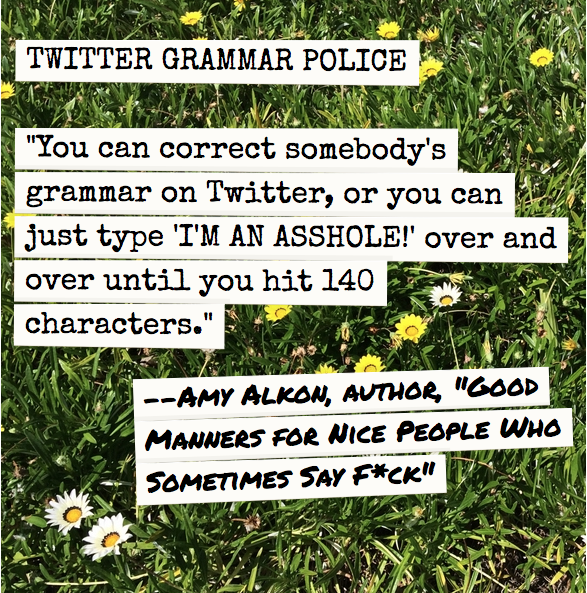 However, I find it completely insulting to hold people who are, say, in wheelchairs to a lesser standard of grammar...
...Or to intimate that people of certain races -- I'm guessing she means people who are "of color" -- can't manage nice, grammatical English.
Again, I'll bring up my late, formerly wheelchair-powered cartoonist friend, John Callahan. He hated how people would treat disabled people with kid gloves -- meaning, not joking about them and behaving like we would with people who have, say, two working legs. People we can't joke about aren't quite "one of us" in the same way everybody else is. So, basically, by treating disabled people as off-limits for jokes or criticism, we treat them like they're less human.
if there's anything that's really ugly and alienating, it's that.
P.S. Dave did tweet back:
@davidyontz
It definitely should be "were." Sometimes Britons flout the rules of the subjunctive, but I think this writer is American.
UPDATE: I forgot to post this bit last night. Dave's great grammar podcasts are here.





At GoodReads, John Hanscom asked this question about If I Was Your Girl:
Why did you use improper English? This might be the world's greatest book, but the title, which should be "If I WERE Your Girl," immediately turned me off.
To each their own. I'm not turned off by "It Ain't Necessarily So."
JD at December 11, 2016 10:48 PM
On the one hand, I am completely on your side. I learned grammar in school, read a lot, and appreciate properly used English. There are magical things you can express with a carefully used bit of grammar, that would otherwise take a lot of extra words.
I also miss the past participle. "I have mown the grass" - not "mowed". I flinch whenever someone uses the past tense instead of the past participle.
On the other hand, language evolves. English is evolving particularly rapidly at the moment. Possibly this is due to the huge number of people who speak it as a second language.
On the gripping hand: Anyone who thinks "If I was your girl" is correct English is just wrong. Where the past participle mentioned above rarely makes a difference in meaning, the subjunctive expresses something specific, something hypothetical. Using the wrong verb tense can leave the reader uncertain what you really meant.
If English were to lose the subjunctive, it would be a poorer, less expressive language.
a_random_guy at December 11, 2016 11:25 PM
On the actual subject of this book: It's aimed at young adults, and is basically a promotion for trandgender people.
This is a shame. As the American College of Pediatricians has written, people with gender identity problems should not physically modify their bodies. Point number 3 of the article is the core: "A person’s belief that he or she is something they are not is, at best, a sign of confused thinking." As such, it is this confused thinking that should be addressed, not the innate physical characteristics of the body.
a_random_guy at December 11, 2016 11:34 PM
"If I were your girl" is the front-half or back-half of a conditional.
"If I was your girl" is a wish.
https://www.youtube.com/watch?v=Lt6r-k9Bk6o
Lastango at December 12, 2016 12:08 AM
@Lastango: The fact that a music video also gets it wrong doesn't change anything. It should be "Damn, I Wish I Were Your Lover".
Continual misuse is, in fact, changing the language. So many people fail to use the subjunctive that it is being lost. In another 20 years, the title of that video and the title of the book will both be unremarkable.
Further examples of the subjunctive, along with an observation that misuse is changing the language.
a_random_guy at December 12, 2016 1:31 AM
"It Ain't Necessarily So." is clearly slang usage, which is different from bad grammar.
PS "Different from" is correct. "Different than" is not. Yet another thing I learned from Dave.
Amy Alkon at December 12, 2016 5:17 AM
"... and grammar policing is classist, racist & ableist."
Proving once again that how fast people trot out the name-calling is a pretty good proxy for how candy-ass their arguments are.
Old RPM Daddy (OldRPMDaddy at GMail dot com) at December 12, 2016 5:42 AM
"Continual misuse is, in fact, changing the language."
Yes, the constant misuse so much that words are lost, meaning is lost, and eventually bad grammar is accepted. Sad
The next site I saw this morning was a comic about grammar:
http://xkcd.com/1771/
the other patrick at December 12, 2016 6:44 AM
How gripping - from a fan of Elmore Leonard...
Radwaste at December 12, 2016 7:22 AM
Modern English is a tough language. It's archaic German, Norman French, Latin, and Spanish, all squished into Latin rules. And we've added Chinese words and even made up a few new words over the centuries.
Correcting grammar on instant messaging, Twitter, and blog sites where typos are understandable and there is no editing after posting is pretentious and pedantic.
Autocorrect is probably responsible for a great deal of language misuse on the Internet, at least the non-edited parts of it.
I had a pop-up ad this morning that said "between you and I." Okay, you spent thousands putting together and ad and paying for it to be deployed, and you couldn't pay a few hundred to have it edited.
Usage of "between you and I" drives me nuts in popular songs, too. I understand the songwriter need to rhyme, but it's still grating on the ears.
A commenter on another Web site I was reading yesterday urged the writer of the article to take a "collage coarse" so he'd know "what he was talking about."
Another of my pet peeves is "should of" and its cousins, "would of," and "could of." (used phonetically in place of "should've," "would've," or "could've")
Yes, incorrect usage (or any usage) will change a language. However, correct language usage imparts a discipline not only to writing but to thinking. Our language is not changing because we are getting smarter, as it has for the past few thousands of years, but because we are getting lazier and dumber.
We're not adding words and concepts, we're losing them, and scrambling to use existing words to fill in the intellectual blanks (e.g., "impact" to mean affect or "ultimate" to mean best). This decline in correct usage does not bode well for the English-speaking world, or what's left of it.
Note: if your pretense is that you are better educated and so much smarter than everyone else on a blog site (say, this one), you should use correct grammar and punctuation, lest folks call into question your claim to superior education and/or intellect. And, yes, raw intellect and correct language usage are not necessarily correlated, but education and correct language usage should be.
Conan the Grammarian at December 12, 2016 7:32 AM
I was watching local new many years ago when a teaser for the story to come after the commercial came on. The tag line read, "Freak Sheik." All hope it was about an eccentric Arab chieftain were dashed when the info-bimbo informed viewers that freak shows were becoming hip.
I blame a certain '80s women's jeans brand for people not knowing that the French word, "chic," means "elegantly stylish" and is pronounced "SHēk."
Now, an entire generation thinks "chic" is pronounced "chick."
Conan the Grammarian at December 12, 2016 7:44 AM
No, the "if" clues the reader in that it's subjective. That means "were" is the correct verb tense in that sentence.
"[P]erfectly common" does not mean "also correct," it only means common.
And "it communicates its intended meaning" by the receiver's decoding, not by the sender's proper encoding. Therefore, it is subject to being misunderstood. [Props to this writer for knowing to use "its" instead of the more commonly, but wrongly, but commonly, used "it's."]
Conan the Grammarian at December 12, 2016 7:52 AM
One thing I've noticed is that we, as a society, don't aspire to higher socio-economic usage anymore - in language, dress, or anything. We aspire downward.
Cargo shorts are now perfectly acceptable office attire. they may be more comfortable than a wool suit, especially in summer, but the wearer doesn't sheepishly acknowledge "I'm dressed like a bum today, but it's 100º out." Instead he questions "who wants to wear a tie if you don't have to?" As if he's getting away with something or putting something over on someone by not dressing up.
"Ninety-nine percent of the people in L.A. did not know shit about how to dress or seem to care. Nobody wore a necktie. They’d wear a suit and leave the shirt open. Or the thing now, they’d button the shirt collar, wearing it with a suit but no tie, and look like they’d just come off the fucking reservation. Ronnie Wingate, not knowing shit either, said, “Why wear a tie if you don’t have to?” Like not wearing it was getting away with something. He had told Ronnie one time, “I used to dress just like you when I was a child and didn’t know better.” Living in migrant camps, moving from Florida to Texas to Colorado to Michigan, out here to California, the whole family doing stoop labor in hand-me-down clothes." ~ Elmore Leonard (Get Shorty)
"[Bo] Catlett liked to watch people going by, all the different shapes and sizes in all different kinds of clothes, wondering, when they got up in the morning if they gave two seconds to what they were going to wear, or they just got dressed, took it off a chair or reached in the closet and put it on. He could pick out the ones who had given it some thought. They weren’t necessarily the ones all dressed up, either." ~ Elmore Leonard (Get Shorty)
Conan the Grammarian at December 12, 2016 8:08 AM
As someone who has taken the *class* on the history of the English language, I sort of agree with Conan, but not really.
Language is first and foremost a conveyer of information. The more clearly, and cleanly language does that, the more useful it is.
(Unlike English, is is very hard to be misunderstood in German, so German is considered a better language for military engagements.)
But language is also the product of culture, and as such, it is a window on the values, the social class, and to a great extent, the education and geographical origins of the speaker (or writer)
English is a difficult language gramatically, and it also isn't just one language. Acceptable usage in different parts of the majority English speaking countries, and the borrow words from indigenous and minority cultures also differ greatly.
I have known a number of blue collar people whose spoken and written English is darn near perfect, and also a quite a few college graduates with poor language skills.
Do you know that the English grammer rule of never ending a sentence with a preposition comes from Latin? Proper Latin never does that, but some of the Germanc languages do.
Who is right? Well that is a matter of opinion, and not fact.
Arguing over little grammer nuggets, which weren't standard usage four hundred years ago, and won't be standard usage 200 years in the future is the worst sort of pedantic virtue signaling.
Nice people don't do it, to anyone outside of their immediate family.
Isab at December 12, 2016 8:11 AM
A guy walks up to me and says, "Where's the library at?"
And I said, rather smugly, "Around here, we don't end sentences with prepositions."
So, he said, "Okay, where's the library at, asshole?"
Ending sentences with prepositions is fine in English. You wouldn't ask someone "With whom did you go?" Like most people, you'd ask, "Who did you go with?"
You could argue that grammar policing is ableist, but only if you're talking about a mental disability, such as dyslexia or mental retardation. Frankly, I'd be annoyed if some grammar nazi was badgering someone with an IQ of sixty about the proper use of "who" vs. "whom." He got the salient points across; you know what he means. Be gracious and overlook the occasional grammatical faux pas.
Patrick at December 12, 2016 8:18 AM
I ask people "with whom did you go?" all the time.
The preposition ending is, as Isab pointed out, one of the old Latin rules into which I mentioned English has been stuffed. Even the most persnickety grammarian won't argue with "Who did you go with?" If you follow that rule religiously you get ridiculous sentences like, "This is some shit up with which we will not put." (hat tip Scary Movie IV).
And, Isab, I didn't say language didn't change. I said it has been changing, expanding to accommodate new information and concepts, until now. My argument is the language today is devolving, not that blue collar folks can't speak properly. We're aspiring downward; no one wants to sound like an English professor anymore, that's "elitist" or "sounding white."
Conan the Grammarian at December 12, 2016 8:35 AM
You could argue that grammar policing is ableist, but only if you're talking about a mental disability, such as dyslexia or mental retardation. Frankly, I'd be annoyed if some grammar nazi was badgering someone with an IQ of sixty about the proper use of "who" vs. "whom." He got the salient points across; you know what he means. Be gracious and overlook the occasional grammatical faux pas.
Patrick at December 12, 2016 8:18 AM
Graciousness is an underated quality. Ever so much more important than being right. That extends to any correction of anyone outside of your immediate juvenile family.
95 percent plus of the world doesn't speak your variety of colloquial English. You are not socially or intellectually superior to them in any way.
Isab at December 12, 2016 8:36 AM
One of the reasons Lloyd Fredendall lost the Battle of Kasserine Pass in World War II is believed to be his ambiguous orders to subordinates.
Conan the Grammarian at December 12, 2016 8:44 AM
Unlike English, is is very hard to be misunderstood in German, so German is considered a better language for military engagements.)
One of the reasons Lloyd Fredendall lost the Battle of Kasserine Pass in World War II is believed to be his ambiguous orders to subordinates.
Conan the Grammarian at December 12, 2016 8:44 AM
On the other hand, I find German humorless. English is much wittier.
It isn't that they don't joke, the jokes are just ponderous.
Think of all the English jokes that rely on a play on words, and how you could translate them into German and still be funny. It doesnt happen.
Isab at December 12, 2016 9:00 AM
This is the sort of nonsense up with which I will not put.
H/T to Sir Winston.
I R A Darth Aggie at December 12, 2016 9:08 AM
English is versatile. You can substitute an unrelated word for another or even make up words and people will generally get your meaning. Only in English would "yada yada yada" make sense.
As for humor, Frederick II once sent Voltaire a message in German that said "Voltaire is an ass." Voltaire sent it back, having added "Frederick II." To get the joke, you have to know that "one" and "an" are the same word in German. So, Voltaire's message read, "Voltaire is one ass, Frederick the second." I don't know how true that story is, as sending insulting messages to Germanic emperors is not known for helping one to lead long and happy lives, but Frederick and Voltaire were known to be friends.
Conan the Grammarian at December 12, 2016 9:19 AM
Actually, that witticism was first published in The Strand and Churchill was not then identified as the author. Since he was a frequent contributor to the magazine, it is likely that had he authored it, he would have been credited.
No one is sure how it became attributed to Winnie, perhaps his well-known penchant for witticisms stood him in good stead.
Conan the Grammarian at December 12, 2016 9:25 AM
"If I was your girl" can be correct or incorrect depending on context.
If you intend to use the subjunctive ("If I was your girl you wouldn't go there"), then that's incorrect usage and it should be "were".
If you intend to talk about a situation in the past ("If I was your girl, it was because I loved you"), then that's correct.
So it'd take more information than we have to determine whether the title to that book is wrong.
Latin immigrant at December 12, 2016 11:01 AM
If I could travel back in time, other than experiencing more days with my beloved father, long dead now for 23 years, it would be to undo some of my cocksure 20 something cuntishness that a thing like spot on American centric English grammar actually matters, in the grand scheme of things.
Kindness in the human heart is a much more important quality, and harder to find.
I have given up hectoring, lecturing or even correcting bad manners, poor spelling, or poor grammar, My kids are adults, and I don't have that job anymore.
It can simply not be done diplomatically without coming across as a pretentious bitch.
Isab at December 12, 2016 11:19 AM
Thank you, Latin immigrant. Very kind and thoughtful. After all, it's clearly not a complete sentence, either way, so if we haven't read the book, we're not in a position to judge.
Same goes for movies with titles like "Blank and I" and "Blank and me."
If anyone's interested, here's a thread on the subject of when to say "if it was."
https://groups.google.com/forum/#!search/%22lenona%22$20%22if$20it$20was%22/alt.english.usage/G7SXyChWRFQ/8hhYx0T__xoJ
lenona at December 12, 2016 11:27 AM
Damn guys. I thought I was having a bad day.
Bob in Texas at December 12, 2016 11:51 AM
"You could argue that grammar policing is ableist, but only if you're talking about a mental disability, such as dyslexia or mental retardation"
Lamictal makes me jumble my grammar all the time. It feels like English is a language I learned as as an adult. When it comes to speaking it I will have correct grammar but I wont remember words.
You never know why someone has shitty grammar so why be a dick about it? You can teach me all the grammar you want but I can't process it.
Ppen at December 12, 2016 12:10 PM
Do any of you know some of those inept grammar nazis who "correct" people when in fact their original statement was the correct one?
For instance, you might say to someone, "Would you like to go to dinner with my cousin and me?"
And they'll snap, "It's 'my cousin and I.'"
Well, no it isn't. "with" makes it the dative case, not the nominative. And you probably regret inviting them to dinner.
One of my favorite games online is to make it look like I'm mixing up 'affect' and 'effect,' when, in actuality, I'm not.
"Do you think the U.S. military presence will effect the situation in Somalia?"
"It's 'affect,' not 'effect.'"
Depends on what you're asking. If you asking about a situation in Somalia that already existed and whether the U.S. military will influence it in some way, it's 'affect.'
But if you're asking whether the U.S. presence will bring about a situation where none existed, it's 'effect.'
Patrick at December 12, 2016 12:13 PM
Sorry, I meant the oblique case. I was thinking of German, in which the word "with" (mit) always takes the dative case.
Patrick at December 12, 2016 12:21 PM
But if you're asking whether the U.S. presence will bring about a situation where none existed, it's 'effect.'
Cute. But is there any city or country on Earth where no situation exists?
dee nile at December 12, 2016 12:29 PM
Conan, the observation of the lowering of standards in many things is interesting.
From above: "bad grammar is accepted."
The reality is -- and this is something that Dave and I discuss all the time -- that language evolves. Some proper ways of saying things, like saying "his and her" instead of "their," I have done away with.
Elmore Leonard said, "If proper usage gets in the way, it may have to go."
That's what I go by when I can.
I discuss with Dave whether some leeway I want to take is too much of a stretch -- whether it's just too grammatically wrong and will be seen as an error or whether I should go with what has the best rhythm and sound. Also, sometimes what's grammatical is less understandable.
If I were 20, I'd want to have perfect grammar. Or I'd be more likely to. Now I just want to be readable and understandable.
Amy Alkon at December 12, 2016 2:22 PM
Conan wrote:
One thing I've noticed is that we, as a society, don't aspire to higher socio-economic usage anymore - in language, dress, or anything. We aspire downward.
Agreed. The term 'elite' is now a slur.
Amy wrote:
Elmore Leonard said, "If proper usage gets in the way, it may have to go." That's what I go by when I can.
Agreed. Of course, that's predicated on knowing proper usage and using judgment to make the choice to reject it.
Kevin at December 12, 2016 2:51 PM
Conan and Kevin, speaking of "elitism"...
https://www.newspapers.com/newspage/98508936/
Trouble is, it's difficult to read in its format, and Google Books didn't help the way I'd hoped it would (it only gave a snippet view from Miss Manners' Guide to Excruciatingly Correct Behavior - Page 13). So here it is:
1980
Dear Miss Manners:
Now don't get me wrong. I am not a boor. I know perfectly well to keep my elbows off the table, I do not take my shoes off at formal gatherings and I have never asked for a doggie bag at the Watergate. I seem to be suffering, however, from a case of severe social jealousy.
The problem is that my best friend is a well-born, upper-class, blue-blooded gentlewoman. I am not talking about the kind of ostentatious display of manners of the nouveau riche; my friend has the real thing - authentic social eclat.
What it boils down to is this: She has taste. Her makeup is flawlessly done with Princess Marcella Borghese; I slap a little Vaseline Intensive Care onto my face each morning and consider myself ready for the day.
She turns heads when she wafts into a room; I raise eyebrows in the same room because I trip over furniture.
She lifts her Coquilles St. Jacques gracefully to her lips without spilling a drop; it is all I can do to get my coffee from table to mouth without pouring it on my lap.
Several weeks ago, we were in a restaurant and the waiter was so overcome by her that he spent three-quarters of an hour describing to my friend everything on the menu and left with her order, only to return a few minutes later to ask if, by any chance, did I also want anything to eat?
My friend has background, sophistication, edification. She can name any piece of music within the first two bars: "Why, it's Bruch's Swedish Dances for Piano with Four Hands, Opus 63," she says casually in response to hearing a few notes on the radio. My singular musical achievement was learning Fur Elise by heart in high school. I played it on the piano over over and over, regaling joyfully in my cultivation, until my father, desperate for quiet, pleaded with me to stop.
Miss Manners, what I need to know is this: Can a friendship between an aristocrat and a bourgeoise possibly survive? Is there common ground somewhere between those who have presence and those who just take up space?
Gentle Reader: Miss Manners urges you to continue this friendship, for the sake of common humanity. You are probably the only friend this poor lady has.
Believe Miss Manners, it is not easy to be perfect these days. It is quite out of fashion and attracts the admiration of no one except garrulous waiters. And yet, there are those of us who cannot help it, and we, too, have souls and crave affection from those more fortunate than ourselves.
It was not always thus. Until recent years, people strove for perfection, and the person who achieved it was universally admired and imitated. Once it might have been a charity for a person such as your friend to overlook the awkwardnesses and anxieties of someone as yourself and value you for your best qualities.
Now, however, it is our faults for which we are loved. Imperfect table manners are considered a sign of subscribing to the principles of democracy; ignorance of high culture to be an indication of spirituality, and blurting, rough speech to be a clue to perfect honesty.
Miss Manners hopes you will be grateful for what you have, and tolerant of the handicaps of your friend.
(end)
Btw, there's an interesting letter that follows, on whether it's OK to refuse to give carless friends a lift home.
lenona at December 12, 2016 4:24 PM
"This is the sort of nonsense up with which I will not put." is an idiotic strawman argument against pedantic grammar.
"Put up with" is pure colloquialism for "tolerate." "This is the sort of nonsense I will not tolerate." Easy and simple.
setfio at December 12, 2016 6:38 PM
If I was you, I would be careful about my verb choice.
If something in that sentence sounds a bit off, then the title of this book should sound a bit off as well.
I always thought the Churchill quote ended with "I shall not put."
sgerrard at December 12, 2016 6:55 PM
Amy: "It Ain't Necessarily So." is clearly slang usage, which is different from bad grammar.
Indeed it is, and some people are probably turned off by that in the same way John Hanscom is turned off by "If I Was Your Girl."
There are things that turn me off. For example, injecting an apostrophe into plural words ending in s ("people drive to work in car's or pirate's?) drives me nuts. I think it started with younger people but I see older people do it quite a bit too.
As a side note, a girlfriend of mine back in the mid-80s turned me on to an album that has a great version of "It Ain't Necessarily So": The Age of Consent by Bronski Beat.
JD at December 12, 2016 9:26 PM
Conan: I was watching local new many years ago when a teaser for the story to come after the commercial came on. The tag line read, "Freak Sheik." All hope it was about an eccentric Arab chieftain>...
When I was young, I thought "sheik" was pronounced "sheek. I didn't realize the error of my ways -- or, I should say, thoughts -- until I saw this album for the first time.
JD at December 12, 2016 9:33 PM
Conan: "I ask people 'with whom did you go?' all the time."
I'm not the least bit surprised.
Patrick at December 13, 2016 12:54 AM
I dont' know if "Sheik" is pronounced "shake" or "sheek." I'll leave it to an Arab speaker to educate us on this. Wikipedia says it is pronounced "SHēk" with a long e.
I will say one thing, you have interesting tastes in music, JD.
Conan the Grammarian at December 13, 2016 7:07 AM
"I will say one thing, you have interesting tastes in music, JD."
I will state this for Crid as well, though I am sure he thinks it so obvious it should not be repeated:
If you do not know Frank Zappa, you do not know a musician. You might know a songwriter or someone good at an instrument, be it ukelele or vuvuzela, but Frank had all the musicians at his house.
-----
Which reminds me of another example of the insanity of the social justice worker, and the basic stupidity of those who listen to them:
Radio stations can't play Zappa's "Valley Girl", because Moon tells us, in Valspeak, that one of her teachers is, "Lord God King Bu-Fu", who plays with his rings and flirts with all the guys, yuck.
But rappers can still call for shooting police and debasing women.
Radwaste at December 13, 2016 9:32 PM
Leave a comment