





The Cookie Criminals Of New Jersey
Erica Jedynak and Heather Russinko write at the WSJ that the New Jersey government should lift its ban on people selling cookies they make at home. We're not talking about them selling fish stew that's been sitting out for hours. On countless occasions, I personally have eaten home-baked cookies that are weeks or perhaps a month old (hello, hoggo!), and have survived.
New Jersey politicians like to talk about finding a recipe for job creation and economic growth. If they're serious, one place to start is to take the lid off a bill that's been simmering in the legislature for years: a repeal of the ban on selling home-baked treats.Right now, state law forbids the selling of homemade baked goods, on pain of a fine up to $1,000. Bakers can work legally only in industrial kitchens, which cost upward of $15,000. That's a price tag that few culinary hopefuls, from grade-schoolers to grandmas, can afford.
One of the authors here, Heather Russinko, learned that firsthand. I am a single mom who works full time, but I never miss an occasion to bake for my son's birthdays or school events. Eleven years ago, I had the idea of beginning a business on the side selling cakes. The plan was to bring in some extra money to pay the bills and start a small college fund for my son. But then I learned about the home-baking ban. I can't afford the legally mandated kitchen renovation or to rent an industrial kitchen for $20 an hour. I struggle simply to pay monthly living expenses.
Times are tough. This is ridiculous.
I want government to protect me from criminals who seek to rob me and to put out any house fires, but this is bullshit:
What's strange is that nearly every New Jersey lawmaker agrees that the ban should be repealed. The state General Assembly has twice--in 2013 and 2014--unanimously passed "cottage food laws" to lift the baking ban. The Senate, however, is another story. There the chief opponent is Sen. Joseph Vitale, the chairman of the Health and Human Services Committee, who has let the repeal die. He told the Associated Press earlier this year that he appreciates home-bakers want to "make some extra money and do the right thing, it's just there are public safety and public health concerns."But that argument doesn't go very far. Homemade goods already can be sold to the public at charity events or given away for free. How would allowing them to be sold for a profit put public health at risk? "It's the same kitchen. It's the same ingredients. It's the same food handling," home baker Robin Hart told a radio news service in September. "This is a craft, like oil painting or knitting or whatever else people do with their talents. We just aren't allowed to sell."
What I'm interested to know is who lobbied Vitale (commercial bakeries?) to get him to hold this position -- one that fails the most basic logic test. So, those cookies some mom makes for the class are no probski -- but if she keeps one batch aside and sells them to a neighbor, hello, they are suddenly dangerously toxic?
And I would guess that parents whose children have some terrible allergy would have the rudimentary sense to avoid buying goods made in somebody's home kitchen. Of course, people have gotten sick from getting food they were allergic to in highly regulated restaurants. So let's not pretend the government is some kind of magical illness preventer.
Oh, and regulation doesn't stop Venice restaurant Gjelina from this appetizing food prep (click on the photo here to get a closer view):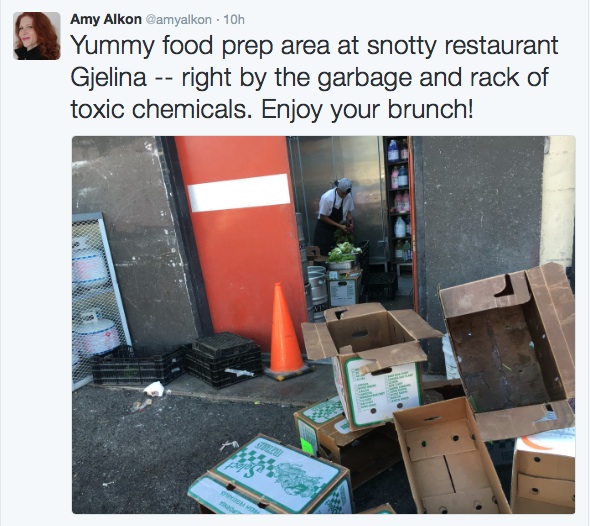
via @adamkissel





When llamas was just a cria, he worked as the lowest form of life in the kitchen of a very right-on vegetarian restaurant - which is still open for business, so it must be doing something right, almost 50 years later.
Even now, when I eat in a restaurant, I don't think too hard about how my food is prepared. What goes on in restaurant kitchens - even in well-run, hygienic establishments where the staff actually cares a bit about food quality and food safety - would scare most restaurant customers right out the door.
It should be remembered that the style of restaurant kitchen that's often seen in the US - open to the dining area and visible to the customers - developed directly from food safety and hygiene concerns, and was pioneered by the seminal White Castle burger chain in the 1930s. So the public does care about this, and knows what good food handling looks like. Why would anyone suppose that people cooking in their kitchens at home - which is, after all, where they prepare their own food - would suddenly ditch common-sense food safety practices?
As suggested, I suspect it has a lot to do with campaign contributions from established food businesses. That's usually who is pushing the hardest for business regulations these days.
llater,
llamas
llamas at December 5, 2016 7:06 AM
Why would anyone suppose that people cooking in their kitchens at home - which is, after all, where they prepare their own food - would suddenly ditch common-sense food safety practices?
So why then can you give away good baked at home for free, or to a third party to sell for their fundraising efforts
lujlp at December 5, 2016 7:13 AM
What I'm interested to know is who lobbied Vitale (commercial bakeries?) to get him to hold this position -- one that fails the most basic logic test. So, those cookies some mom makes for the class are no probski -- but if she keeps one batch aside and sells them to a neighbor, hello, they are suddenly dangerously toxic?
I have a friend who makes delicious fried chicken. If I ate it at his house, that would be perfectly legal, but I don't think it's so legal when he charges $10 for incredible fried chicken with two sides and drops it at my office for lunch (it's his side business).
So don't tell anyone.
And I would guess that parents whose children have some terrible allergy would have the rudimentary sense to avoid buying goods made in somebody's home kitchen.
I wouldn't make that guess. Rudimentary sense isn't a hallmark of the times in which we live, or the people among whom we live.
Kevin at December 5, 2016 8:46 AM
The paranoia about food is insane. Most cases of food poisoning come from greens, since you don't cook them, or from the source of the meat (like e coli), not from the restaurant.
I love any hole-in-the-wall country BBQ or seafood place I find and don't care about the sanitation, not even the mud on the floor. If you are paranoid about it, don't eat there.
The idea that we can prevent all harm with enough rules is simply a conceit.
cc at December 5, 2016 9:08 AM
There's another reason to not do this, other than the obvious crony regulationism. If you did this, and someone gets expensively sick, and they get a slip and fall lawyer to sue you, not only will you lose money on the deal you might lose a lot of money on the deal.
Unless you incorporate in some manner or form, you could lose everything. So you'll settle for a $AMOUNT, and then have to pay your lawyer her fees, too.
I R A Darth Aggie at December 5, 2016 9:42 AM
The volume of food being cooked in the average home kitchen is not high. Add commercial-level output and the pressure on the cook(s) increases, to the point that some food safety practices may become inconvenient.
I would suspect you're right. As with hair braiding and other home-based businesses that take money from established enterprises, enterprises with money to hire lobbying or otherwise influence legislators, do not want low-cost competitors in the market and attempt to raise artificial barriers to entry.
That's a good point. If I buy hand wrapped food prepared in a private kitchen," i have enough sense to understand this was not prepared in a kitchen overseen by the health department and my purchase comes with no assurances of safety or purity.
Caveat Emptor is advice for a bygone day when the average buyer actually had enough sense to beware; and was not looking for an instant payout by suing someone. This was a public that recognized that the government could not, and should not, oversee every aspect of interpersonal interactions, whether commercial or not.
Conan the Grammarian at December 5, 2016 2:26 PM
And I would guess that parents whose children have some terrible allergy would have the rudimentary sense to avoid buying goods made in somebody's home kitchen. -Amy Alkon
I wouldn't make that guess. Rudimentary sense isn't a hallmark of the times in which we live, or the people among whom we live. -Kevin
I recall reading about a lawsuit.
This woman was suing the elementary school and the parents of her child's friend.
Her son was horribly allergic to peanuts, and the kids friend gave him half a peanut butter cookie or sandwich and had died
Problem was, according to the defense, this mother had never informed the school her child had an allergy, never informed any parents of the allergy, and during questioning had admitted she never even told her SON about his allergy because she wanted him to have a "normal childhood"
Most people are fucking morons
lujlp at December 5, 2016 3:09 PM
Crap. Not this again.
"Homemade goods already can be sold to the public at charity events or given away for free. How would allowing them to be sold for a profit put public health at risk? 'It's the same kitchen. It's the same ingredients. It's the same food handling,' home baker Robin Hart told a radio news service in September. "This is a craft, like oil painting or knitting or whatever else people do with their talents. We just aren't allowed to sell."
No, Robin Hart, it's not - and you actually don't have the authority to make that claim, on top of the gross conceptual error of equating a consumable with display art.
How much should you be allowed to sell, in competition with a shop that must pay workers, adhere to codes and on and on and on, before you must comply with standards?
The BATFE says that I will not be subject to Federal laws regarding firearms sales unless I am "in the business", as determined at the sole discretion of the BATFE. So - should I just make guns and sell them for a living without the BATFE?
You're a broken record (wow, dating myself!) on this issue, so I might as well repeat myself:
Government is IN the food inspection business because the PUBLIC EXPECTS TO BE PROTECTED AGAINST FOODBORNE ILLNESSES in COMMERCIAL VENTURES. Government operates the COURTS in which YOU will seek redress if YOU are injured by an improper food handling process executed on the food YOU eat. YOU are INCOMPETENT of determining whether a food handling procedure is valid or if bacterial or chemical agents are present in the food you buy. In some cases, YOU will be permanently injured or killed by faulty practices, AND NO INSURANCE OR LEGAL PENALTY WILL UNDO THAT.
Food manufacturing, distribution and handling guidelines, no matter if they have penalties attached, are distributed because startups often have no idea. This is why church dinners sicken people despite the best intentions of the elders.
I have a co-worker who brought a pot of chili in to work. In front of us, assembled for lunch, she dipped a spoon, tasted it, licked the spoon clean, then dropped it back in the chili.
What else do you think happens in her kitchen?
Organics ARE PERMITTED. I have linked to the Happy Cow Creamery, in SC, as an example many times. I have ALSO noted several times that it is the PREVENTION aspect of food handling regulations, NOT INSPECTION, that provides you safety.
Yet here you are again. The house you live in was wired according to code. The car you drive was built under a myriad of regulations so you aren't impaled because of a speed bump. Laws insist that the medicines you take are both subject to purity standards and accompanied by a monograph describing as much as is practical about them. The airplane you take to France has passenger limits and even permission to operate determined by international regulations, and its every move, from pushback to parked, is controlled by the FAA - and you have lamented the uncontrolled nature of private aircraft, even as the pilot has every intention of arriving alive, be he in a Cessna or a Boeing.
You want to count on your own good sense when buying foods. History, not just me, has proven that idea wrong again, again and again. It's just not enough. Chuck(les) might as well be here promoting homeopathy.
Radwaste at December 5, 2016 4:48 PM
@ Radwaste - you're confusing the supposed intention of (most) regulation with its actual, practical effect.
Your house was supposed to be wired to code, but in practice, it was wired according to the working practices of the electrician. Inspection can't possibly check the wiring of an entire home, and most inspection is cursory anyway. In a side job servicing generators, I have seen the most appalling hack work done by licensed electricians, plumbers and mechanical contractors, all passed as good by local inspectors. As we are learning just today in Oakland, regulation and inspection really has far less impact on public safety than you think. The Ghost Ship was repeatedly inspected by local authorities, and yet 30-something people are dead.
The car you drive was built according to a myriad of regulations, most of which have little to do with ensuring your safety and many of which (eg fuel economy standards) actually increase occupant dangers. The rates of automobile deaths per million miles have been essentially flat for the best part of a decade in spite of all of the regulations which have been applied, supposedly for our safety. FMVSS standards are just like most other government regulations - driven as much by lobbying and special-interests as they are by actual concern for the welfare of the citizens.
Your co-worker who licked the spoon exposed you to essentially zero actual hazard. Remember - yucky seldom actually means death. Sure, church suppers sicken people now and then - but they are trivial hazards when compared with the hundreds killed and hundreds of thousands sickened each year by commercial food businesses, all of them regulated and inspected. The 'prevention' you claim really doesn't work nearly as well as you think it does.
And - just because regulation may be beneficial in some areas of life, doesn't mean that it is beneficial or required in all areas of life. I'm not equipped in any way to judge whether an airplane has been properly maintained or whether its pilot is competent to fly it. But I and many other people are actually quite well-equipped to judge whether a bakery is making wholesome food, and even if they are not, the market will quickly correct them at trivial risk and expense to the public. The burdens and costs of regulation in many areas of life vastly outweigh the trivial benefits to public safety, which in many cases are effectively non-existent anyway. Does a hair braider or a eyebrow-threader really need a cosmetology license and 1,000 hours of training? Do you really need a mortician's license to sell a casket? As in these cases, large areas of state regulation have little to do with public safety or public benefits, and are really engines of rent-seeking and guild-style protectionism. That's exactly why big business (which you would typically expect to resist regulation) typically lobbies so hard for it - because its effect is to stifle competition, and that has now become its driving purpose.
llater,
llamas
llamas at December 6, 2016 4:10 AM
And so llamas advances the argument that since some inspections are cursory, faked or otherwise, they should not be done.
Again.
And worse, you've assumed I have a position I have not taken, with, "The 'prevention' you claim really doesn't work nearly as well as you think it does."
Nope. What I have ACTUALLY shown, in past links to Happy Cow and the description of inspection and monitoring practices, is that prevention is the only way to go, and that it is successfully implemented at the best facilities.
Ahem. Do you think Jack Daniels or Budweiser does't test everything it uses?
These industries do not HAVE to be told that quality controls increase profits AND provide protection against lawsuit. Not everyone has received that clue.
So inspections don't work, huh? Cool. I'll just falsify a few records at work. That waste has been sitting here (Savannah River Site) for decades, so what's the problem with skipping a few inspections? We can just get a new manager if something gets out.
So, you think the lady who licked the chili spoon runs a clean kitchen? How do you know?
By the way - what's the answer to my question? How much can you sell before you must comply with food safety regulations?
And remember that this affects that minimum-wage worker, who can't spell "burger" on the marquee, who decides he can make them at home for more money.
Step right up. Some of you have the position you can always tell if your food has RoundUp in it.
Which is sort of hilarious given the long-standing joke that some SE Asian restaurants cook and serve pets without telling anybody. They can do that, you know.
This is not an argument for bureaucracies to sell inspection results for kickbacks. It's absolutely not an excuse for inspectors to not do their jobs. It's not even advocacy for the "stick" function of penalties. It is an observation that the vast database of proper material handling is available, but will not be used by many people - and that this has been proven again and again, and paid for with illness injury and death. It is an observation that the inspections required by assorted agents across the nation are the reason you can breathe today. That irony should be apparent to any Californian!
Radwaste at December 6, 2016 2:45 PM
Enhancement: The History Channel© is airing a series called, "The Food That Built America". Again and again, it shows how industry did not police itself in its zeal to sell food to the public...
AND
Industry leaders STARTED the drive to require standards and inspections to keep those who would use shortcuts, endangering the public in the process, from doing business.
Thank Henry Heinz.
Radwaste at April 8, 2021 5:13 AM
Leave a comment