





One More Reason To Love Jon Corbett: Going After NYPD's Corrupt Gun Permit Process
Basically, it seems you are likely to get your gun permit application denied in New York City if you provide only information about yourself (showing that you aren't nuts, aren't a felon, etc.) and you don't also provide fine food and prostitutes.
It also seems to be a permit-denying strike against you if you are just an ordinary citizen and not a rock star.
From Jonathan Corbett's site:
In 2002, a former head of the licensing division, D.I. Benjamin Petrofsky, was accused of (and later demoted for) helping famous rock-and-roll musicians receive a pistol permit in exchange for VIP concert tickets and after-party admission. Exhibit E - Messing, Philip. "NYPD Under Fire in Aerosmith 'Got a Gun' Scandal." New York Post (Nov. 24th, 2002). He allegedly went as far as to fingerprint the musicians inside Madison Square Garden. Wiederhorn, Jon. "Janie's Got A Gun Permit? Aerosmith Flap Lands Cop in Hot Water." MTV (2002).
I know civil rights advocate Jonathan Corbett through his making even bigger monkeys of the TSA by challenging the scanners and through his fighting the TSA's disgusting violations of our rights and his work to try to get his case on them heard by the Supreme Court. 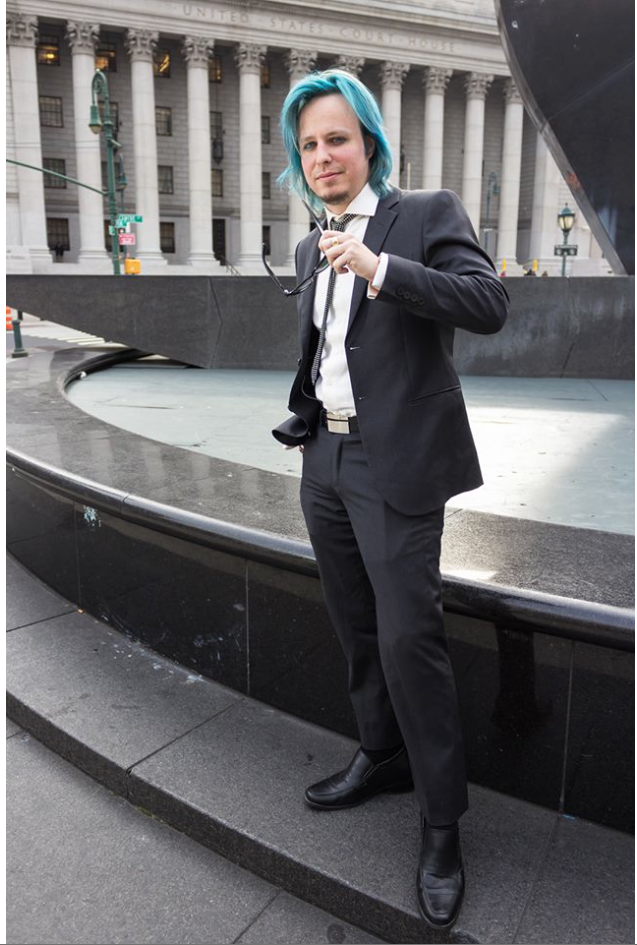
About Jonathan:
Jonathan Corbett is a technology expert turned civil rights advocate. Trained as a computer scientist and having consulted in that capacity for Fortune 500 companies, government agencies, and the like, his career took a change after his frequent traveling brought him regular encounters with the Transportation Security Administration. Jon noticed that the number of rules, the invasiveness of the searches, and the general lack of respect for the public had been increasing while no real security benefit was gained.When the TSA announced in 2010 that it would make its body scanners used as primary screening, Jon was the first to file a lawsuit to enjoin the practice. TSA body scanners use electromagnetic radiation to create images of your body without your clothes, a highly intrusive "digital strip search" with questionable (at best) health risks. Worse, the scanners fail to improve security, as they can only spot differentials in density, leading to the failure to detect items carried by anyone who had studied the technology and adjusted the placement of objects on his or her person. Jon proved this in his 2012, "How to Get ANYTHING Through TSA Nude Body Scanners," video, where he demonstrated that objects on his person could not be detected by real TSA screeners using body scanners at airports across the country. His work was studied and confirmed by top university researchers in 2014.
Well, now Corbett's a technology expert turned third-year law student challenging New York City's gun permitting process. He writes about the denial of his permit and the process:
After one hundred years of New Yorkers receiving gun licenses if and only if they gain the favor of the NYPD - often through cash payments - it is well past time for the courts of this state to step in and declare the NYPD's implementation of the "proper cause" requirement to be unconstitutional...We left off last fall with in Part III, where I filed suit against the NYPD for: 1) requiring that I provide them a "good reason" as to why I should be allowed to bear arms, 2) requiring that I answer entirely irrelevant questions (Have I ever been fired? Have I ever been prescribed a prescription painkiller?), and 3) refusing to fulfill a public records request that would shed light on their supposed process for deciding on license applications.
After receiving service of the complaint, the NYPD filed a motion to dismiss, alleging that: 1) it's totally constitutional to require a reason before allowing a citizen to exercise his or her rights, 2) that these questions are totally rational to ask of one seeking a gun license, and 3) that releasing records would "interfere with a law enforcement investigation." Judge Carol R. Edmead of the New York County Supreme Court granted this motion on February 7th, 2017, essentially rubber-stamping the NYPD's arguments. Judge Edmead required the NYPD to make no showing, for example, as to why they needed to know answers to any of their obviously irrelevant questions, and required the NYPD to present no evidence -- not even a sworn declaration -- that releasing records would cause legitimate interference with law enforcement.
The most glaring of Judge Edmead's errors were in 2 parts:
She conceded that gun restrictions must be subject to "intermediate scrutiny" -- that is, they must address an "important" governmental objective by means "substantially" related to that. She then went on to say that she was approving the NYPD's actions because they were "rational." But a finding of "rationality" is not the test that she just stated was appropriate. The NYPD's tomfoolery must not be merely "rational" but be a substantially tight fit -- asking not significantly more than is actually required to fulfill the "important" governmental objective of public safety.I'm actually somewhat shocked that she granted a motion to dismiss on the public records request given that, in deciding a motion to dismiss (the first opportunity a defendant has to get a case tossed out of court), a judge cannot yet weigh evidence because the plaintiff has not yet had a chance to present evidence. Yet she had no problem finding that releasing the records would definitely interfere with a law enforcement investigation, just because an attorney for the NYPD said so. In doing this, she cut off the case before allowing me a chance to argue the other side.
I immediately filed a notice of appeal, and today I "perfect" the appeal, as they say here in New York, by filing the "record" (a copy of everything that happened in the court below) and my appellate brief -- given the requirement of 10 copies of everything (8 for the court and 2 for the opposing party), well over 2,000 pages had to be printed, bound, and delivered to make this happen (links to digital copies below). In it, I detail for the New York Supreme Court, Appellate Division the history of corruption in the NYPD's licensing division.
He explains in his brief:
New York City is one of the few remaining jurisdictions in this State to read the "proper cause" requirement of New York's gun licensing statutes, N.Y. Pen. Law § 400.00(2), to require that an individual demonstrate a "need" to carry a handgun that is greater than that of the average citizen. At present, the New York Police Department's ("NYPD") licensing division is given nearly absolute discretion over which citizens have so demonstrated, resulting in rampant corruption within the division and a system where the rich and connected may exercise their constitutional right to bear arms while the remainder of the citizenry remains disarmed and disenfranchised.Petitioner-Appellant Jonathan Corbett (hereafter, "Corbett") is an upstanding U.S. citizen who has never committed a crime, has passed the NYPD's background check, has been licensed to carry firearms in other states for nearly a decade, and has responsibly exercised his rights under those licenses for that time. Notwithstanding, Corbett's gun license application was declined because he failed to demonstrate "proper cause" and refused to answer three questions on the NYPD application that are irrelevant to whether or not he is qualified to possess a handgun. Weeks later, the same NYPD official who denied Corbett's license was transferred out of the licensing division, and at least two of his subordinates arrested, for handing out gun licenses to street mobsters in exchange for cash. This, of course, is not the first such incident of corruption in the licensing division; indeed, such corruption has been found regularly over the last 100 years.
The court below ignored Corbett's arguments regarding his federal constitutional rights, regarding the recent U.S. Supreme Court precedent that overrules New York's long standing assertion that gun ownership is "a privilege, not a right," and regarding the rampant corruption within the licensing division, and summarily concluded that the NYPD's decision to deny Corbett's license was rational, even though "rational basis" is not the right standard of review. That court additionally refused Corbett's request to compel the NYPD to turn over documents under the state's Freedom of Information Law ("FOIL") without any evidence that an exemption was met.
For these reasons, Corbett respectfully requests that this Court re-consider his arguments and reverse the decision of the court below.
QUESTIONS PRESENTED1. Has the U.S.SupremeCourt's pronouncement of an individual right to bear arms in District of Columbia v. Heller, 554 U.S. 570 (2008), invalidated New York's "privilege not a right" stance on guns?
2. In light of the continuing corruption within the New York Police Department's Licensing Division, have Corbett's Second and Fourteenth Amendment rights been violated as applied?
3. Does conditioning a license approval upon answering "Questions 11 - 13" on the New York City pistol permit application pass constitutional muster?
4. Are pistol permit applications compiled for "law enforcement purposes" pursuant to the N.Y. Freedom of Information Law?
5. Is an agency attorney's assertion, unsupported by evidence in the form of declarations or otherwise, that the releasing of records "would interfere with law enforcement investigations" sufficient to carry a motion to dismiss on a N.Y. Freedom of Information Law claim?
STATEMENT OF FACTSI. Corbett's Pistol Permit Application
In December 2015, Corbett appeared at the NYPD Licensing Division and submitted an application for a permit to own, and carry on his person outside his home, a concealed weapon1. Record on Appeal A056 - A067. Such a license is known in NYPD parlance as a "business carry" permit, despite the fact that it may be issued to individuals unrelated to a business need. There exists no other permit type by which a civilian New York City resident may carry a handgun in public, whether openly or concealed (i.e., there is no "personal concealed carry" license, nor any variety of "open carry" license, available to civilians). Id. at A056 (see checkboxes); N.Y. Pen. Law. § 400.00(2).
During Corbett's appearance at the Licensing Division, Corbett provided to the Licensing Division the following: (1) three-page application, (1) letter of necessity, (1) letter of explanation for checkboxes on the application that specify that they require additional explanation, (1) notarized affidavit certifying that Corbett does not have a roommate, (1) notarized affidavit from someone willing to take possession of Corbett's weapons upon his death or disability, (2) "passport-style" photos, (1) New York identification card, (1) U.S. passport, (1) social security card, (1) copy of Corbett's business tax return, (1) set of fingerprints, and, $429.75. Corbett's application was accepted for processing. Id. at 056 - 067.
On December 24th, 2015, NYPD Police Officer Thomas Barberio mailed to Corbett a letter advising that Corbett needed to schedule an in-person interview and provide the following additional documents: (3) letters of recommendation, notarized and signed by people who know Corbett for at least 5 years but are not family members, (1) letter from a doctor describing any mental illness Corbett has ever suffered, (6) months of bank withdrawal slips, (1) copy of Corbett's out-of-state gun license, (1) statement describing any handguns Corbett owns out-of-state and how they are stored, (1) affirmation of familiarity with New York's laws regulating use of deadly force, (1) affirmation that Corbett has never had any "orders of protection" issued against him, any original court records for any interaction with criminal courts whatsoever, including driving infractions (e.g., "failure to wear a seatbelt" would be sufficient to require additional records), pictures of Corbett's "business," inside and out, and numerous additional tax records and other records related to the businesses Corbett owns. Record on Appeal A068 - A070.
Corbett expeditiously provided these documents to P.O. Barberio to the best of his ability and scheduled an interview, and on April 7th, 2016, Corbett met with P.O. Barberio for the requested interview. The interview consisted of verifying that all documents were in order. No substantial "investigatory" questions were asked. Exhibit A, Corbett Decl., ¶ 3. Corbett was advised by P.O. Barberio at that time that the NYPD's background check results on him were clear of any issues. Id., ¶ 4. Corbett was also advised by P.O. Barberio that the officer who would be taking over his application from P.O. Barberio was unlikely to grant it because Corbett did not show a sufficient "need" to carry a firearm. Id., ¶ 5.
On April 18th, 2016, NYPD Deputy Inspector Michael Endall wrote to Corbett a letter with a decision regarding his permit application. Record on Appeal A094, A094. D.I. Endall did not find any problems with Corbett's "good moral character." Indeed, Corbett has never been accused of, let alone convicted of, a crime. Exhibit A, ¶ 6. Notwithstanding Corbett's good moral character, the letter stated that Corbett's license would not be approved for two reasons. First, Corbett declined to answer Questions 11, 12, and 13 on the 3-page application. These questions ask whether Corbett has ever been "discharged from employment," "used narcotics or tranquilizers" (including under the care of a doctor), or "ever been subpoenaed to, or testified at, a hearing or inquiry conducted by any executive, legislative, or judicial body." Record on Appeal A057. Corbett's application stated the following regarding Questions 11 - 13: "I refuse to answer questions 11, 12, and 13 because they are entirely irrelevant as to whether I am qualified to carry a handgun. Additionally, I refuse to answer question 12 because
a) nearly every adult in the U.S. has been prescribed, at some point, a narcotic pain reliever or tranquilizer, and therefore I believe this question is used as subterfuge to allow the NYPD to unlawfully deny licenses, and [b]) the NYPD does not have the qualifications, nor any appropriate procedure, to determine if the usage of such medication is an indicator that a license should not be granted." Record on Appeal A061. Corbett's assertion that the NYPD had no medical qualifications, written procedures (including any bases for determining whether a particular disclosure would be disqualifying, as well as any system of protecting Protected Health Information as defined by the federal Health Insurance Portability and Accountability Act (HIPAA), 42 U.S.C. § 1320d(4) and 45 CFR § 160.103) has not been disputed.Second, D.I. Endall alleged that Corbett did not show "proper cause" - a "good reason" to exercise his Second Amendment rights. Record on Appeal A093. For the purposes of this appeal, Corbett concedes that he did not show "proper cause" the way the NYPD interprets it: as a showing of need greater than that of the ordinary citizen. This appeal instead challenges the lawfulness of that NYPD interpretation.
Corbett filed a timely agency appeal on May 6th, 2016, stating that under evolving law, the NYPD's position regarding "proper cause" is an unconstitutional restraint on his Second Amendment rights, and re-iterating his position, described supra, that Questions 11 - 13 are irrelevant. Record on Appeal, A095, A096. On May 31st, 2016, Respondent-Appellee Prasso wrote to Corbett advising him that his appeal had been denied, re-iterating the NYPD's position described by D.I. Endall. Record on Appeal A098.




This is how it works in blue states, and it's an aspect of Curleyism. The ruling class cuts police and property protections for the public, feeling safe in doing so because they themselves can afford private security. And they make the gun permitting process difficult to navigate, knowing that they themselves have the political connections to cut the red tape and make sure that their own security is armed. This is one of the measures that they take to drive off the middle and working classes, which are the most likely to form political opposition to the ruling-class agenda.
Cousin Dave at July 25, 2017 5:57 AM
God forbids he ever has to dial 911 because no one will show up. Or in the case help does arrive they will shoot him by accident.
Sixclaws at July 25, 2017 6:03 AM
NYC's former mayor, David Dinkins, has already said the citizens of that city have no right to expect the police to show up if they call them.
And, judging by what he had to turn in, NYC requires an absurd amount of paperwork for a concealed carry permit.
Conan the Grammarian at July 25, 2017 7:44 AM
The permitting *process* provides a lot of opportunities for graft. That is what it exists for.
Isab at July 25, 2017 8:08 AM
NYC's former mayor, David Dinkins, has already said the citizens of that city have no right to expect the police to show up if they call them.
See: Castle Rock v. Gonzales, 545 U.S. 748 (2005).
"To serve and protect" is a clever marketing scheme, but that's all it's ever been. Remember that as politicians in Florida contemplate doing something! in regard to this:
http://www.cnn.com/2017/07/21/us/florida-teens-drowning-man/
Wonder if any proposed "duty to help" bills will exempt the police?
I R A Darth Aggie at July 25, 2017 11:36 AM
You know IRA, one could claim this man a victim of the drug war.
These kids were high, if they'd've called the cops they might have faced charges
lujlp at July 25, 2017 1:26 PM
Leave a comment