





Patterncake, Patterncake: Why We Think Of Firefighters As Men And Nurses As Women
On the top here, it's a perfect response from @YeyoZa to this question below from Salon: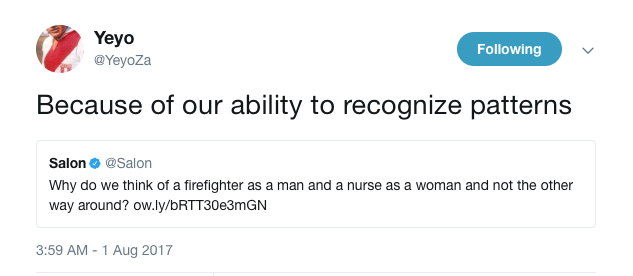
And as Yeyo adds in a later tweet:
@YeyoZa
Feminist academics don't understand that patterns cause stereotypes rather than the other way around
A friend took me out for dinner tonight and told me about how LA falls all over itself to try to hire female firefighters, building special showers for them and other facilities, but most who try to pass the firefighter test wash out.
Why?
Because it apparently takes a certain broadness of shoulders to be able to haul the hoses and gear up two flights of stairs. Few women of the very, very few women who want to become firefighters have that body shape.
Here's Christine Pelisek's LA Weekly investigative piece on the attempt to get more female firefighters into the LAFD:
Just 12 hardy women attempted to make it through the months of training, but few survived. Five are struggling to endure rigorous, 17-week academies now in progress. Two are on city-paid injury leave. Five resigned or were terminated. None has become a full-fledged department employee -- and if history is any guide, few of them will ever fight fires.Mary was among them. She seemed a natural. She needed just eight minutes in 2006 to breeze through the Candidate Physical Ability Test -- a test that stops most men right at the start. Yet Mary was shocked when real training began. "The first five minutes of work, we did 75 pushups, climbed up an aerial ladder, jumped off a sixth-floor roof, and then did more pushups." Alongside men also struggling, she pressed on. One guy was too fat, and failed. She was in top condition, yet "getting to the point I was endangering myself." She ended up near the bottom of her class, ahead of seven or eight men.
She can lift 80 pounds above her head. But she didn't realize she couldn't lift "80 pounds over and over again." The way she sees it, she simply was not big enough or muscular enough. The other two women in Mary's class also washed out. One couldn't pass the ladder-hauling tests. The third left because of an illness in her family.
Firefighters pull heavy lengths of hose, climb stairs while wielding giant power tools like chain saws, and lift 180-pound, 35-foot wooden ladders -- akin to carrying a concrete lamppost. Firefighters' physicians say that a human expected to pull the heaviest hose lines must weigh at least 143 pounds. And that's just for starters. "Less than 10 percent body fat was not enough," says Mary, who purposely gained 15 pounds of muscle to achieve the bulk she needed.
She's had it with firefighting, but Vesey has not. The former Air Force officer plans to rejoin the training academy -- and that will cost her, and taxpayers, a lot. "I know now if I go to the tower [department jargon for the 17-week training], I should be prepared" for the unfamiliar equipment that stymied her the first time. She's strengthening her hand grip, which failed her several times, and is readying for the Los Angeles Marathon.
Recruiting has become a pricey endeavor, with taxpayers ponying up $82,692 to send a single recruit through the drill-tower academy -- and spending another $82,692 each time a failed recruit is encouraged to try again.





Feminist academics don't understand that patterns cause stereotypes rather than the other way around
This!! But it's not just feminist academics, it's virtually all SJWs.
Rex Little at August 2, 2017 12:47 AM
The interpretation of those patterns is still up to us, and subject to our internal prejudices and biases.
Conan the Grammarian at August 2, 2017 4:49 AM
Muscle density counts, too. And so does height. Longer arms/legs = more leverage, so with higher density = greater mechanical advantage.
I R A Darth Aggie at August 2, 2017 7:45 AM
Also, this guy? One guy was too fat, and failed. put him with a college Power 5 football strength and condition coach for 6 months, and he breezes thru those parts of the training.
I R A Darth Aggie at August 2, 2017 7:47 AM
Men and women are hormonally and physically different. There are individual differences, sure, but I am basically not cut out for boy jobs -- those that require physical strength of any magnitude and those that require you to be calm in the face of physical danger.
I'm calculatedly brave, which is to say that I will take social risks -- stand up to people who are behaving badly -- but I only do this if I sense that somebody will not try to beat me up. I will lose -- to anybody with more upper-body strength than a 6-year-old boy.
Amy Alkon at August 2, 2017 8:10 AM
It is sad how many people are simply out of touch with reality. In college, weighing 145 lbs I could bench press 220. Men's hand grip is generally twice or more as strong as a woman's. I have had many men give a handshake that crushed my fingers--never from a woman. Never. Fire fighting is not a concept. People's lives are on the line. I think it was NYC that decided it would be ok for female fire fighters to drag someone down the stairs by their feet to get them out--I'd rather not thanks. I've picked up guys my size or bigger when just fooling around and did a fireman's carry (over the shoulders) and it was not hard. Women simply can't do it. The same rescue is required in the army by the way. You have to be able to CARRY the wounded out by yourself.
None of this is to disparage women. Women are wonderful. But they are not muscle brutes and pretending otherwise costs money and costs lives. This pretending is part of the conceit that reality is whatever we feel it is. Sorry, it isn't.
cc at August 2, 2017 9:11 AM
More proof that feminism is societal cancer, and that women, collectively, are willing to be delusional when it appears to confer some apparent advantage.
Not the way to win respect...
Jay R at August 2, 2017 10:12 AM
@YeyoZa
Feminist academics don't understand that patterns cause stereotypes rather than the other way around
__________________________________________
Offhand, I don't remember anyone claiming that negative stereotypes FORCE anyone to live up to them.
But some stereotypes are only 5% true. Others are 80% true. It's very important that everyone acknowledge that - AND which stereotypes are which. Those that are only 5% true cannot be blamed on the group itself, as a rule.
Not to mention that you don't get to assume that anyone is a nurse or a doctor when said person is not wearing an ID badge or a very specific uniform. Voicing your assumption could easily turn out to be a faux pas.
lenona at August 2, 2017 10:53 AM
Firefighters: 7% women, 93% Men
Nurses: 91% Women, 9% Men (all licenses); 90.4% Women, 9.6% Men (Registered Nurses)
So if you guess that a firefighter is a man, or a nurse is a woman, you're right 9 times out of 10.
Criticas at August 2, 2017 12:12 PM
So if you guess that a firefighter is a man, or a nurse is a woman, you're right 9 times out of 10.
_________________________________________
Yes, and that would presumably be before you met either of them face to face.
When you do meet someone, I'd say that voicing your assumptions when you could be wrong 9% of the time counts as "easily" possibly turning out to be embarrassing for both of you. Watching one's words until the last minute is hardly a bad idea.
lenona at August 2, 2017 2:26 PM
Here's my idea to reduce costs. Recruit fire fighters from the winners of the "Ninja Warrior" game show. That way we can all get a good laugh at the much larger number of people who don't make it.
jdgalt at August 2, 2017 4:15 PM
It's true that stereotypes come from pattern recognition. But, when politics and culture get thrown into the mix, there is a tendency for patterns and stereotypes to become mutually reinforcing. This can be positive or negative. When the stereotype is negative, though, then it can become a trap for people who have been stereotyped. Consider: Leftists have very stereotyped ideas about what politics various minorities should embrace, to the point where some leftists will denounce members of the class who don't conform as not being "authentic", as if they were genetically defective in some fashion.
Cousin Dave at August 2, 2017 7:17 PM
Deciding what to do based on stereotypes must consider two items: Frequency or likelihood that the stereotype is true as to an individual of the group oni question and...the severity of guessing wrong.
If I took a Ford F350, put in a gun rack, NRA and Trump bumper stickers, and painted the whole thing camo and drove it around Austin for a while, I coulsdpresume every tenth Prius driver would flip me off. So, after a bit, I've been flipped off forty times. No biggy.
But if I thought that one out of two hundred would call the cops and say I threatened them with a gun or tried to run them off the road, I'd have to talk to the cops twice. That's less than forty but, obviously more serious.
Richard Aubrey at August 2, 2017 8:39 PM
Leave a comment