





How To Retain What You Study
Do "spaced retrieval" (aka "spaced learning") -- learning jags with breaks in between -- to most effectively ingrain concepts and behavior.
Excerpt from my "science-help" book, "Unf*ckology: A Field Guide to Living with Guts and Confidence."
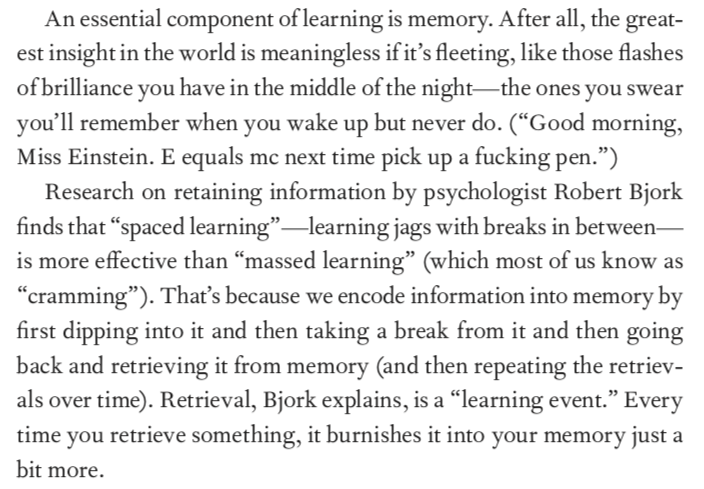
This is how I memorized my TED talk, "The surprising self-interest in being kind to strangers."
I'd recite a paragraph a few times, then walk away and do some other stuff, then come back and recited again. And on to the next, and then the next day, recalling again.
I was so worried that I'd never remember it all -- always thinking (over the years) that I was terrible at memorizing. However, I saw that learning through repeated "retrieval" really does the job.





If you have trouble with learning the physical world, I suggest that you concentrate on principles before you are immersed in details.
For instance, understanding that heat is NOT temperature - that it is the transfer of energy due to a difference in temperature, and that temperature itself is a measure of the kinetic energy possessed by a substance - opens all sorts of understanding when faced with somebody talking about global warming.
The units used to measure things are good clues to observing the principles at work.
At all times, you must discard colloquialisms. Many of those are outright lies when held to the light. They were just convenient at one time when someone described things to the slow.
Radwaste at January 17, 2019 4:06 AM
No surprise. Almost everyone has at some point crammed for an exam, and then promptly forgotten most of it as soon as they completed the exam.
It's much the same in the physical world, in terms of learning motor skills and what is called "muscle memory". For most people, it's better to practice a skill for a little while and then move on to something else. Highly repetitive practice is for when you've already got the skill learned and you are trying to fine-tune the details.
Cousin Dave at January 17, 2019 6:05 AM
I've been trying to get my third-grader to make and use flashcards as a study method for things she needs to memorize. She insists that the online prep that is generally offered now (for spelling words and multiplication tables and vocabulary and whatnot) are adequate. I've tried to explain that actually making the flashcards are part of the studying, and that reviewing them can be done just a little at a time. After failing to make the UIL Spelling team by one spot, she seems to be coming around. She has a Cecchetti ballet exam coming up in a few weeks, and she will need to know a number of theories and French terms, so she has started on flashcards for those.
I have a terrible visual memory. To learn places on a map I always needed to know stories or facts about them.
ahw at January 17, 2019 7:32 AM
I find that writing things down improves my recall greatly. Not for the notes, but the actual act of writing it. If I need to remember something in the morning, I write it down in the evening and wake up remembering it. Typing doesn't have the same effect
Conan the Grammarian at January 17, 2019 7:50 AM
This observation about learning is so true. It's why I believe that any classroom testing needs to include constant quizzes. I mean one or more per week. Being forced to learn and review a small amount of material that you recently had in class is a tremendous way to create and reinforce memory. When you get an answer wrong, you can immediately correct if you misunderstood, and, if it was from a failure of memory---well, nothing burned a fact into my brain like discovering the one incorrect answer that brought my grade down to a 90% from a perfect score.
Terrible life lesson learned when I went to law school. We had ONE TEST, that's it, at the end of an entire year for the first year subjects. I was so unprepared for that testing method and didn't take the necessary steps to basically quiz myself as the months went by. I didn't even know that would be the testing method until the year was halfway over and no mid-terms were given.
RigelDog at January 17, 2019 10:40 AM
Ahw's ideas about memory seem righteous. Longhand, not laptop.
Crid at January 17, 2019 11:00 AM
Forcing TED presenters to memorize talks and start over if they flub a word (as a friend described her painful experience at a local TEDx) is just nuts. How many great talks are they missing from people with great ideas, simply because they don't allow folks to use a teleprompter?
I'm sure it has something to do with their lawyers.
Grey Ghost at January 17, 2019 1:51 PM
"Forcing TED presenters to memorize talks and start over if they flub a word (as a friend described her painful experience at a local TEDx) is just nuts."
Meh, I dunno.
The inimitable Robert McKee routinely gave his two-day seminars sans teleprompter for years, going nearly verbatim from his own book from memory.
Gog_Magog_Carpet_Reclaimers at January 17, 2019 3:32 PM
I had a teacher tell us you remember 10% of stuff just by writing it down. Don't know where they got their stat from, but I write the stuff down and it helps.
NicoleK at January 17, 2019 9:15 PM
It has been shown clearly that college students who take notes longhand so much better on the tests than students who take notes on a laptop or tape a lecture. Something about longhand helps the memory, probably because it engages muscle memory. I also found (lo these many years ago) that if I copied my notes over and then condensed the key formulas (in math class) onto a page, I could visually memorize that page.
Memorization is a skill like any other and it used to be exercised more. I would memorize maps before starting a trip back before google. People used to memorize the whole bible.
cc at January 18, 2019 11:27 AM
Leave a comment