





People With Parts That Work Differently
I was so happy to see this funny tweet by Dr. David Ley, who has one arm that's different from most people's arms.
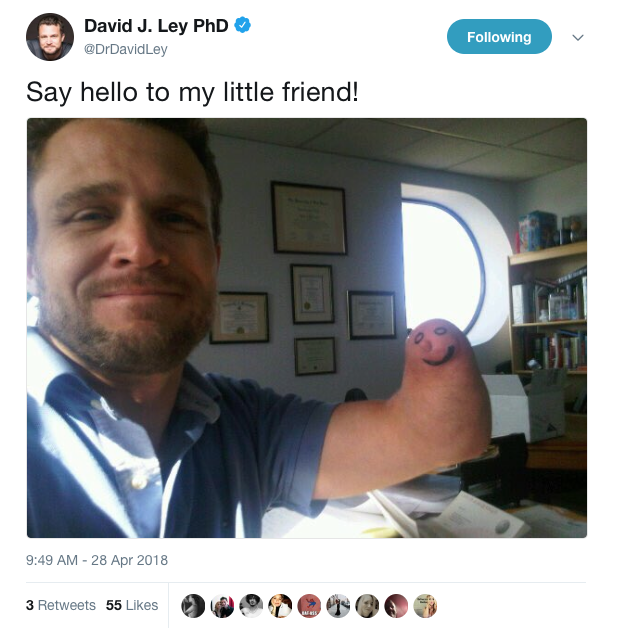
People often don't know what to do or say when they encounter someone with one arm that stops before most of our arms do -- or, say, someone in a motorized wheelchair. They often default to pity -- or look away. That's dehumanizing and frankly pretty ugly.
My late quadriplegic cartoonist friend, John Callahan -- like David Ley above -- challenged those views with his thinking and work.
Here's a 1992 Timothy Egan piece covering Callahan (that my friend, his manager, Deborah Levin, pitched and got into New York Times Magazine):
This year is a landmark for the 43 million Americans whom the Government classifies as physically or mentally impaired. The Americans with Disabilities Act, which went into effect in January, forbids bias in hiring and requires businesses and public offices to accomodate the disabled. It has been called the most sweeping anti-discrimination law since the Civil Rights Act of 1964. For all the liberating intents of the new law, Callahan would add another dimension, one that defies legislation: the freedom of the disabled to laugh at themselves.Not that being crippled, blind or diseased is inherantly funny. Obviously it is not. But, says Callahan, that does not mean pity should monopolize all feelings for or about the disabled.
"I'm sick and tired of people who presume to speak for the disabled," says Callahan, wheeling down the street in Portland, where he is a celebrity. "The question of what is off-limits should not be defined by some special interest group. The audience, the readers, should decide."
Just as Lenny Bruce broke the rules of stand-up comedy in the early 1960's, Callahan sees himself as a rebel force against politically correct views and people who are trying to narrow the boundaries of appropriate humor. The last thing he wants is to be called by one of the new euphemisms for people with disabilities, terms like "vertically challenged" for dwarfs or "otherly abled" for someone in a wheelchair.
"Call me a gimp, call me a cripple, call me paralyzed for life, but just don't call me something that I'm not," he says. "I'm not differently abled. I can't walk. But I also hate it when people say 'wheelchair-bound.' People who can walk are not car-bound."
Callahan's words, which can seem bitter and harsh at times, are softened by the way he talks. He drops one-liners, throwaway jokes and self-deprecatory remarks about himself in between barbs aimed at his critics. On an otherwise gloomy, recent visit to the doctor, he says, "Why couldn't I have walking pneumonia?"
He didn't minimize his physical situation but he didn't precious-ize it, either.
I took Callahan's lead in an advice column responding to a guy with a muscular condition.
Callahan understood that a person's disability often becomes a big wall between them and the rest of us because we're afraid of doing or saying the wrong thing. But through his refusal to, uh, pussychair around the subject, Callahan told people how the disabled want to be treated, which is "just like everyone else." And because the rest of us get poked fun of, Callahan did cartoons featuring disabled people. One of these has a posse on horseback in the desert looking down at an empty wheelchair. The posse leader reassures the others, "Don't worry, he won't get far on foot" -- which became the title of Callahan's autobiography.




Meet Shaquem Griffin, drafted this weekend by the Seattle Seahawks.
Old RPM Daddy (OldRPMDaddy at GMail dot com) at April 30, 2018 6:13 AM
My wife was in a wheelchair for several years before she died. Her biggest wish when we were out was that people speak directly to her instead of through me. It gives the wheelchair user human-ness. (That may not be a real word, but you get my point).
Jay at April 30, 2018 6:28 AM
I used to work with a finance manager who was missing most of his right arm.
One day, near Halloween, a coworker decorated the marketing department's office space, complete with a fake severed and bloody right arm. When the finance guy came through our department, he picked up the fake arm. You could see the worry in the coworker's eyes that she had offended or insulted him (he outranked her by at least two levels). He waved the arm and quipped, "Oh good, you found my arm."
The truly surprising thing about the incident was that he had never been known as a guy with a sense of humor.
Conan the Grammarian at April 30, 2018 7:16 AM
Stand up comedian (who doesn't stand uo all that well).
https://www.youtube.com/watch?v=xsqInns6LXQ
Steamer at April 30, 2018 9:43 AM
I remember an older lady who worked at my local Rite Aid drugstore back in the 80s and 90s. She was missing her hand and most of her left forearm. She could check you out and bag your goodies with the best of 'em.
I did not pity her or look away, I'm happy to say. I respected her the same way I did the other cashiers.
mpetrie98 at April 30, 2018 11:39 AM
I have a friend who was a Navy doc ("corpseman", according to a former president) who was blinded at Hue. Fifty years ago last February.
There are a couple of things I'd like to offer to do for him but that would imply he hadn't been able to get along on his own--which, with the usual Navy help--he had been for half a century.
Richard Aubrey at April 30, 2018 11:51 AM
I have a friend who was a Navy doc ("corpseman", according to a former president) who was blinded at Hue. Fifty years ago last February.
There are a couple of things I'd like to offer to do for him but that would imply he hadn't been able to get along on his own--which, with the usual Navy help--he had been for half a century.
Richard Aubrey at April 30, 2018 11:52 AM
I am impressed with what people are able to do in spite of disabilities. It is hard to know how to respond to them, especially if they are strangers. I have helped someone whose wheelchair would not go over a bump on the sidewalk and helped an old lady at airport with arthritis (real bad) who could not get the plastic spoon etc out of the plastic.
For all the good things the ADA has done, it also has had side-effects. Because a business is forced to often go too far to accomodate the disabled and cannot fire them without a lawsuit, the % of the truly disabled who have a job has actually gone down quite a bit over recent decades (though there is debate about why). How much might a business be inconvenienced? The EEOC sided with a deaf employee who wanted to run the cash register. It called it discrimination in a restaurant that sends waiters out with big platters because some women can't carry them. It has sided with certifiably crazy employees who are violent and disruptive. When an affiliate of the Mother Teresa foundation wanted to open a shelter, it was to be required to put in an elevator in the old building, which they could not afford. And of course there are the tens of thousands of lawsuits about disabilities. There is too much tendency today, given how even regular people are victims, to look for a reason to sue or to demand special treatment. People want to bring their service peacock on a plane or claim that being asked to be pleasant to customers is unfair. All of this hurts the truly disabled who need some assist for real.
dd at April 30, 2018 1:15 PM
The Canadian Human Rights commission ruled it an undue burden for a woman with a skin condition to wash her hands after shitting before handling food, nor was it an equatable solution to give her the jobs where she never handled food
lujlp at April 30, 2018 5:59 PM
When I saw the title, I thought this was going to be a post about gender issues. I remain surprised that, although people can readily see physical differences between people, some of which are handicaps, it still does not occur to them that internal differences can be just as profound.
Radwaste at May 1, 2018 8:10 AM
When I saw the title, I thought this was going to be a post about gender issues. I remain surprised that, although people can readily see physical differences between people, some of which are handicaps, it still does not occur to them that internal differences can be just as profound.
Radwaste at May 1, 2018 8:11 AM
"Dr. David Ley, who has one arm that's different from most people's arms." Do you mean his arm got amputated?
"someone with one arm that stops before most of our arms do" Yes' someone whose arm's amputated.
It seems to me that's you who are defaulting to pity - using these convoluted sentences. And do you know why? Because it's just normal and there's no easy way around that.
Paolo Pagliaro at May 6, 2018 4:13 PM
Leave a comment