





Mommy And Daddy As Rent-A-Clowns
 X percent of parents believe this! X percent of parents believe that!
I just love it when some company gins up parental guilt and stress based on...the opinions of other parents!
Kelly V. Lobanov, of "The Hodges Partnership," which sounds like a think tank but is actually a P.R. firm, sent me an e-mail asking me to publish an article:
Hi Amy,
Please consider publishing the article below which highlights the importance of active play and how parents struggle to find time for it.
A national online survey of 1,000 parents of children 12 years and younger found:
- that while 99 percent of parents agree that playtime is important
- 62 percent play with their children less than one hour a day, on average.
My name is Kelly Lobanov and I represent HearthSong (www.hearthsong.com) the national toy catalog that commissioned the survey.
This made me angry, because I know some people -- editors and parents -- may take this seriously, not noticing that these are simply opinions of the least valid sort: those of a bunch of people with no special background or qualifications in child development.
By the way, even if parents beyond the 1,000 do play with their children "less than one hour a day," that doesn't mean it's a problem.
Now, I don't have special qualifications in child development, but I do my homework -- to a degree I suspect Kelly does not. I wrote about kids and play and parental guilt in my column, Look Before You Sleep. Here's an excerpt:
The parental "no" has officially joined the ranks of chronically missing items like The Holy Grail, Atlantis, and Britney Spears' underpants.
You're supposed to be your kids' mom, not their full-time birthday clown. This means meeting their needs, as opposed to falling prey to their ransom demands; i.e., "Send in the chopper and the cupcakes or I'll scream my lungs out until spring!" If you're keeling over from reading "Hand, Hand, Fingers, Thumb" 40 times, it's because you didn't say no 39 times. "No" is also the correct response when besieged with requests for a chunky peanut butter sandwich with all the chunkies removed. But, children can be such finicky eaters! Correction: American children can be such finicky eaters, because their parents tend to confuse parenting with working room service at a five-star hotel. In France, on the other hand, the kids' meal is whatever the parents are eating; brains, livers, kidneys and all. And while the kids can pick out bits they don't like, their choice is clear: eat or starve.
Saying no to your kids will not turn them into meth-smoking, liquor store-robbing carjackers. Actually, throwing up a few boundaries might even serve to prevent this -- and less dire but extremely annoying outcomes (just what society needs, another 35-year-old snot who was denied nothing during childhood). Kids need to feel loved and secure -- and that doesn't take hours of mommy-and-me Lego. In fact, psychologist Judith Rich Harris writes that "anthropological data suggest...there may be something a little unnatural about adults playing with children." Anthropologist David F. Lancy notes that, beyond Western society, one "rarely" sees it. Regarding this apparent lack of a parental instinct for parent-child play, Harris writes, "This implies that children do not require play with an adult in order to develop normally." . . .
I dashed a quick e-mail off to Kelly:
Parents shouldn't be playing with their kids. They haven't throughout history. Not much, anyway. I just heard a whole talk at an evolutionary psych conference on how the important thing is for kids of various ages to play together, and I've written about this as well. My question is why are you putting pressure on parents? (I know -- to sell products.) Yes, play is important. Kids can do it just fine without mommy and daddy's help.
Here's Kelly's article:
THANKS FOR THE BALL, DAD, C'MON, LET'S PLAY
Unfortunately, Most Parents Have Little Time to Play with Kids, Survey Finds
(Big fucking deal, Amy adds)
by Kelly V. LobanovAngie Schuler, an advertising account representative and mother of two, has heard it all about maintaining a healthy work-life balance. But between her 60-hour work week and making sure Isabelle, age 6, has done her homework and Gavin, 3, has not hidden his vegetables in the sofa cushions, there's not much time for fun and games.
Like most parents, Angie knows all about the importance of play time. Finding the hours - or even minutes - in a hectic day, however, is not always possible. She is not alone. Despite near universal acknowledgment that playtime is a vital component of a child's development, 62 percent of parents engage in "active play" with their children for six hours or less per week. That translates to under an hour a day on average. If that's not bad enough, 16 percent of moms and dads admit that playtime with their kids averages less than one hour each week.
According to a new survey commissioned by HearthSong, a national toy catalog, and conducted by IPSOS Public Affairs, 99 percent of parents with a child aged 12 and under believe that children's play is important for a variety of reasons, but in a world in which the demands on parents' time are considerable, only 38 percent of parents say they spend at least six hours per week in active play with their kids. One in six parents doesn't even spend an hour a week, averaging fewer than 10 minutes per day in playtime with their sons and daughters.
"Everyone recognizes that for children to be children, they need time to play," said Beverly Fries, an educational play expert at HearthSong, one of the nation's leading catalog toy companies. "Play at any stage of a child's development helps instill a sense of accomplishment, delight and both intellectual and social growth. What is equally important to understand is the opportunities that play provides parents to engage with their children, to praise and encourage them in ways that instill strong and enduring bonds."
The survey also found that parents who do play with their kids, over one third (36%) say they most often play with games or toys, another quarter (27%) most often participate in unstructured play and a like number (27%) play outside, in either unstructured or structured activities such as sports.
Parents were fairly evenly split on the value of structured play. Forty-four percent of respondents said that structured play such as play groups, school and sports leagues satisfy their child's play requirements, while 56 percent disagreed.
When asked what they believed was the most important aspect of play in contributing to their child's development, more than one in four parents (27%) said "learning to interact with others," while fewer mentioned developing "motor skills" (18%), "problem solving" (17%), "creative thinking" (17%), "imagination" (12%) or a "sense of accomplishment" (9%).
And lastly, despite the growing popularity of electronic toys, such as computer and video games, only 38 percent of respondents indicated that their child spends more time with electronic toys than with other types of play.
"Laughter and engagement in active play is essential to the well being of your child," said Fries. From newborns to pre-teens, active play enhances a child's mental, physical, emotional and social development throughout their life."
Boston College psychologist Dr. Peter Gray, who studies mixed-age play, actually gave the plenary address on this subject at NEEPS, the NorthEastern Evolutionary Psychology Society conference I attended this May in New Hampshire. Here's an excerpt from a paper he wrote on it, Nature's Powerful Tutors; The Educative Functions of Free Play:
Age-mixed play is less competitive and more nurturing than same-age play. When players differ widely in age, experience, and ability, there is no point in trying to prove oneself better than others. Rather than focus on winning, players find ways to make games fun and challenging for all concerned. Age mixing is valuable both to the younger and the older children involved.Younger children benefit by being exposed to the more sophisticated activities and abilities of older children, among whom they find role models. A useful idea here is Lev Vygotsky's concept of a zone of proximal development: defined as the realm of endeavors that a child can do in collaboration with more skilled others, but cannot do by himself or herself or with others at his or her same level (Vygotsky, 1978). For example, two 4-year-olds cannot play a simple game of catch. Neither can throw or catch well enough to make the game fun. However, a 4-year-old and an 8-year-old can play catch and enjoy it. The 8-year-old can toss the ball gently into the hands of the 4- year-old so the latter can catch it, and the 8- year-old can run and leap and catch the wild throws of the 4-year-old. So, catch is in the zone of proximal development for 4-year-olds. We have made analogous observations for many intellectual and social skills, not just physical skills.
Older children also benefit in many ways from their interactions with younger ones. In age-mixed play, older children have opportunities to practice leadership and nurturance and to consolidate their own knowledge through teaching. Also, the creative activities of younger children inspire older children and adolescents to continue to play at such activities as painting and modeling with clay, and to develop artistic skills.
As a culture we are affording children continuously less opportunity for free play, unguided by adults, and continuously less opportunity to interact with children who differ from themselves in age. The observations I have described here suggest that, in letting these trends continue, we are depriving children of the most enjoyable routes to education.
Guilting parents who don't find it fascinating to read the same book to a kid 40 times is unproductive and maybe even damaging. Psssst! Parents! 3-year-olds can be cute, but they're BORING. And it's just fine to admit that.
You do your parental duty by breaking your kids out of the nuclear family bind so they can be socialized with other kids of all ages. Set it up so your kids play with other kids -- of all ages. Your job, as a parent, is to sit there with other parents and talk about adult things, adjudicate any fights, and say "That's wonderful!" when your kid occasional points out that they've manage to climb a tree without cracking their head open. (Yeah, okay, how they'll get down is anyone's guess -- but maybe the other kids can help your kid work that out, like kids have pretty successfully for generations and generations.) 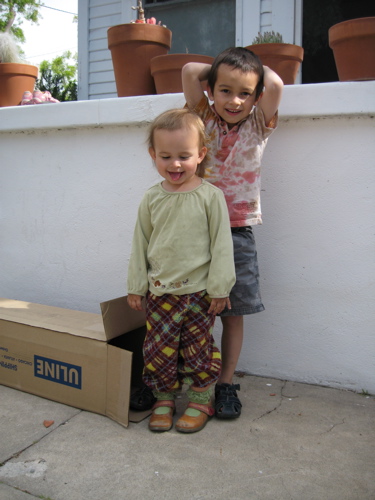
Those are my two friends in the photo: Dinosaur Boy, who's 7, and In-Charge Girl, who just turned 4, and who knows who's the boss and will be quick to show you if you forget it!




Thanks for a really good read, Amy. Regarding adults playing with children, I never knew a child yet that had any difficulty keeping themselves entertained without help from an adult. I remember my sister spent a small fortune on toys for her first child, only to find that he was more content making his own playthings out of paper grocery bags and pots from the kitchen.
Playing with your child (which probably erodes the parent-child relationship more than anything else) and supplying them with all the latest doo-dads and sophisticated electronic games is less important than simply setting the appropriate boundaries and letting them entertain themselves.
Patrick at August 30, 2008 1:32 AM
Great post! This has been part of my philosophy of parenting for years - my children are 17, 15, 10 and 8. While I do homeschool my four (meaning that I am actually with them most of the time) I don't hover. When they are younger, I make sure that they have some great toys (blocks and dress up clothes and toy food and dolls/action figures) and I get out of the way. We socialize as a family with other families and do exactly what you mentioned - "talk about adult things, adjudicate any fights, and say "That's wonderful!" when your kid occasional points out that they've manage to climb a tree without cracking their head open."
liquid at August 30, 2008 5:12 AM
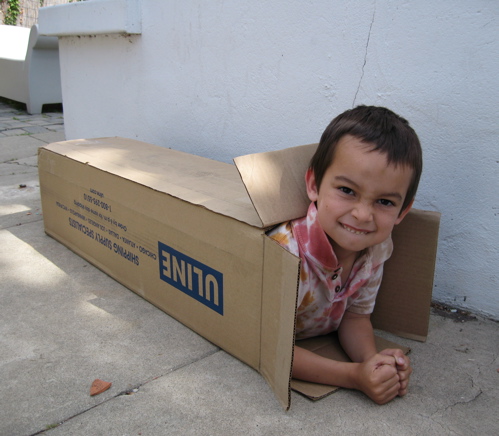
Thanks, Patrick and liquid. And while I didn't say so directly, the point you mention, Patrick, about how creative kids can be with a paper bag or a box, that's why I used this photo at the top of "Dinosaur Boy."
In fact, last year, I gave the little girl a big sunhat for her birthday. She's not wearing a dress here, but a lot of the time, we dress kind of alike, she and I, so I got her a hat like I would wear. Well, when she first saw it, for some reason, she had no interest, and ran off with the wrapping paper, which she found fascinating. Her mom was a bit horrified (I think, thinking that I'd feel bad), but I didn't at all. I was just happy I wrapped it right.
Amy Alkon at August 30, 2008 6:06 AM
That article reminds me of why I stopped reading parenting magazines. All of the guilt inducing, your-never-a-good-enough-parent garbage. An hour a day? Hell, I almost never play with my kids. That's why I had two of them! I can't remember the last time they even asked me to join in when they played together. If I did, it would come across as phoney and forced.
Karen at August 30, 2008 6:32 AM
When my parents were building their house, the cabinets and appliances came in great big cardboard boxes. My brother and I created a maze out of all those boxes and entertained ourselves until the boxes were ripped to shreds. My mom helped make the windows, since she didn't trust us with a box cutter, but other than that she just left us alone. We were only 4 and 5 years old at the time, but I still remember how much fun that was!
Pirate Jo at August 30, 2008 6:39 AM
That sounds like fun. I remember stuff like that from childhood...building things and playing with things that weren't supposed to be toys, and making villages in the sandbox.
My neighbors' kids, the kids pictured there, have particularly great parents. The dad will play with them on the weekend -- checkers, for example. I'll see him sitting outside with them on the ground playing checkers. And he'll read to them in the evening. But, all in all, he and their mother give them stuff they can use creatively, like a thing of big, thick, colored chalk they can use to draw on the cement outside. And he brought them home these magnets with movable arms and legs, and suggested they draw them, and the little boy made all these monkey drawings, one of which I bought from him for a dollar and put on my refrigerator. (I particularly loved that he wasn't sure whether he wanted to sell it to me at first, and only decided to a couple days later!)
Anyway, these kids are very smart and always doing some project themselves. The reason that they're great kids (beyond, I'm guessing, having good genes) is that their parents love them and give them boundaries and a secure base. "Secure attachment" is the technical term for it, from Bowlby.
Amy Alkon at August 30, 2008 6:48 AM
I don't think I would have been a very good father, and have no regrets about not becoming one, but I think my own choices for toys would have been strictly the creative. Start with blocks, then move up to tinkertoys, then Lego, then erector sets. Drawing pads, crayons, colored pencils, modeling clay, and other stuff, that allows a child to create.
NO coloring books, EVER! I can't think of anything less creative than giving a child a book with the pictures already drawn for them and sentencing them to the mundane task of filling in the lines. Especially things that already have standardized colors to them, such as a Christmas coloring book. Santa's suit is red. Every child knows that, so what's the point in putting him uncolored in a coloring book. Why don't you just color the suit for the child already?
And I'm glad you didn't fret the sun hat, Amy. Just because she didn't have immediate interest, it doesn't follow that she will not be interested in the future. Besides, it sounds like you made a practical choice. Just because she didn't want to play with it right away, it doesn't mean it wouldn't be a good accessory at the beach under that California sun. You gave her some nice (and often overlooked) protection against skin cancer.
Patrick at August 30, 2008 11:32 AM
I just laugh at these things, and find them amazing: give a kid a present you ordered online and fretted about the on-time arrival of, and she's blasé about the present and goes off for an afternoon to play with the wrapping paper.
And she wears the sun hat sometimes these days!
Amy Alkon at August 30, 2008 11:48 AM
So true, Amy. Your two friends in the photo look like they are having fun together, on their own, without adults getting in the way. My brother and I played street cricket with nieghbourhood children, rode bikes, walked the dog, went exploring, rode homemade billy-karts and had loads of fun - sans adults!
And Patrick, couldn't agree more about the colouring books.
lizzylights at August 30, 2008 3:48 PM
Hands down the favorite toy around my house has been a small wood mortar and pestle (the kind for making guacamole). It's a drum! It's a container! It's rollable! Turn it upside down and use it as a house for your other toys! You can decorate it! I've actually given these as gifts. But my little one's favorite gift ever was a box wrapped in colored comics inside a box inside a box inside a box. That was it. A bunch of boxes. Maybe you should give straight-up wrapping paper next time, Amy. I do have to say, though, that I believe in playing with kids -- not all of the time, mind you, and please don't ask me to talk for the dolls, but we do puzzles together and ride bikes together and, yes, do coloring books together (but only ones about things like swimming or fire safety).
JulieA at August 30, 2008 4:46 PM
I expect to get hammered for this, but considering that I grew up with seven other siblings, we were well-versed at entertaining ourselves.
Today given the number of single parent homes, coupled with the single-child mentality, things aren't what they were when I grew up. We played outside, all day, and until after dark.
My daughter (her parents are divorced) is without any children to play with where I live. At eight years of age, that has been the case with her since she was four.
I felt that given she had no siblings, I should "step-in" and play, and play I did.
I'm not going to say that as grown man, I "had a blast" with one tea party after another, but to deny my daughter that interactively (in some cases I'd play with her for four to six hours at a time) two - three times a week, would have been cruel. Add to that the fact that she's highly-intelligent (yes, I know all parents say that), I had to engage her intellectually.
If I had to to do it all over again, I'd repeat what I did regarding the amount of time I have (and continue) to spend with her.
We went fishing today. Some @ssclown in a row boat came by and was screaming into his cell phone (a pet peeve of mine) and was also dropping the F-bomb like mines in the water.
I'm not overly protective of my daughter, she's heard it before, and will hear it again, and furthermore, I am not myself offended by cursing.
At age four, she once turned away from her desk, looked me squarely in the eyes and said very matter-of-factly, "daddy, there's a f@@king flea on me!" This was during a bad flea infestation that took lots of time and cash to eradicate.
After recovering from my WTF did she just say shock, I was only wishing I had it on tape. She didn't understand what she was saying, but based on my reaction, she realized it wasn't a good thing to say to a parent.
Nevertheless, when the donkey in the row boat kept dropping the F-bomb as if he were mining for subs, I yelled "nice language" quite sarcastically. Given my physical stature, I was fairly confident that he wouldn't be confrontational.
As he rowed away after uttering a sheepish "I'm sorry", my daughter asked "why did you do that dad?"
I explained that although I wasn't offended by his f-bombing, nor was I concerned if she heard it, his behavior was inappropriate and rude. "He shouldn't be cussing around parents and their children" I further explained.
She countered, "that wasn't a good idea dad." "Why not" I inquired. "Because that's how adults get into fights, by saying things like that to each other."
"How do you know" I asked. Because I've seen it" she said.
I agreed that she was right and let it go.
As the donkey was approaching on his return trip, my daughter asked, "Are you going to say something Daddy if he drops the F-Bomb again?"
"I dunno, probably." "Why," she retorted, "because it's wrong" I insisted. "I won't be rude or nasty" I assured her.
"How about you be quiet and I'll say something to him if he does it again" she asked. "Sometimes children handle things better than adults do dad" she added.
"You're right, what will you say?" "I'll just tell him nicely that he shouldn't talk that way in front of me."
"Okay, you handle it if it happens, and I'll keep my mouth shut" I told her.
My daughter just turned eight one month ago.
At age five, she explained to me that when it comes to court, visitation etc, (keep in mind that she was commenting on what she personally observed) that "I don't have an opinion," because "the judge tells me what to do" and "how come no one else in the family but you has to do what the judge says daddy?"
What am I missing with this playing with your kids thing? I might be in absolutely denial, however I feel that my daughter seems "normal" to me.
Two days ago she say a cop on a cell phone and said "look dad, there's a cop calling the cops on himself." I asked, "are you serious?" No dad, just being sarcastic.
I simply hope that she desires to be a Family Law Judge.
Tony at August 30, 2008 8:36 PM
Amy Alkon
http://www.advicegoddess.com/archives/2008/08/30/mommy_and_daddy.html#comment-1586103">comment from TonyMy daughter (her parents are divorced) is without any children to play with where I live. At eight years of age, that has been the case with her since she was four. I felt that given she had no siblings, I should "step-in" and play, and play I did.
This is called being a great guy. It's just that parents shouldn't feel guilty for letting kids play with kids rather than playing with kids themselves.
It is ideal, per Peter Gray's talk and other stuff I've read for kids to have mixed-age play. If you can arrange that for her -- maybe through the Y or some other organization -- that would probably be good for her. Still, it kinda sounds like she's turning out pretty well already!
Amy Alkon at August 30, 2008 10:12 PM
Amy,
I really liked this post. I just recently learned that my son is displaying symptoms of a mild form of autism. He is extremely bright and too smart for his own good, but he lacks social skills with children and has anxiety and sensory issues. (There's more, search Asperger's Syndrome on WebMD. I was so thrilled for the longest time that my son loved to play with me, but understood when I needed my private time and time to tend to his needs, like dinner, etc. I am being encouraged by his counselor to step away and tell him he can't play with me and he needs to go play with his friends in the neighborhood. I wonder if I didn't contribute to some of his emotional issues, but as a very young mom, I was very wrapped up in my kid because I worked and was still in high school. We still play, but it's more like a family game night for a couple hours on Friday night, and he is doing just fine. Just because you don't devote every spare minute to your kids doesn't make you a bad parent. Social skills with children their own age need to be nurtured, because in school, they spend the majority of their time with children. People need to lighten up. It takes 40 hours or more per week sometimes on both parent's parts just to provide the basics. We can't be expected to come home from work, fix dinner, and play kickball til bedtime every night.
Jessica at August 30, 2008 11:30 PM
Thanks -- it meant a lot to me to get the research-based information out there. Meanwhile, Cybele Weisser, one of the WSJ bloggers on parenting pretty much buys into the angst ginned up by this press release. Ugh. Never mind looking for the work of people like Peter Gray. She just asks the readers what they think. (Like there's not enough of that going on in the damn press release.)
Amy Alkon at August 30, 2008 11:57 PM
Got it. I missed that point, sadly, and after reading the article twice.
I normally agree with you Amy, but was temporarily perplexed here. That said, I agree that children should be playing with children rather than adults.
Tony at August 31, 2008 8:04 AM
I am a grandpa. My wife is an abuelita. Our adorable two year old grandson calls her Buela.
If a kid needs an adult to play with, it's our job, not mommy and daddy. Parents are part of the authority structure that kids need to accept to function as adults. Grandparents are not, thus can play with them.
As I tell my daughter, to play well with a baby, you gotta' think like a baby, and I do, heh, heh.
But, toys?? WTF? Grandson knows this, too. Even at 15 months, if someone insisted on giving him a toy, he'd look it over for a few minutes, then over his shoulder it would go. And he would head for his favorite thing, which was the CLOTHES DRYER. He liked to clean the lint filter; open the door and play with the thing that turns on and off the light bulb. Clothes Dryers actually do something and he knew it from a very young age. He was that way with other things, like the built-in vacuum hose, and the dishwasher. He loved to look in the engine compartment of a car. Door knobs, hinges, and latches. At two, he is dinking around with his dad's remote control helicopter video game.
Which brings up the issue that such decisions should be based on a kid's basic personality which is always unique.
I disagree that kids are supposed to only play with kids. Watching the superior social skills of home schooled kids over the years, I finally realized most young adults are still in the adolescent stage because their peer group are other kids, so they grow up learning only how to be kids, not adults. (Home schooled kids have parents as their peer group, and know from a young age they are going to be adults.)
Kids who are exposed to adults as their peer group mature much quicker and are more tranquil and happy.
I remember years ago, a family friend would not let her daughter come to our house, because when morning came at our house, the girls got dressed, and set the table for meals. At her house, the kids ran around in their pajamas all weekend, and ate when they felt like it, as well as slept when they felt like it. She said there was time for kids to learn responsibility when they were adults.
Guess whose kid got knocked up in college and had an abortion and whose didn't? And, guess whose kid went instead to the eclipse with the University astronomy team as an under-grad?
irlandes at August 31, 2008 9:05 PM
Again, I mean no disrespect in asking this, but how do you draw a correlation between kids running around in their pj's, playing all weekend, and having abortions in college?
Were all of this kids you write about from intact families?
Tony at August 31, 2008 10:37 PM
CORRECTION: Were all of these kids you write about from intact families?
Posted by: Tony at August 31, 2008 10:37 PM
Tony at August 31, 2008 10:52 PM
I play with my girls - scrabble, boggle, monopoly, backgammon, cards, all kinds of board games. When they're of a mind to sit down and play. Outside stuff, they do all that while I'm cleaning house or whatever. They do kid stuff with other kids, and they do other stuff by themselves, legos and computer games and what-not. They learned at an early age that they were expected to entertain themselves if I, and/or their gramma or grampa, were busy. We make time to do stuff together when we can, but they know that I am not there to entertain them or relieve their boredom, they're plenty capable of that on their own.
Flynne at September 2, 2008 7:32 AM
My 11-month-old is already learning a lot about playtime.
1. She can amuse herself most of the time - either with the toys she has, their containers, or by just exploring the environment.
2. We sometimes get on the floor and play with her. But we certainly don't do it for "x hours" and we don't feel guilted into it.
3. She sometimes comes to us to play, but we don't always do so. We always let her know that we see her (we don't ignore her), but she's learned already that sometimes we just are busy, and so gets bored with staring at us and goes to find something else to do.
My dad played chess/checkers with me, and we threw various athletic implements around. He also would involve me in various building/fabricating projects so I could learn useful skills. But I also had plenty of time to play with my friends and entertain myself. Children learn a LOT from exploratory and experimental play. They get to develop their imagination, learn to entertain themselves, and develop mental/social skills naturally - rather than have everything structured and/or have their entertainment "given" to them.
I can't wait until she's old enough to start on Duplo blocks (legos are awesome) - but in the meantime I'm hand-crafting some oak letter/number blocks. That way I can build her some nice towers or something, and she can find out how much fun it is to knock them over. :)
Jamie (SMS) at September 2, 2008 11:47 AM
Amy, your friends are too damned cute for words! And I loved that one of Dinosaur Boy at the top! My grandson's favorite toy at my house is a box left over from my move. It was lying around when they came by just after I finished emptying it (finally!) and he impulsively climbed right in and tried it on for size. Now it's beating even my Playstation for first attention from him. Uh, did I mention that since it went over so well I've left it lying around my living room?
T's Grammy at September 3, 2008 11:35 AM
Leave a comment