





Bushwick Gallery Owner (To Activist) On "The Liberal Racism Of Low Expectations ... In Your Parochial Backwater Of A Mind..."
A Bushwick (long-deadly slum in Brooklyn) gallery owner -- Ethan Pettit -- who has been accused of "gentrification," takes on the activist, Anthony Rosado, saying that artists do gentrify a neighborhood, and that's a good thing.
At Gothamist, Emma Whitford writes:
Described in a Ted Talk bio as a "writer, performer, and cheerleader" in the early Williamsburg art scene in the 1980s, Pettit gave a talk at TedXBushwick in March 2015 entitled "Art Causes Gentrification." In the talk he posits that, "Artists seed in the neighborhood all of the essential elements we need to get the neighborhood going."...Pettit referred to Bushwick as a "blighted and crime-ridden community" and added later that "artists were the first wave of gentrifiers who turned this mess around."
Pettit also added, in a Facebook comment: 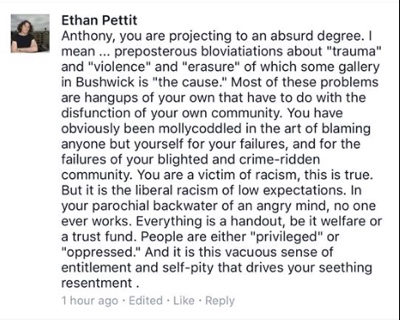 And more from Whitford's post:
In response to a comment from Giron challenging the "Bushwick 200" event's inclusion of real estate as a category in light of "the endemic harassment and displacement of working class Black and Latino families from the neighborhood," Pettit wrote: "Your neighborhoods were in bad shape dude. It was not some magisterial Inca civilization I assure you."
Naturally, another activist responded by saying, "This is the fact of hipster racism."
And this is Bushwick circa 2000, from a New York Times story by Julian E. Barnes:
Today, most of the tracts of charred, vacant land have given way to new homes. Between 1990 and 1997, the neighborhood had a net gain of 738 new housing units, a number likely to increase in this year's census count. As in the rest of the city, crime has dropped sharply, as a result of a strong national economy, less crack cocaine use and more aggressive policing. In the last six years, murders are down 72 percent and robberies 58 percent.But for every gain, a problem lingers. Bushwick has the borough's highest number of children on public assistance and its second highest rate of hospitalization for asthma, and the city's highest rate of childhood lead poisoning. The graduation rate at Bushwick High School is 35 percent, compared with 61 percent for the borough.
Oh, what a charming ungentrified urban eden it was!
More on the changes (largely due to state money being poured into the hole that was Bushwick) here at Wikipedia (bottom of the entry).




New Mexico can't find enough people to pick its pepper crops. I say the new welfare should be a bus ticket to an agricultural state.
I bet when faced with actual labor as the alternative, they'd start graduating high school pretty quick.
momof4 at January 10, 2016 7:42 AM
Come on, it's hard work going to the mailbox to get a welfare check. It even requires putting on pants.
Amy Alkon at January 10, 2016 8:56 AM
It is only "gentrification" when low-income blacks or other minorities are priced out of a neighborhood.
When working class whites are priced out of their neighborhoods it is called progress. Or it is done through the use of eminent domain.
charles at January 10, 2016 9:30 AM
And when racism, violence, and crime push affluent whites out of an area it's called 'white flight'.
I swear, you just can't please some people.
Ben at January 10, 2016 10:18 AM
Not really. A bathrobe will suffice in most cases.
Conan the Grammarian at January 10, 2016 11:26 AM
Poor people need to live somewhere. What I like about my village is you've got a range... you've got large single family houses, medium ones, twin houses, village apartments, farms, and block apartment buildings. You've got your doctors, lawyers, farmers, plumbers and maids all living in the same little area, and their kids all go to school together.
There's something to be said for it. We don't have a problem with ghettos and blighted areas that invite the destructive despair you see in other places. A "bad area" is a couple blocks.
That said, we do hear about more burglaries than we would hear about if we lived in a nice, isolated American suburb, so there's that.
All in all, though, I think mixed income models work pretty well. Break up the ghettos.
NicoleK at January 10, 2016 12:59 PM
That said, we do hear about more burglaries than we would hear about if we lived in a nice, isolated American suburb, so there's that.
All in all, though, I think mixed income models work pretty well. Break up the ghettos.
Posted by: NicoleK at January 10, 2016 12:59 PM
They tried that in the US, spreading out section 8 housing into middle class neighborhoods. It turned safe neighborhoods into crime ridden ones.
The biggest problem is the disconnect between the local areas, and the welfare benefits. If your are not beholden to your neighbors for the source of your livelihood, you have no vested interest in not shitting where you live.....
Also, it is amazing what open carry laws can do to reduce the crime rate in almost any type of neighborhood.
You can usually tell when you are in a neighborhood with a crime problem. Developments will have walls around them, and security gates, to make them less of a target.
If you have never visited Johannesburg I would suggest doing so, if you want to know how "mixed income neighborhoods" actually look.
The concrete garden walls topped with razor wire and glass shards and the bars on the windows are kind of a clue of how to survive in a *mixed neighborhood*.
Isab at January 10, 2016 1:43 PM
Lived next to a gov't housing project and the only interaction I experienced was frequent break-ins, a kid trying to set my wood pile on fire, and drug guys w/guns firing off rounds.
It took me a long time to get out of the area but it beat being homeless and sleeping in coats/hats/gloves.
Once my son came to live w/me I had to figure out safe firing lines because it did not matter whether we were home or not. These guys are not in their right minds.
So I keep my mouth shut because there is no right answer. You can't kill them all, imprison them all, educate them against their will, or hope they gain some pride in themselves. They have their 'culture' and do not want to change. After a certain point they can do no different.
Bob in Texas at January 10, 2016 4:59 PM
The problem with the working class being priced out of the city is a problem mainly with cities that have draconian restrictions on housing development and marketing. Like New York.
Cousin Dave at January 11, 2016 9:44 AM
NicoleK,
Mixed income/non-welfare works all right. Mixed income may also work in culturally homogeneous Europe (if I recall you are across the pond). But here in the US when you mix welfare and non-welfare groups the severe culture disconnect leads to nothing but trouble.
Ben at January 11, 2016 11:14 AM
Leave a comment