





People Voting In Increased Minimum Wage Lack Rudimentary Math Skills
In a perfect world, filled with unicorns and a flying car in every garage, we would all make piles of money, no matter what job we do, and have three months off to vacation in the Caribbean.
(Truth be told, I don't go out in the sun, I love writing books, and my idea of being at one with nature is looking out the window of a left-bank, Parisian loft onto posies in a window box, but you get the idea.)
Anyway, people in various states are voting in increases in the minimum wage -- without realizing that these have consequences, like people losing their jobs or not getting hired and businesses closing down.
A Colorado business has taken another approach. At 22 Words, Abbie Heugel writes:
Last November Colorado voters approved Amendment 70, which will incrementally raise the minimum wage in the state to $12 an hour by 2020.When the law passed, the minimum wage was $8.31 an hour; on Jan. 1, it become $9.30 an hour. Tipped service employees, like restaurant servers, now make $6.28 an hour, set to rise to $8.98 by 2020.
Most restaurants would absorb the cost into its menu prices, but not general manager Lilith Marquez, who said that she wanted customers to "know where the increase on their bills came from."
...Corona's management estimates Amendment 70 will cost $185,000 this year at their three locations. It's a cost now partially paid -- directly, and transparently -- by customers,
They've incorporated it on their tabs for customers: 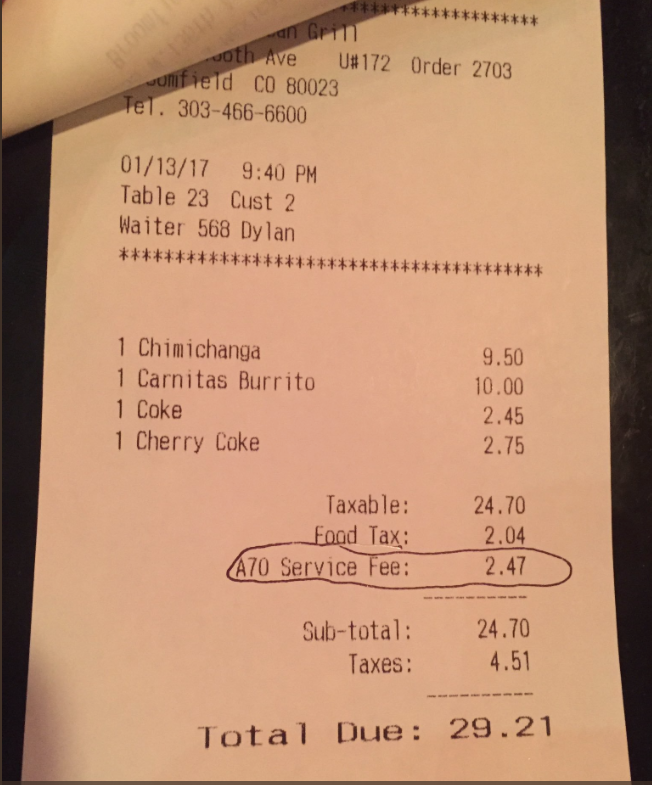
Oh, did you think the restaurant was just going to pick up the cost at no cost to you?
Of course, customers were previously free to increase the wages of the person serving them -- through giving generous tips. (And as I wrote in "Good Manners for Nice People Who Sometimes Say F*ck," a server typically has to share tips with busboys and other non-tipped staff.)
via @AriArmstrong




Except that the restaurant just added more than 10% to their profit. That 2.47 is more than the addditional labor cost of the meal. The 24.70 includes rent, cost of materials, other taxes, and the profit margin, none of which were directly affected by A70.
Steve Downey at July 27, 2017 8:16 AM
Sure they do. If they provide a product and/or service people are willing to pay them for providing. And if they're smart enough to price their product and/or service at a level that covers their other operating costs and leaves them something when all accounts are settled.
These "assholes" are providing jobs. How many people have you hired? What do you pay them? What skills do those jobs require? When you hired your gardener or contractor, did you go with the one who was cheaper? Did you balk at paying for extras? Did you take as long as you could to pay the bill? How much money did you cost the contractor when you did that? How many people did you deprive of a "fair" or "living" wage when you did that?
And who are you to decide who "deserves" to make a profit? If you don't like the charge, don't eat there. Tell your friends. Others may disagree and eat there. However, if they provide adequate satisfaction to enough people and control their expenses, they might just make a profit. Welcome to the real world; bring a sweater 'cause it's a cold place.
Fair wages? What's fair is what people are willing to pay for the service provided by the wage-earner. That's called reality.
Sorry people, most minimum wage jobs are not viewed by the market as so complex that they qualify as skilled jobs. The feeling is that almost anyone can do them with a modicum of training or practice. That's why the wages paid for those jobs are low.
And if the mandated minimum wage goes beyond what is tolerable by the dining public, the waiter is out of a job. People will eat at home or go to a cheaper place.
One thing people like these two tweeters fail to understand is that the real world only brings you in for what you can provide at a price it's willing to pay. That's reality. The fact that the high school dropout is not making the same money as the software engineer is not "unfair," it's completely fair.
The dropout can improve his employability by taking a class, reading a book, applying himself to learning a skill, or simply by putting down the bong and showing up to his soul-sucking minimum-wage job on-time and sober for once, and maybe learning something.
Conan the Grammarian at July 27, 2017 9:29 AM
https://www.colorado.gov/pacific/cdle/minimumwage
Both categories of minimum wage workers got a $0.99 increase. For those expecting tips, that works out to an 18% increase, for non-tipped, that works out to an 11% increase.
If we had access to their number of worker hours they had last year, we could estimate their future costs.
I think separating that out as a line item on the bill is a passive-aggressive move. If people question that, then remind those people that your #1 cost is labor, and that most eateries run a profit margin in the single digits percent wise.
Of course, some of the kitchen staff were making more than minimum last year, say, $9.20, and got a whole $0.11 raise they might be...less than happy to be making the same as the greenhorn that got hired last week to wash dishes.
I R A Darth Aggie at July 27, 2017 9:49 AM
Oh, and it bears repeating: the defacto minimum wage is always, always, $0.00.
I R A Darth Aggie at July 27, 2017 9:52 AM
The idea that McDonald's cashiers should make a "living wage"--ie enough to support a family--is insane. This is an entry level job. Did you not notice that most of the employees are teenagers? Have you ever met a teenager that you would pay $30,000/yr (which is $15/hr more or less). What is an entry level job? It is something to put on your resume to show that you show up for work, don't screw up, don't get in fights, have showered. Then you move up to the slightly better job. Places like France with high min wage always have high unemployment, especially of young people who can't get started. While the US unemployment rate is around 4.3% right now, in France it is 9.5%, and when ours was 9% in 2009, theirs was 15%.
cc at July 27, 2017 11:01 AM
I went on Google to find out what the profit margin of a typical McDonald's is: about 6% of revenue.
Payroll and payroll taxes are about 26%.
If all the employees were paid $8.31 an hour, an increase to $9.30 an hour would be about 11.9%.
That 11.9% increase in the cost of payroll is about 3.1% of revenue (.119 x .26 = .031) which is a little more than half of the franchise owner's profit... and incentive.
Ken R at July 27, 2017 11:18 AM
Thing is, at one point in our history, you could make a living with the wages of a clerk, cashier, or typist. You couldn't support yourself or your family in high style on that, but you could make sure there was something edible on the table. You were probably living in a boarding house or a tenement at that wage.
With higher minimum wages came higher costs. And with higher technology came higher costs. Modern life is not cheap. Pay phones don't exist anymore, so you need your own phone (cellular or landline). Television is broadcast in Hi-Def, so good bye rabbit ears. A turntable is an antique and most music is sold to be played on an expensive portable electronic device.
The days of being able to purchase a bare-bones new car are gone. No automobile manufacturer wants to own that end of the market. And boarding houses have disappeared. So the lower classes have fewer options for transport and residence.
I've read numerous stories of people in the past who put themselves through Harvard or some other Ivy League institution while working as typists or clerks. With today's DoE bureaucracy and the ready money available through the student loan free money giveaway program, university tuition has skyrocketed.
Minimum wage activists are nostalgic for a time that has passed - ironic since they accuse minimum wage opponents of nostalgia for a Downton Abbey era when household help could be had for pennies.
Walter Lord notes in A Night to Remember, his excellent history of the Titanic sinking, that the cost of a single one of John Jacob Astor's shirts would have paid the annual wages of one of the Titanic's radio operators.
Thing is, time and technology have played a role in pricing "livable" beyond mere minimum wage calculations. An unskilled worker in today's modern, mechanized world is a lost foundling. Yet, we keep dumping them into the world without a clue.
It's not a "livable" wage we should be shooting for, it's an employable underclass. Our parents and schools need to be turning out literate and numerate graduates, instead of depending upon community colleges and trade schools to turn their uneducated output into productive and self-supporting citizens.
Parents bear some blame in this, too. You can't expect a teacher to take on the emotional, intellectual, and philosophical molding of your offspring. Read to them. Discuss things with them, beyond which Kardashian has the biggest butt. Illiterate parents make for illiterate children, except in Ben Carson's case, but that was an exception.
The minimum wage is not a magic panacea that will ease all social ills. It comes with unintended consequences, not the least of which are lower employment and higher prices. We no longer live in a world in which "two hours of pushing broom" will buy an "eight by twelve four-bit room."
Conan the Grammarian at July 27, 2017 11:55 AM
"It's not a 'livable' wage we should be shooting for, it's an employable underclass. "
This. Today, our high schools in particular are nearly useless. For most of the students, it's simply a ticket to get punched. They come out knowing little more than they knew when they went in. (And they didn't go in knowing very much, because the primary schools aren't holding up their end either.) Other than the small percentage of students whose parents can afford to send them to serious private schools (and even all private schools are not on the same level), and the small percentage who are self-motivated and will go out of their way to educate themselves, we aren't teaching anyone anything. Not math, not science, not English, not civics, not how to live like a regular adult, not anything. There is a reason why this is happening. Don't forget that rule #1 in the Dictator's Handbook is: "Cut off access to education."
There aren't many jobs anymore for people who put bolts in holes all day. A robot can do that job faster and cheaper. There are jobs for people who can program, operate, or repair the robot. Those jobs are going wanting, and the small category of people who both have the skills and are interested in those jobs are doing pretty well. There was a time when an average American laborer didn't need any education to speak of -- didn't need to know how to read, didn't need to know arithmetic, none of that stuff. All they needed to know was how to drive a mule to pull a plow, or cook a few basic meals. (And produce children and raise them.) Some people had to learn more skills; the farmer, unlike his farmhands, had to know some things about production and cost and how to price crops and land, keep books, keep up with improvements in methods and crops, etc. But they were the exceptions.
Then the factories came along, and workers needed to be able to read instructions and count parts and units produced, at least. The education system adjusted to that; it turned out a lot of workers with the minimum competency to do those jobs. There were some skill jobs; some people had to repair the machinery, some people had to supervise, some people had to buy materials and calculate costs, and so one. But they were outnumbered by the line workers, by a good bit.
Now the game has changed again. The minimum competency to hold a job that can support a family has gone up. The knowledge range has flattened -- the robot keepers have to be at least somewhat knowledgeable about its design, its production capabilities, and so on. They aren't as far apart from the engineer who designed the robot, or the executive who decides what products to produce, as the assembly line worker of the 20th century or the farmhand of the 19th was from the professionals in their vocations. The education system has not adapted to the change. In fact, it is fighting the change tooth and nail.
Cousin Dave at July 27, 2017 12:38 PM
To be fair Cousin Dave the guy who used to put bolts in holes is now running the robot who puts bolts in holes. These machines aren't complicated. It is kind of like Conan's example of clerking. Before machines could do all the math for you clerks had to have a certain level of education and skill to do the job. A McDonald's clerk and a Dickens clerk are not doing the same job. Hence the difference in relative wages.
As for the literacy rate, you couldn't read a bible if you couldn't read. With the high level of religious motivation in the US literacy rates have been pretty high for quite some time. In the 1870s it was already at 80%. By 1900 it was 90%. And has only risen since then. Industrialization is not what has driven this trend.
I also disagree with you on the education system. If you look at US vs. fixed standards or vs. international scores you will find the US has continuously decreased the quality of our education system since the department of education was founded. In part this is due to a desire to decrease the disparity in education outcomes. But the only way that was accomplished was by bringing people on the top down. In part the change is due to a desire for national standardization. In all honesty a public school in Colorado, Texas, New York, or anywhere else are pretty much identical. The main variance is due to tax base. But this standardization comes at a cost. Local issues cannot be addressed. New York and Texas may have different educational issues but those individual issues cannot be remedied because everyone must do the same thing at the same time in the same way.
Hence the strong push these days for charters. Even in the same locations people don't have the same desires for the local education system. Some want the three Rs. Some want arts and crafts. Some want sports. Some just want a daycare. You can't be all things to all people. Just can't be done. Charters allow people to chose what they want for their children. Of course this destroys equality of outcome and standardization.
Another issue is grade inflation. In all honesty a 6th grade education for my grandparents is approximately the same as a 12th grade education today. Also, far more people graduate from college than they used to. In the 1940s only 40% of US citizens had a high school degree. Today that is 90%. In 1940 less than 5% had a bachelors degree. Today over 30% do. With increased supply there is reduced demand. I somewhat doubt we are actually better educated as a whole. But we are certainly better credentialed. Hence those credentials mean much much less.
Ben at July 27, 2017 8:24 PM
One of the things consistently missed by most observers of the minimum wage argument is this:
No one can change the basic unit, "one hour of work".
Radwaste at July 27, 2017 9:37 PM
If the restaurant in question pays the increased wages as described and absorbs the cost of $185k, that's $185k out of what might be considered the owners' take-home.
How much money do you have to be making that losing $185k is not a concern?
Right. It's a concern.
So they're going to do something. Increase prices is one item which means their customers are going to show up for the lunch--cheaper menu than dinner--order Pepsi instead of beer with a meal, etc.
Or simplify the menu meaning potentially fewer customers.
Both of which mean fewer min wage slots.
Or, in the case of fast food, automate. I looked up automatic burger makers and found they're available. Didn't click on any of the hits because I didn't want anybody trying to sell me one. You can get those which make gourmet burgers from bun to lettuce, or the cheaper models that simply make and flip the patties.
Raising the minimum wage from, say, $8 to $10 is an eight dollar cut in pay for those who can't get a job at $10.
Richard Aubrey at July 28, 2017 6:15 AM
It raises the question of what would an hour of unskilled labor be worth on an open market. Seven or eight years ago, in these pages, I had done a bit of math and figured it to be about $3.50. Now I'm thinking it may have gone up to $5 or so. Don't forget that in order for the worker to receive $5, the employer has to shell out more than that to cover taxes and mandates. Call it $6. That's about where the minimum wage should be, if there is to be a minimum wage at all.
This is one of the things that makes using illegal labor so attractive. Illegals can be paid less than the minimum wage, which means the employer can make jobs available to them that can't be offered to legal residents. And the illegal takes home more than the legal worker would at the same wage, because there are no deductions or fringe costs that the employer has to pay for illegals. Yes, automation can do some of those jobs, but putting in automation is a capital expense. For that, either you have to pay for it up front, or else you have to finance, and pay the costs associated with that. And, a capital expense gets you into complex aspects of tax law. The math may well work out that employing illegals is cheaper in the long run, plus you don't need to be a tax law expert to employ illegals. And, when you hire illegals, you don't have to worry (much) about SJWs who want to get hired just so they can file nuisance lawsuits against you. If an employee shows up for work drunk, or doesn't show up at all, you just fire him.
Cousin Dave at July 28, 2017 6:56 AM
If I was handed a bill like that, I'd refuse to pay the "A70 service
fee". This is not a fee they're legally entitled to tack on. They
don't have the right to add on random fees of whatever amount they
feel like unless there has been conspicuous advance notice to the
customer.
Think about it. Suppose the restaurant surprised you with a
"utensil fee" of $500 on your bill. Would you pay it? How about
$1? After all, it may actually cost $1 to collect, wash, and handle
the utensils.
Ron at July 28, 2017 7:34 AM
It is an itemized bill, Ron. If you refuse to pay then the cops will have a conversation with you as a dine and dasher.
Ben at July 28, 2017 8:33 AM
Ben: I take it, then, that you'd pay the $500 utensil fee because it's on an itemized bill.
Secondly, if all but the junk item is paid, it's clearly not dine and dash; it's a commercial dispute.
Ron at July 28, 2017 10:40 AM
Depending on the restaurant, yes a $500 utensil fee is normal. If you don't want to pay those prices don't go to swanky restaurants. As long as everything was displayed before service was rendered then yes you have to pay for what you used. And no, partial payment is still dine and dash if you leave without paying. Would not paying $2.45 for the coke be any different?
Ben at July 28, 2017 3:00 PM
As long as everything was displayed before service was rendered
Exactly. If the menu showed coke as $1.00 and you were billed $1.00
with "special coke fee $1.45" as an itemized extra charge, that's
inexcusable and unenforceable.
And no, partial payment is still dine and dash
The law says otherwise. In fact, sometimes charges explicitly on
the menu have been ruled unenforceable. Let me provide an example.
Disclaimer: while the following is generally true, case law can
vary in different states.
I'm sure you've seen those menu statements saying
parties of x or more will be charged a y% service charge
or
parties of x or more will be charged a y% tip
There's a legal difference between those two statements. It turns out that
a service charge is attributed to the restaurant and thus is fully taxable to
the restaurant. Therefore, restaurants tended to refer to it as a tip, and
thus avoid paying the various taxes.
In numerous court cases across various states, there were occasions
where the service was so awful that the party refused to tip,
despite what was written on the menu. The courts have ruled that a
service charge clearly stated on the menu was enforceable. However,
they ruled that tipping is always optional, and despite the clear
notice on the menu, the restaurant was enjoined from trying to
require the complaining party to pay that charge.
Ron at July 28, 2017 4:25 PM
Ron,
Read the whole article. They posted the fee on the front door. Don't want to pay it, don't even go inside. But I am sure to make others who think like you do feel better, they will be raising their prices in a month and then you can sit around and wonder why everything is getting so expensive lately.
Sheep Mom at July 29, 2017 7:15 AM
As Sheep Mom said, the charge was posted, it followed local tax law, by your own argument if you don't pay it you are engaging in theft Ron.
Ben at July 30, 2017 7:29 AM
Leave a comment