





Why You Don't Beat Somebody To Death For Grabbing The Last Can Of SpaghettiOs
I'm live-blogging this from the Human Behavior and Evolution Society Conference, an annual gathering where anthropologists, ethologists, psychologists, and evolutionary psychologists from around the world present their work.
We don't need religion to keep us from stealing, raping, and killing and committing lesser crimes against other humans. We have evolved adaptations that prevent us from doing it.
Here's Haidt's definition of morality, from this morning's plenary that Penn prof Rob Kurzban (a young researcher I've known since he was a grad student at UCLA) is giving now:
Moral systems are interlocking sets of values, practices, institutions, and evolved psychological mechanisms that work together to suppress or regulate selfishness and make social life possible.
Kurzban points out the actions that are deemed altruistic are often not -- quoting Adam Smith:
"It is not from the benevolence of the butcher, the brewer, or the baker, that we can expect our dinner, but from their regard to their own interest."
Kurzban and Peter DeScioli are doing some really interesting work trying to fill in holes in the literature on cooperation, reciprocity, and punishment. Some of their work relates to the underpinnings of my book, I SEE RUDE PEOPLE, One woman's battle to beat some manners into impolite society (October 30, 2009, McGraw-Hill). One of their papers, now in press, can be read here.
Here are the conclusions from his plenary: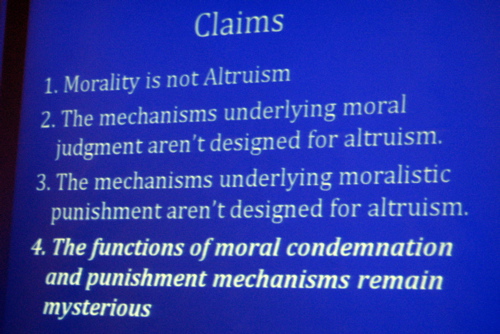 In the question and answer session after Rob's talk, he said he defines morality as "a system that evaluates acts on a scale of wrongness." (And he doesn't mean in the logical sense, of course.)
On a related note, Haidt's work on "elevation," a word he borrowed from Thomas Jefferson, is very interesting, and almost made it into my book. Here's a quote from the Haidt link just above:
Elevation is elicited by acts of virtue or moral beauty; it causes warm, open feelings ("dilation?") in the chest; and it motivates people to behave more virtuously themselves (to "covenant to copy the fair example").
Haidt's most recent book is The Happiness Hypothesis: Finding Modern Truth in Ancient Wisdom
My question: While there are reputational benefits from acting generously (if people are watching), why do people feel good, or even elated or "elevated," when they do generous, prosocial acts? I don't think anyone's answered that. And I'm asking from an evolutionary standpoint -- why would we have evolved to have this feeling?
Rob says, "elevation is evolution's way of rewarding you for doing an act that will improve your reputation."




Amy, is there an example of an atheistic society that was not morally decadent (our own certainly is, as you yourself are adept at pointing out)?
I'm not advocating for religion, but rather that I think religion is itself one of our evolved mechanisms for social bonding and enforcing morality. Every society has it, so it probably serves a purpose of some sort. Atheists should probably settle for being an enlightened minority in an otherwise religious sea of average humanity. Sure it's elitist, but what the hell.
Todd Fletcher at May 30, 2009 11:49 AM
Well first off todd, most of those morally decadent people claim to be belivers.
Second ask your self this. Is the beliver who does the right thing in hopes of avoiding hell really a better person then the athiest who does the right thing with no thoughts of avoiding eternal damnation?
lujlp at May 30, 2009 12:22 PM
The mistake people make is in thinking they have to get meaning out of life when life is something you put meaning into. An act of altruism has it's base in empathy for the human condition. The reason it can feel good is because it's defiant. It's the anomaly that places you outside the compartmentalization of behavioral economics.
jon at May 30, 2009 1:55 PM
One explanation is that a strong group of people has a competitive advantage. My genes are more likely to survive if my extended family survives.
Another is that we are socially conditioned to feel good when we do things that we are taught are good. E.g. if a child is rewarded with a smile when they're nice, they might feel something similar when they're nice as an adult.
A standard element of Christian theology is that everyone is morally decadent. I wonder to what extent this encourages moral decadence.
Pseudonym at May 30, 2009 2:03 PM
is there an example of an atheistic society that was not morally decadent
Atheists are not a cohesive group (just people who do not believe, sans evidence, in The Big Man In The Sky).
We don't live in an "atheistic society" at all. We're a highly religious, highly superstitious society where people will frequently mention they're doing something because Mercury's in something or other, or their "rising sign" is something or other.
The point is, we have evolved mechanisms for what we call morality. Without religion, you still get derogated by people if they know you've done something anti-social, losing reputation. Or sent to prison if you're caught. You won't get along very well in a group if you're known as a selfish motherfucker. Somebody here presented work on how the kids who do best socially, with other kids, are (and I'm remembering here), altruistic aggressives, meaning, I think, kids who are aggressive in getting what they want (not pushovers), but who also are generous to other kids.
Amy Alkon at May 30, 2009 2:07 PM
Fair enough, "atheistic society" is a poor choice of words, "secular" would have been better.
I'm basically making the point that religion was the main method, historically speaking, of enforcing morality & group cohesion, and that I think it evolved for that purpose.
Civilizational decline is often, maybe always, associated with decline in religious observance. Rome, Greece, Medieval Islam, China, etc. have all followed this pattern, and we're following it now. Why? I agree with you that morality has enough basis in common sense to be adopted; I don't need religion to see the good in it. But for many people loss of religion leads to nihilism or something close to it, and that leads to moral decay.
It's just something I've noticed from reading history. I don't have any answers. And I ain't about to start goin' to church to stave off our ultimate doom!
Todd Fletcher at May 30, 2009 3:07 PM
Explain then eygpt, the aztecs, myans, incans, russia, and the british empire.
It could just as easily be argued that rome fell due to incompotent corrpt leadership, crushing buracracy and a never ending cycle of uprisings and shady deals with mercinaries who betrayed them.
In fact some historians argue that rome fell due to an increase in religious observence due to people being less concered with the here and now as the end of the world was just a few years away and everyone was more concered with heavenly rewards then earthly concerns
Also did you know that armegeddon has been 'a few years away' now for nearly 2000 years?
Some others attribute romes fall to their loss of military superiority with their rank and file mercinaries being loyal to local commanders and not the empire coupled with the invention of the hore shoe which gave the gemanic people a military advantage.
lujlp at May 30, 2009 3:40 PM
The problem is that the benefits of delaying immediate gratification in favor of apparent altruism are often subjective & impossible to quantify or measure in a laboratory. As an example, when I was studying engineering in university, I spent 8 hours one night helping a fellow student with her computer-aided design assignment. The professor had gone home for the day, the teaching assistant was a useless jerk, and her friends had either finished or given up & gone home. That left me, sitting next to a girl who was getting hopelessly frustrated & ready to cry. Yes, she was very sexy, but I had no intention or expectation of getting into her pants. I never saw her again after we graduated, & the only direct reward I got from her was a smile and a "Hi Martin!" whenever I ran into her in the hallway. If I'd gone home & left her alone with her computer, I would have spent a pleasant but totally forgettable evening eating dinner, watching TV, then going to sleep. Instead, after more than 15 years, I still have delightful memories of her eyes lighting up when she finally understood something after I'd finished explaining it, listening to her voice get softer & more cheerful as the hours went by and she realized that she could actually get this thing done, watching her tiny feminine hands on the keyboard, etc.
The rewards for my time & effort exist only in my mind & memory, but that's enough to make it all totally worthwhile. If the folks at the conference are looking for concrete, quantifiable explanations for apparent altruism, they will probably always be disappointed.
Martin at May 30, 2009 6:20 PM
Why do people immediately seek to show their religion as the source of morality? Because they don't know about other religions. There was no choice involved. Their faith is inherited.
-----
Robert Heinlein talks about morality at length in Job: A Comedy of Justice and Stranger in a Strange Land. Others talk about mirror neurons, and the ability to understand what another person is going through.
Me, I cheer success. I have discovered that nobody else has to lose for me to win. Of course, somebody can choose to lose if they want to be a victim...
Radwaste at May 30, 2009 6:51 PM
I'm basically making the point that religion was the main method, historically speaking, of enforcing morality & group cohesion
Actually, small group size (knowing everyone around you) is a huge influence on keeping people from misbehaving.
Amy Alkon at May 31, 2009 12:14 AM
I think that is a pretty good definition of morality. The gap I see is why over time we keep shrinking childhood? In other words, if we are truly moving away from selfishness why do we see increased introduction and normalization of adult behaviors by children? I am not talking simply about the increase of children being sexual active at earlier and earlier ages (although that is happening). I see the sexual activity at a younger age as just a symppton of a larger problem. What I am talking about is I see an increase of children being encouraged by the structures of society to mimic all behavior of adults at earlier and earlier ages. They are encouraged to mimic adults in how they look, dress, and behave. Is there a trend to stop being children and become adults at an earlier and earlier age? Is the average 10 year old today much closer to being an adult than a child compared to a 10 year old 20 or 30 years ago? If so, do people here think that is a good or bad thing to shrink the time kids are allowed to be kids through the same pressure mechanisms that also govern morality as stated above? Or is there something else at work here? I ask because the question that follows is who benefits from such a trend? I suspect it is adults marketing to youth. If so, where are the moral mechanisms to prevent that type of selfishness? Does anyone else feel that way? And if so, is it a problem?
LoneStarJeffe at May 31, 2009 7:08 AM
Jeffe -
I think you've got it precisely backward.
Children are being encouraged to stay child-like to later and later ages. You now have people living in their parent's homes into their 30s and never taking responsibility for their own lives.
What you're seeing is the expanding of "adolescence" in both directions. We'll allow you some things that used to be "adult" like sex, but no booze. Jobs, but no responsibility.
Adolescence is childhood for the sexually mature.
brian at May 31, 2009 8:29 AM
Brian, absolutely right! I was going to make that exact same comment.
Karen at May 31, 2009 10:18 AM
Hi Brian,
Be sure to sit down. I agree with you!!!
We are also seeing, as Brian correctly pointed out, more adults refusing to accept adult responsibilities. So I amend my question. Why is this happening that we both see children, and I use the age 10 as an example, being urged to mimic adults as well as adults 18 and above being able encouraged to not assume adult responsibilities? And does that mean we as a society are getting better over time or worse in terms of what is considered acceptable morale behavior?
LoneStarJeffe at May 31, 2009 12:28 PM
I facebooked the other day that I could barely believe my girls had finished their first year of school. A friend replied back "11 more, and you can tell them to get a scholarship or join the military!". It's true. There will be no 30 year old teens in this house!
momof4 at May 31, 2009 1:17 PM
Jeffe - Worse.
Here's the thing - What is the easiest way to control people? Sex. So, what do you do, if you're looking to establish complete control over a population without them knowing you're doing it?
You teach them about sex at an early age, then you punish them for using what you taught them. This makes them sheepish, and causes them to look to "authority figures" for permission to do everything.
Then you take the school system and you make sure that nobody who graduates is capable of doing anything of value. Therefore, they need the government to take care of them.
Where the whole thing falls down is that you can not have a totally service economy, as we are finding out to our pain.
At some point, the progressive agenda must be repudiated. This will happen at approximately the same time that monkeys fly out of my ass.
brian at May 31, 2009 7:29 PM
vlad at June 1, 2009 6:45 AM
Right. Look at the abortion figures in both places. Someone's having a lot of sex they don't want to be responsible for. And a lot of that is probably with people they really ought not be having it with.
Most public schools are so lousy that the most driven students aren't getting anything of value out of them. The only lesson learned is "get your education elsewhere, and never let on that you know anything in school".
Or, as Mark Twain once put it: Never let school interfere with your education.
brian at June 1, 2009 8:14 AM
Leave a comment