





I'm A "Speech Nut"
And if you are, I turned it into a t-shirt you can buy at Cafe Press. Proceeds go to my bacon fund.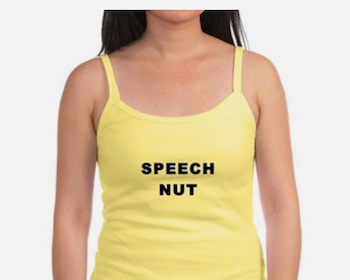 The story on this is that a New Yorker writer has deemed "Speech Nuts" like "Gun Nuts." (Personally, I have no problem with people who defend the Second Amendment or any other part of the Constitution, and I actually am grateful to them for it.)
Anthony L. Fisher writes at Reason that Kelefa Sanneh thinks the American devotion to free speech is overrated because there's less of it in Europe:
Ironically, over more than 4,000 words, Sanneh is never able to present a coherent thesis of his own, though two sub-headlines hint at what he might be getting at:The new battles over free speech are fierce but who is censoring whom?Free speech really can be harmful, and its defenders should be willing to say so.
After noting that defending free speech was once the vanguard of the left, when it meant defending the rights of civil rights protesters to agitate and fighting back on obscenity charges leveled at comedians like Lenny Bruce or rappers like 2 Live Crew, Sanneh writes:
But as the nineteen-nineties progressed, fights over obscenity subsided and fights over so-called political correctness intensified; "free speech" became a different kind of rallying cry, especially on college campuses. Often, "free speech" meant not the right to protest a war but the right to push back against campus restrictions designed to shield marginalized groups from, say, "racial and ethnic harassment"--that was the term used by Central Michigan University, in its speech code, which banned "demeaning" expressions.Note the use of quotation marks around the words free and speech, implying that the use of the phrase is inappropriate when used to defend the right to express unpopular ideas that lack the social merit of the writer's preference.
And this bit from Fisher is key:
While painting Americans as unsophisticated "nuts," clinging to their guns and free expression, Sanneh describes "diversity of thought and belief" as a paradoxical formulation. But such diversity is the very essence of pluralism, the idea that one's deeply held principles can and should coexist with others, and the free exchange of ideas can allow the worst ideas to be debated and defeated in public.Writing in The Atlantic, Jonathan Rauch made "The Case for Hate Speech," using prominent homophobes as an example of how "bad speech" ultimately helped to advance the cause of gay rights. If expressing such speech were outlawed, the ideas themselves wouldn't go away, and the fight over the value of such ideas would never be had. In the name of sparing feelings, the unacceptable status quo is maintained, and no is forced to choose a side.
Greg Lukianoff, the president of the Foundation for Individual Rights (FIRE), says Sanneh's article attempts to "paint proponents of free speech as unsophisticated, which is deeply ironic because he fails to do basic research into the complexity of First Amendment law, how much we still rely on the First Amendment in a very real legal sense, how poorly hate speech restrictions work in other countries, and how common campus speech codes are."
Here's Lukianoff at FIRE with "10 Things The New Yorker Gets Wrong About Free Speech." Here's a bit from one of them:
2. "But then the current free-speech debate is rather paradoxical, too--it can be hard to tell the speakers from the censors."A quick pass through FIRE's vast database of campus censorship cases--or even a quick Internet search--proves this assertion flatly wrong: Censors are easy to identify. They're not simply decrying speech they dislike, but are actively and openly punishing students for it. They're also making headlines in the process. Two high-profile FIRE cases that made national news in the past month demonstrate the conspicuousness of the campus censor:
In 2007, Valdosta State University (VSU) student Hayden Barnes posted a collage on his personal Facebook page protesting the planned construction of campus parking garages. Angered by Barnes' activism against his pet project, VSU's then-president Ronald Zaccari claimed the picture constituted a threat on his life and had Barnes expelled without a hearing. With help from FIRE, Barnes sued and, after an 8-year legal battle, received a $900,000 settlement late last month. Details of the case opened FIRE President and CEO Greg Lukianoff's 2014 book Unlearning Liberty: Campus Censorship and the End of American Debate, and news of last month's settlement was covered in numerous publications, including the Atlanta Journal-Constitution and The Chronicle of Higher Education.




I guess I'm just nutty. I kinda like the whole Bill of Rights. It is a reminder to our elected leaders that they work for us, not the other way around.
Tho the current crop of leaders and wannabe leaders seems to not believe that.
I R A Darth Aggie at August 13, 2015 6:11 AM
"Free speech really can be harmful, and its defenders should be willing to say so."
Nonsense. I defy the author to name a single real-world instance in which speech is actually 'harmful', where 'harmful' means 'anyone has been burdened in any way in their person, goods or civil capacity'.
What he's calling 'harmful' actually means 'someone disagreed with him, or someone was offended, or someone got their pwecious liddle feewings hurt.'
It's just another example of Social Justice Worriers trying to reframe terms so that they can suppress opinions they don't like. See also 'hate speech', 'microaggression', 'trigger' and a variety of other terms which SJWs are trying to normalize as pseudo-valid cover names for 'stuff we don't like'.
Repeat after me - nobody gets to harness the power of the state (which, remember, means men with clubs and guns, and rooms with bars and no door handle on the inside) simply to prevent other people from simply saying things in public they don't want to hear. Don't want to hear it? Too bad. Go somewhere private where you can control what people say, or live with it. The solution for free speech that you don't like is to counter it with free speech you do like.
One of the ten wisest men who ever lived wrote these words, 200+ years ago, and they are as true today as the day he wrote them:
"That to suffer the civil magistrate to intrude his powers into the field of opinion and to restrain the profession or propagation of principles, on supposition of their ill tendency, is a dangerous fallacy, which at once destroys all . . . liberty, because he being of course judge of that tendency will make his opinions the rule of judgment, and approve or condemn the sentiments of others only as they shall square with or differ from his own;
That it is time enough for the rightful purposes of civil government, for its officers to interfere when principles break out into overt acts against peace and good order;
And finally, that Truth is great, and will prevail if left to herself, that she is the proper and sufficient antagonist to error, and has nothing to fear from the conflict, unless by human interposition disarmed of her natural weapons free argument and debate, errors ceasing to be dangerous when it is permitted freely to contradict them."
Words to live by - not this namby-pamby pantywaisted whining about how 'free speech can be harmful, he hurted my feeeeeelings!'
llater,
llamas
llamas at August 13, 2015 6:42 AM
Cliff's Notes: I have no argument, so you shut up.
MarkD at August 13, 2015 6:50 AM
A couple of things. First, as Fisher noted, Sanneh's equivocation of free-speech champions with "gun nuts" is a clear signal from the tribal leadership to the tribe of what they are required to believe. In their religion, defending free speech = blasphemy. (They've been learning from the Islamists.)
Second: It seems to be a widespread thing these days to view "rights" as actually privileges granted by the government, and the government has the moral authority to grant or take away those privileges as it sees fit. Witness the creation, by law and regulation, of "protected classes" of people who have more rights than people defined as being in non-protected classes. And then we have the unofficial privileges that the ruling class grants to itself and its cronies of essentially being above the law. (As we discussed yesterday, we're seeing this with Hillary and her secret email server now; if she were an ordinary federal employee, she'd already be in jail.) This is the current theory, and it is very much a European view. In European tradition, only the monarch has rights; subjects have privileges which may be granted or not by the monarch, at his/her pleasure. Further, by definition the subjects are incapable of understanding the rationale by which the monarch might choose to do one or the other; therefore, it is not to be questioned by the hoi-polloi. We saw how well this worked out in the 19th century. Somehow the theory survived the demise of the monarchies and it is still widely believed across western Europe today.
This is not the Founders' concept of rights. As they spelled it out in the Federalist Papers (I need to find the specific one to quote; I think it was written by Madison), rights are not things granted by government. Rather, they are inherent; you have rights because you are a human being. (There are some supernatural aspects of the argument I'm avoiding here, because I don't want to divert the discussion, and in this context they're not important.) Government's responsibility is to defend and protect those rights. The Bill of Rights was added on to the original Constitution to make that absolutely clear. Taking these rights away from someone constitutes stripping them of their human dignity. It's not just a legal nicety. And when the government attempts to abridge those rights, the citizen has not only a right but a duty to question the government's rationale.
Cousin Dave at August 13, 2015 6:53 AM
This, as Cousin Dave notes, is disturbing and dangerous:
Amy Alkon at August 13, 2015 7:59 AM
Cousin Dave: "The Bill of Rights was added on to the original Constitution to make that absolutely clear."
Yes, and one thing that is interesting about the Bill of Rights is that they almost didn't happen!
For one, many attending the constitutional convention felt they weren't needed since the constitution stated that those "powers" not listed in the constitution were reserved to the people (or something like that). In other words, since the constitution didn't say the government could limit speech, it was a given that the government couldn't limit speech. Some opposed to the bill of rights felt that they were sort of an overkill in stating the obvious.
Secondly, most states already had most of the Bill-of-Rights rights in their state constitutions and that there wasn't a need to re-state these rights.
It is just one of the quirks from history that "there but for the grace of God" we could have gone down a different path. And some folks seemed determined to take us down that path today.
charles at August 13, 2015 8:49 AM
This.
The Founding Fathers held the position that rights transcend government; that governments were put in place to protect those rights, not to disburse them.
Conan the Grammarian at August 13, 2015 9:39 AM
Dear gawd I get *so* sick of folks saying "well, in Europe they...". This is not Europe. It's America. We left Europe because of their nonsense. Why in in the name of all that is holy would we want to emulate them? Are some people just jerks? Yeah, and eventually no one but their own little echo chamber even listens to them. Good grief, we're not children. Don't like the song they're playing in the bar? Then leave and refuse to go there again if they continue to play it. Take you money elsewhere. Some speech might hurt someone's feelings. That sucks. It does. It makes the speaker a jerk. It doesn't take away his right of free speech. You either debate the jerk or you walk away. It's not that hard. I swear I'm going to go move to a desert island and leave humanity behind. As long as it's somewhere Amazon delivers I'll be good. Seesh!
Hegwynne at August 13, 2015 1:58 PM
A bit off topic, but that isn't a very flattering picture. I'm not good enough in adds to say why. But that picture really doesn't sell t-shirts for me.
Ben at August 14, 2015 6:19 AM
Leave a comment