View Out My Window: Morning Glories Waving Hello
(I think one might be flipping me the bird, but I can't be sure.)
This is the view across the alley from the cute little Airbnb place I rented in Long Beach while I'm attending SPSP, the annual Society for Personality and Social Psychology conference.  The big challenge today comes tonight -- driving home at a time when I won't encounter stop-'n'-go traffic on the 405 (making me less likely to get carsick)...but while not driving after dark, which also makes me more prone to getting carsick! (Getting this checked out in March, after I get through the health care gatekeeper visit so I can get a referral to an otolaryngologist to look for rocks in my head and other vestibular issues.)
"Ladies, Join An Oil Rig-A-Thon To Increase The Presence Of Women Working On Oil Rigs!"
You never see tweets like that.
But here's a tweet I just saw: 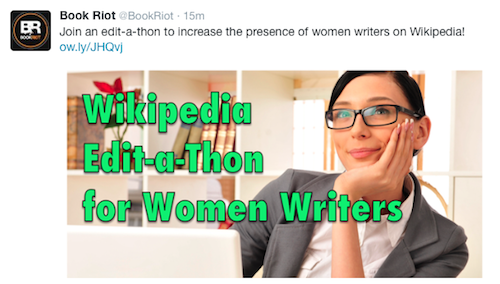
Yes, there are far fewer female editors than male on Wikipedia.
Why? Oops, can't call it "discrimination!" -- since it's a voluntary job.
What I want to know is why people so often feel compelled to push women into jobs they show no interest in taking -- as if pushing them into these jobs is a good thing.
"Blah, Blah, Blah, Pickles, Tomato, Because We Say So": The Language The Government Uses To (Legally) Steal From Citizens
The point is, the government can say just about anything to steal your money as long as they contend that it is proceeds from a crime -- even if they have zero proof of any such thing. That's right. ZERO.
Oh, and they don't like to use the word "steal." "Civil asset forfeiture" sounds so much nicer.
And yes, in a case where the poor victim tries to fight back, it does help to have a cooperative judge, and that's exactly what they have in the Kim Dotcom case. (Dotcom is the founder of MegaUpload.)
Mike Masnick writes at TechDirt:
Back in November, the DOJ argued that it should get to keep all of Kim Dotcom's money and stuff because he's a "fugitive," which is a bizarre and ridiculous way to portray Kim Dotcom, who has been going through a long and protracted legal process over his potential extradition from New Zealand (though he's offered to come to the US willingly if the government lets him mount a real defense by releasing his money). Dotcom's lawyers told the court that it's ridiculous to call him a fugitive, but it appears that Judge Liam O'Grady didn't buy it.In a ruling that was just posted a little while ago, O'Grady sided with the government, and gave the DOJ all of Dotcom's things. You can read the full reasoning here and it seems to take on some troubling logic. Dotcom's lawyers pointed out, as many of us have, that there is no secondary copyright infringement under criminal law, but the judge insists that there's enough to show "conspiracy to commit copyright infringement." But the reasoning here is bizarre. Part of it is the fact that Megaupload did remove links to infringing content from its top 100 downloads list. To me, that seems like evidence of the company being a good actor in the space, and not trying to serve up more infringing downloads. To Judge O'Grady and the DOJ, it's somehow evidence of a conspiracy. No joke.
Oh, and Paypal's cutting off Dotcom's new site, Mega -- that didn't just occur to the Paypal execs one day out of the blue. Also from Masnick at Techdirt:
This all goes back to this dangerous effort by the White House a few years ago to set up these "voluntary agreements" in which payment companies would agree to cut off service to sites that the entertainment industry declared "bad." There's no due process. There's no adjudication. There's just one industry getting to declare websites it doesn't like as "bad" and all payment companies refusing to serve it. This seems like a pretty big problem.
Loopy
Crazy-tired links.
Indoctrinating Men That They Are Criminals By Virtue Of Being Male
Last month, I saw this bit I've pasted in below, and I forgot to do a blog post on it then, but it's worth taking a look at.
It's an example of how the push for "equality" has become a push for unearned power over men -- and, in the process, a way to squash the less-than-alpha males into terrified eunuchs. Scott Aronson commented on his blog, excerpted here:
I spent my formative years--basically, from the age of 12 until my mid-20s--feeling not "entitled," not "privileged," but terrified. I was terrified that one of my female classmates would somehow find out that I sexually desired her, and that the instant she did, I would be scorned, laughed at, called a creep and a weirdo, maybe even expelled from school or sent to prison. You can call that my personal psychological problem if you want, but it was strongly reinforced by everything I picked up from my environment: to take one example, the sexual-assault prevention workshops we had to attend regularly as undergrads, with their endless lists of all the forms of human interaction that "might be" sexual harassment or assault, and their refusal, ever, to specify anything that definitely wouldn't be sexual harassment or assault. I left each of those workshops with enough fresh paranoia and self-hatred to last me through another year.My recurring fantasy, through this period, was to have been born a woman, or a gay man, or best of all, completely asexual, so that I could simply devote my life to math, like my hero Paul Erdös did. Anything, really, other than the curse of having been born a heterosexual male, which for me, meant being consumed by desires that one couldn't act on or even admit without running the risk of becoming an objectifier or a stalker or a harasser or some other creature of the darkness.
Of course, I was smart enough to realize that maybe this was silly, maybe I was overanalyzing things. So I scoured the feminist literature for any statement to the effect that my fears were as silly as I hoped they were. But I didn't find any. On the contrary: I found reams of text about how even the most ordinary male/female interactions are filled with "microaggressions," and how even the most "enlightened" males--especially the most "enlightened" males, in fact--are filled with hidden entitlement and privilege and a propensity to sexual violence that could burst forth at any moment.
Because of my fears--my fears of being "outed" as a nerdy heterosexual male, and therefore as a potential creep or sex criminal--I had constant suicidal thoughts. As Bertrand Russell wrote of his own adolescence: "I was put off from suicide only by the desire to learn more mathematics."
At one point, I actually begged a psychiatrist to prescribe drugs that would chemically castrate me (I had researched which ones), because a life of mathematical asceticism was the only future that I could imagine for myself. The psychiatrist refused to prescribe them, but he also couldn't suggest any alternative: my case genuinely stumped him. As well it might--for in some sense, there was nothing "wrong" with me. In a different social context--for example, that of my great-grandparents in the shtetl--I would have gotten married at an early age and been completely fine. (And after a decade of being coy about it, I suppose I've finally revealed the meaning of this blog's title.) [...]
Now, the whole time I was struggling with this, I was also fighting a second battle: to maintain the liberal, enlightened, feminist ideals that I had held since childhood, against a powerful current pulling me away from them. I reminded myself, every day, that no, there's no conspiracy to make the world a hell for shy male nerds. There are only individual women and men trying to play the cards they're dealt, and the confluence of their interests sometimes leads to crappy outcomes. No woman "owes" male nerds anything; no woman deserves blame if she prefers the Neanderthals; everyone's free choice demands respect.
That I managed to climb out of the pit with my feminist beliefs mostly intact, you might call a triumph of abstract reason over experience. But I hope you now understand why I might feel "only" 97% on board with the program of feminism.
A Boy And My Dog
"Detroit-ornery" boyfriend, babysitting my wee dog, pretends to not be huge pushover: "I'm putting my foot down!" Mmhmm. Sure. 
"Eat The Rich!" Another Science Day In Long Beach
One of my tweets from yesterday, from the evolutionary psychology pre-conference at the Society for Personality and Social Psychology conference in Long Beach:
Daniel Sznycer #SPSP2015 points out common societal irrationality against the rich: "...as if the poor are poor because the rich are rich."
As for the evolutionary origins of this thinking, Sznycer and his colleagues at UCSB do some very interesting work, and a number of his papers can be accessed at the link (on his name). Here's one -- on attitudes toward welfare. (And read the paper -- don't leap to the conclusion that he's a pusher of "progressive" ideology [or any ideology] just because he's an academic.)
Lunkie
Big, oafy links.
Science Day In Long Beach: "Are Breastfeeding Moms Bitchier When Threatened?" And Other Questions
I'm at the Society for Personality and Social Psychology conference in Long Beach.
Today is the evolutionary psychology pre-conference.
I got here a little late (as I parked at the convention center and then took what I was told by a parking dude was a "two block walk" to the Hilton, which turned out to be two rural blocks, as in, about 15 long city blocks. Grrr.).
I did catch a bit of the end of Jennifer Hahn-Holbrook's talk on breastfeeding. Here's my tweet about a bit of it:
Breastfeeders fiercer! #SPSP2015 Jennifer Hahn-Holbrook: Breastfeeding moms inflicted more punishment on "hostile confederates" than did formula feeders
Hahn-Holbrook's whole talk was on a fascinating subject: "Does breastfeeding offer protection against maternal depressive symptomatology?" And you can read it here.
Here's the abstract:
Mothers who breastfeed typically exhibit lower levels of depressive symptomatology than mothers who do not. However, very few studies have investigated the directionality of this relationship. Of the prospective studies published, all but one focus exclusively on whether maternal depression reduces rates of subsequent breastfeeding. This study again examines this relationship, but also the reverse--that breastfeeding might pre- dict lower levels of later depression.Using multilevel modeling, we investigated the relationship between breastfeeding and self- reported depressive symptomatology in 205 women followed prenatally and at 3, 6, 12, and 24 months after birth.
Consistent with previous research, women with prenatal depressive symp- tomatology weaned their infants 2.3 months earlier, on average, than women without such symptomatology. We also found, however, that women who breastfed more frequently at 3 months postpartum showed greater subsequent declines in depressive symptomatology over time compared to women who breastfed less frequently, resulting in lower absolute levels of depressive symptoms by 24 months postpartum, controlling for important confounds.
In sum, these findings are consistent with a bidi- rectional association between breastfeeding and depression, with prenatal depression predicting less breastfeeding soon after birth and breastfeeding predicting declines in maternal depression up to 2 years after birth.
Zendaya Coleman's Hair: Not Being Able To Criticize A Certain Group Of People Is Racism
Fashion Police is the show on E! Joan Rivers used to be on.
To say the remarks about people's outfits and look are often caustic...well, they typically go from caustic to even more caustic.
That's what the Fashion Police is about. That's why Joan Rivers, the queen of caustic (and not, say, Elizabeth Hasselbeck) was the host.
Well, Giuliana Rancic, one of the panelists there, made a comment about the dreadlocks hairdo of Zendaya Coleman, apparently a Disney star. From Pret-a-Reporter's Hillary Lewis:
On Monday night's episode of E!'s Fashion Police, Rancic commented on Coleman's appearance at the Oscars, saying of the star, who was sporting dreadlocks, that she "smells like patchouli oil and weed." Coleman subsequently posted an eloquent statement on her social media accounts defending her hairstyle. Several other stars -- including Selma director Ava DuVernay, Scandal star Kerry Washington and The View co-host Whoopi Goldberg -- took Coleman's side. And while Rancic quickly tweeted an apology, she followed that up with a somber, much more detailed expression of contrition: a taped message that aired on Tuesday night's E! News.
If the people on a "give 'em shit" show can make fun of white people -- their hair and everything else about them -- but can't make fun of you, you are anything but equal.
This was a point made (in not so many words) by my late quadriplegic cartoonist friend John Callahan. He made fun of quadriplegics -- because it meant treating them like people, like everyone else, instead of like precious little wounded bunnies.
P.S. Another reason to miss Joan Rivers: I'm pretty sure she would have told all the critics to go suck it. Oh, and she would have said something that made Rancic's remark look like a benign compliment. Joan didn't care whether you were black, white, or whatever. She just cared whether you made a good target.
Unemployment Benefits: Perverse Incentives
Couch, meet ass.
Couch, get really, really used to ass.
Robert P. Murphy writes at the Foundation for Economic Education:
A new NBER working paper by Marcus Hagedorn, Iourii Manovskii, and Kurt Mitman estimates that the abrupt end of unemployment benefit extensions led to 1.8 million additional new US jobs created in 2014.The theory here is straightforward: when the government subsidizes an activity, other things equal, people will engage in more of it.
If politicians want to encourage more people to go to college, what do they do? Provide financial support, either directly in the form of tuition assistance, or indirectly through loans with lower interest rates than students could obtain in a free market. If politicians want to encourage people to reduce their consumption of fossil fuels, they might offer tax rebates for the purchase of electric cars or insulation in their homes.
By the same token, then, suppose that politicians wanted to encourage laid-off workers to refrain from accepting a new job. What would they do? Naturally, they would offer to send the jobless workers checks so long as they remained unemployed.
Burpee
Tomato-flavored links.
Stop Feeling So Dim (Like I Did) Every Time "Net Neutrality" Comes Up
I somehow never had time (and never cared enough to make time) to figure it out. Finally, though, somebody did all the necessary work, and all I had to do was read it.
It's a great Mike Masnick post at Techdirt that explains "Net Neutrality" in actual simple English. An excerpt:
What is net neutrality?This is not an easy answer, actually, which, at times, is a part of the problem. The phrase, first coined by law professor Tim Wu, referred originally to the concept of the end-to-end principle of the internet, in that anyone online could request a webpage or information from any online service, and the internet access provider (usually called internet service providers or ISPs) in the middle would deliver that information. At the time, the ISPs were starting to make noises about how they wanted to "charge" service providers to reach end users, effectively setting up toll booths on the internet. This kicked off in earnest in October of 2005, when SBC (which became AT&T) CEO Ed Whitacre declared that internet companies were using "his pipes for free."
The phrase has been warped and twisted in various directions over the years, but the simplest way to think about it is basically whether or not your ISP -- the company you pay for your internet access (usually cable, DSL or fiber, but also wireless, satellite and a few others) -- can pick winners and losers by requiring certain companies to pay the ISP more just to be available to you (or available to you in a "better" way). John Oliver probably summarized it best by arguing that it's about "preventing cable company fuckery" (though, to be clear, it goes beyond just cable companies).
The internet access providers claim that service providers, like Netflix and Google, are getting a "free ride" on their network, since those services are popular with their users, and they'd like to get those (very successful) companies to pay.
Wait, so internet companies don't pay for bandwidth?
They absolutely do pay for their bandwidth. And here's the tricky part of this whole thing. Everyone already pays for their own bandwidth. You pay your access provider, and the big internet companies pay for their bandwidth as well. And what you pay for is your ability to reach all those sites on the internet. What the internet access providers are trying to do is to get everyone to pay twice. That is, you pay for your bandwidth, and then they want, say, Netflix, to pay again for the bandwidth you already paid for, so that Netflix can reach you. This is under the false belief that when you buy internet service from your internet access provider, you haven't bought with it the ability to reach sites on the internet. The big telcos and cable companies want to pretend you've only bought access to the edge of their network, and then internet sites should have to pay extra to become available to you. In fact, they've been rather explicit about this. Back in 2006, AT&T's Ed Whitacre stated it clearly: "I think the content providers should be paying for the use of the network - obviously not the piece for the customer to the network, which has already been paid for by the customer in internet access fees, but for accessing the so-called internet cloud." In short, the broadband players would like to believe that when you pay your bandwidth, you're only paying from your access point to their router. It's a ridiculous view of the world, somewhat akin to pretending the earth is still flat and at the center of the universe, but in this case, the broadband players pretend that they're at the center of the universe.
"The American Gulag"
That's how radio host Mitch Berg put it on his blog, and he's right.
There's a secret interrogation facility where Chicago police "disappear" Americans, "rendering Americans unable to be found by family or attorneys while locked inside what lawyers say is the domestic equivalent of a CIA black site," writes Spencer Ackerman for The Guardian:
The facility, a nondescript warehouse on Chicago's west side known as Homan Square, has long been the scene of secretive work by special police units. Interviews with local attorneys and one protester who spent the better part of a day shackled in Homan Square describe operations that deny access to basic constitutional rights.Alleged police practices at Homan Square, according to those familiar with the facility who spoke out to the Guardian after its investigation into Chicago police abuse, include:
•Keeping arrestees out of official booking databases.
•Beating by police, resulting in head wounds.
•Shackling for prolonged periods.
•Denying attorneys access to the "secure" facility.
•Holding people without legal counsel for between 12 and 24 hours, including people as young as 15.At least one man was found unresponsive in a Homan Square "interview room" and later pronounced dead.
...Unlike a precinct, no one taken to Homan Square is said to be booked. Witnesses, suspects or other Chicagoans who end up inside do not appear to have a public, searchable record entered into a database indicating where they are, as happens when someone is booked at a precinct. Lawyers and relatives insist there is no way of finding their whereabouts. Those lawyers who have attempted to gain access to Homan Square are most often turned away, even as their clients remain in custody inside.
"It's sort of an open secret among attorneys that regularly make police station visits, this place - if you can't find a client in the system, odds are they're there," said Chicago lawyer Julia Bartmes.
Chicago civil-rights attorney Flint Taylor said Homan Square represented a routinization of a notorious practice in local police work that violates the fifth and sixth amendments of the constitution.
"This Homan Square revelation seems to me to be an institutionalization of the practice that dates back more than 40 years," Taylor said, "of violating a suspect or witness' rights to a lawyer and not to be physically or otherwise coerced into giving a statement."
I'm with Berg -- not that I spend "tourist dollar(s)" in Chicago. But see the latter bit of that line from Berg:
Much as I love Chicago, I won't spend another tourist dollar there until those responsible for Homan Square are frog-walked out of their offices and put into Federal custody.And it'll be interesting to see what other such places pop up around the country.
This is what we get in the wake of all the Americans going so quietly and politely as their Fourth Amendment rights were taken from them by TSA thugs at the airport. What all of you who did that without complaint told the bureaucracy and the police-ocracy is that they can get away with it. And to keep doing what they're doing and go a little further and a little further.
Secretary Of Veterans Affairs Invents Time Spent In The Special Forces
Seems like he should be specially forced to give up his position.
From the LAT editorial board:
Really? The secretary of Veterans Affairs? Surely there is no one who should better understand how offensive it is to lie about one's military service than the secretary of Veterans Affairs. Yet that's exactly what Robert McDonald did the night he participated in the Greater Los Angeles Homeless Count in January. While chatting with a homeless man on skid row who said he had served in the elite special forces, McDonald responded, "Special forces? What years? I was in special forces."In fact, McDonald, who graduated from West Point and did serve in the Army's 82nd Airborne Division, was never a member of special forces. This week, he apologized, telling the Huffington Post, which first reported his false claim, that he "reacted spontaneously." The White House described his claim as a "misstatement" and said McDonald "never intended to misrepresent his military service."
The guy lied. To a vet. Just made shit up.
I just love the LA Times viewpoint:
In his defense, McDonald didn't go as far as some others have. He didn't repeat the untruth over and over or peddle it on his resume. He didn't wear a medal or decoration he didn't earn...
He also didn't murder a family of four. This doesn't make him unguilty of lying. Right in a vet's face.
Stupid-Ass California Plastic Bag Ban Suspended
The bag ban is a lesson in unintended consequences.
Judy Lin writes for the AP about the annoying plastic bag ban at stores in California:
A trade group has turned in enough signatures to qualify a referendum on California's plastic bag ban law, suspending implementation of the nation's first statewide ban until voters weigh in on the November 2016 ballot, state elections officials said Tuesday.
How 'bout the supposed benefits of that bag ban? From Reason Foundation, Julian Morris and Lance Christensen write:
The premise of these laws is to benefit the environment and reduce municipal costs. In practice, the opposite is more likely to be the case....The available evidence suggests that it will do nothing to protect the environment; quite the opposite, it will waste resources and cost Californian consumers billions of dollars. Specifically, such legislation will:
•Have practically no impact on the amount of litter generated (moreover, while banning plastic bags at small retailers might reduce plastic bag litter by 0.5%, banning the distribution of HDPE plastic bags by large retailers is unlikely to have any impact even on the amount of HDPE plastic bag litter produced.)
•Have no discernible impact on the amount of plastic in the ocean or on the number of marine animals harmed by debris;
•Increase the use of oil and other non-renewable energy resources, including coal and natural gas;
•Result in five-fold or greater increase in the shopping bag-related use of water;
•Make little or no difference to the costs of municipal waste management;
•Impose enormous costs on California's consumers, likely over $1 billion in both direct and indirect costs (such as time spent washing reusable bags).
A bit from the details -- about the claim that plastic bags are clogging storm drains:
Proponents of plastic bag bans claim the bags clog storm drains, but a comprehensive 2009 survey by Keep America Beautiful found that plastic bags of all kinds represented just less than 1% of visible litter items in storm drains.2 By contrast, as Figure 1 shows, plastic drink containers represented about 2% and other plastic items represented over 10%.3 Clearly, banning plastic bags would do little to reduce the problem of clogged storm drains, so attention should instead focus on ways to reduce the production of litter of all kinds--or mitigate its effects.
Unfortunately, the bag ban passed by idiots in LA will stay in effect. Does this mean that I'll litter less? I never littered in the first place. What it means is that I buy less at the liquor store when I go there for half 'n' half and realize I could get something else -- but I'd have to pay for a bag.
From that link above in the LA Times' Patrick McGreevy piece, follow the money:
SB 270 by former Sen. Alex Padilla (D-Pacoima) would allow grocers to charge 10 cents for reusable plastic or paper bags to shoppers who do not bring their own to the store.The alliance of bag makers argued that the real purpose of the law was to enrich supermarket chains and other retailers through collection of the 10-cent fee.
The opponents said it was untrue that the plastic bags provided by supermarkets are single-use because many consumers use them again to line trash cans, pick up waste left by their pets or carry lunches to work.
"SB 270 was never a bill about the environment," Califf said. "It was a backroom deal between the California Grocers Association and their union friends to scam consumers out of billions of dollars in bag fees - all under the guise of environmentalism.
Clunkie
Linkie with clunks.
Listen To Me On Today's Adam Carolla Podcast (Taped Yesterday) I talked about Ramblers (a little), manners and "Good Manners for Nice People Who Sometimes Say F*ck" (a lot), and jumped in here and there on the news.
Do give a listen! Here's the link.
And if you have yet to buy my book, please buy one now!
The Insulting And Unfair Practice Of Affirmative Action
As it's oh, so euphemistically put in the LA Times subhead, Asian Americans are "learning to deal with diversity" in the "changing landscape of college admissions."
In common language, they're getting fucked -- hard -- by affirmative action.
Frank Shyong reports on a college admissions information session led by a woman named Anna Lee at an Arcadia tutoring center:
Her primer on college admissions begins with the basics: application deadlines, the relative virtues of the SAT versus the ACT and how many Advanced Placement tests to take.Then she eases into a potentially incendiary topic -- one that many counselors like her have learned they cannot avoid.
"Let's talk about Asians," she says.
Lee's next slide shows three columns of numbers from a Princeton University study that tried to measure how race and ethnicity affect admissions by using SAT scores as a benchmark. It uses the term "bonus" to describe how many extra SAT points an applicant's race is worth. She points to the first column.
African Americans received a "bonus" of 230 points, Lee says.
"Hispanics received a bonus of 185 points."
The last column draws gasps.
Asian Americans, Lee says, are penalized by 50 points -- in other words, they had to do that much better to win admission.
"Do Asians need higher test scores? Is it harder for Asians to get into college? The answer is yes," Lee says.
How awful and unfair -- and unfair and insulting to black students who have legitimately earned their way into a place in college, only to be assumed to have been given the special "black person bonus."
Personally, I'm for a more Martin Luther King approach to admissions -- judging somebody by apparent the content of their character, their past performance in school, and their likelihood of making it in college.
Sadly, many who are admitted to schools when it's unwarranted by their tests scores or past performance tend to be left with huge student loans to pay back -- and no diploma -- after they crash and burn in an environment they were never ready to be in.
Cognitive Miser-hood?
Answer to the question of "Why do (some) geniuses behave like jerks?"
I would also say, "Because they can."
And the other answer is, geniuses aren't geniuses across the spectrum, and we forget that.
From To Put It Bluntly, via Gog:
In 1990, after 25 years of marriage to the devoted Jane Wilde, Hawking informed her that he was flying to America with Elaine Mason, his therapist. He has long since left the therapist for whom he left his wife.There is also jerkiness unmentioned in the film, but widely known. In May 2013, Hawking, after initially accepting an invitation to speak at the President's Conference organized to mark the 90th birthday of Shimon Peres, changed his mind and declared that he would not participate in any academic or cultural exchanges with Israel. He announced his support for the BDS - boycott, divestment, and sanctions - movement.
Now there are many reasons why ordinary people should oppose BDS. First, Israel, whatever its faults, is the lone democracy committed to individual rights in the Middle East, and therefore deserves support, not isolation. Second, Israeli Arabs and Palestinians have greater freedom to protest and greater access to independent courts than any other Muslims in the Middle East. It makes no sense to boycott Israel and give a pass to the oppressive regimes ruling Syria, Iran, or Turkey, to name a few. Third, those attending international cultural and academic events tend to be the very Israelis most opposed to their government's policies. BDS, ironically, undermines the Israelis most committed to change and entrenches those most resistant.Genius
But these are reasons for ordinary people. Stephen Hawking is not an ordinary person. He has an added reason to oppose BDS. Hawking suffers from ALS, which has left him unable to utilize any muscles functions except for his cheeks, whose movement is monitored by a sensor attached to his spectacles. He sole means of communication is through a computer Intel Core i7-based communication system, which runs on a chip designed in Israel.
If BDS were universally adopted, as Hawking wishes, the very technology he relies upon to communicate would be unavailable to him. Hawking, a supposed champion of logic, thus takes the absurdly illogical position of opposing the same kind of exchange that allows him to communicate his opposition in the first place.
A first grader would blush at the internal inconsistency of such a position.
For the vast chasms in the rationality of Hawking and others we perceive to be geniuses, University of Toronto Professor Emeritus Keith Stanovich blames a cognitive bias which he calls "dysrationalia." In short, as Bluntly puts it, "smart people, including geniuses, are disinclined to think too much."
I've talked about how "expensive" the brain is in terms of its energy needs and use on my radio show, and this is one explanation.
But maybe our perception is the big problem -- perception that the genius is a genius across domains:
The difficulty becomes acute when the genius encounters a problem outside his ken. Hawking never acted like a jerk when he was dealing with physics, just as Chomsky was sensible when the topic was linguistics, and Fischer was sane when the arena was chess. Once outside their zones of expertise, they could have and should have assumed an air of modest ignorance.But no. For them, a genius must always be a genius. He must swing for the fences, rather than hit to get on base. And when one swings for the fences, one is more likely to strike out. And the harder the swing, the more ridiculous the batter - or thinker - looks when his bat hits nothing but empty air.
The Dumbest Thing Is Continuing Prohibition -- Just For A Certain Age Group
As I and other grumble, you can go die for your country at 18, yet in some states, you can't legally drink a beer.
What we can't have, we always want more -- and this is likely so many on campuses drink like they'll never get a drink again.
I credit my parents -- especially my dad -- for my moderate drinking. I think I once accidentally got drunk at college (because somebody's frozen drinks were tasty), but it really didn't have a lot of interest for me.
Well, now, as a side-effect of our dumb drinking laws, a bunch of students are in trouble after the fake IDs they ordered from China went to the college dean instead of a student named "Dean." (Sounds like they also share a last name.)
From Philly.com, Mari A. Schaefer writes:
The incident came to light when the unidentified dean opened a package from Guangzhou, China, that contained a small lime-green picture frame. Further examination discovered eight realistic - but fraudulent - identification cards made for four 18-year-old male students inside the back cover. The dean contacted authorities.The false identification cards, looking very much like official documents from Maryland and Connecticut, were to be used to get into bars, said Lt. Christopher Flanagan of Radnor police.
Police are not identifying the students or the university, Flanagan said. Villanova University, Cabrini College, Eastern University, and Valley Forge Military Academy and College are all in the township.
"It's more than underage drinking," Flanagan said.
Similar high-quality identification cards have been used in other crimes, including credit card or check fraud, and forgery. Flanagan said such documents can also be used to fill out credit card applications, as identification in scams on the elderly, and occasionally in terroristic crimes.
Oh, please.
They can also be used to pick your teeth or scrape your windshield, but I'm guessing students just want to be a little less impeded in getting a keg or a six-pack.
More from the story:
The students have been offered counseling, and they could face sanctions for violating school codes, Flanagan said.
Counseling? What a crapload.
Here's counseling: Next time you order a fake ID, suss out whether you're buying it from a total dipshit who's too cheap and stupid to get an off-campus mailbox.
via @adamkissel
Loopy
Linky in figure-eights.
Genius Chicago Cabbies Protest Uber By Going On Strike -- Forcing People To Take Uber
From CBS Chicago, a bunch of cabbies staged a protest on Chicago's Loop by driving around for four hours and refusing to pickup fares. And by honking. (My take: the sound of "Honk if you love Uber!")
Dozens of cabs drive in circles around City Hall and the Daley Center for more than an hour, honking their horns to draw attention. Many cabbies had posted protest signs in their windows, accusing Uber of stealing their customers."It's good music to my ears," said cab driver Rocky Mmomo, a steering committee member of the United Taxidrivers Community Council. Mmomo said cabbies want the tax industry deregulated, so it can better compete with Uber and the other ride-sharing companies.
They rather reasonably are now upset at big government -- pissed off at the regulations that have been forced on them. For passenger safety? More for government funding:
The cabbies want the city to do away with chauffeur licenses required for taxi drivers, biannual city safety inspections required for all cabs, and medallions required to operate a cab company. A city medallion costs up to $375,000."We have 12,000 drivers who are suffering, because of the invasion of Uber, and UberX, and Lyft into the streets of Chicago; and that was as a result of the lack of regulation from the city of Chicago," UTCC chairman Fayez Khozindar said at a City Hall news conference.
Cab drivers have said, because regulations on ride-sharing companies are much less restrictive, it's very difficult for cab drivers to compete.
"We'll be sitting at a hotel for two, three hours; and all of a sudden you see three UberX cabs just came and picked up customers while we're just sitting there. How is that fair? That's not fair to a cab driver," cab driver Mustafa Husein said.
Hmm, depends what your definition of "fair" is.
It's fair to the passenger -- who saves money and could have chosen a cab but wants an Uber driver.
The case here is similar to the government's prohibition on my eating, say, unpasteurized cheese -- which I want to do. I would be the decider -- as a functioning adult -- in whether I am willing to take that risk. Why should the government get to decide what I can put in my stomach?
I'm staying in an AirBnB place soon. I'll pay less than half of what I'd pay in a hotel and I have a refrigerator and stove. The guy who owns the place seems great. As was the friendly guy who drove Gregg home ("Dave in the Ford Focus") when he took Uber back from my place. Dave has an interest in maintaining his car because he's driving in it and surely doesn't want to die or be maimed, and cars and drivers are rated by passengers.
I like the "sharing" economy and I choose to participate in it, as do many people. Government shouldn't meddle in that.
ISIS Militants Pledge To Throw Gays Off Leaning Tower Of "Pizza"
"We'll get you -- and your little dog, Pepperoni, too!" they were heard to yell.
Okay, I made that part up. But as reported by PinkNews, in keeping with Islam's commands to slaughter gays, somebody manning an IS-run Twitter account warned:
"#We_Are_Coming_O_Rome, we will conquer and establish the justice of #shariah. We will use your leaning tower of pizza to throw off homosexual
The group were seemingly unaware both that they had misspelled "Leaning Tower of Pisa", and that the tower is actually located in the town of Pisa, nearly 200 miles from Rome.
Rather than succumb to the threats, a number of Rome residents are instead giving the group travel advice, given the city's notoriously poor transport network.
Loved some of these tweets -- and the cute fractured English:
@alessioconte28
#We_Are_Coming_O_Rome ahahah Be careful on the highway-Ring Road: there's too much traffic, you would remain trapped!@Giu_DiChiara
#We_Are_Coming_O_Rome hey just a tip: don't come in train, it's every time late!
Although this is kind of funny, the reality for gays in Islamic countries is not. Here are Quranic references and Islam's position on homosexuality from the terrific site thereligionofpeace.com.
In short:
Homosexuals have been beheaded, hung and stoned in modern Saudi Arabia and Iran, where Muhammad's laws are applied most strictly. Five other Muslim countries also have the death penalty on their books for homosexual behavior. In the past, gays were burned as well. As one cleric recently put it, the only point of theological debate is over how the offender should be killed.
Meanwhile, back at the (Jewish) ranch...
Oh, and in more European hilarity, Swedish Television's former expert on "Islamophobia" has gone to Syria join in the genocide, mass rape, and all the other fun of ISIS.
What's Wrong With America's Economy -- As Told In Hair Braids
There aren't just ridiculous occupational requirements, there are pointless educational ones for people in various professions -- professions that really don't need any state meddling in the form of "licensing."
Nick Sibilla writes at Forbes about state licensing for the occupation of hair braiding for black women -- one of the many battles the Institute for Justice has taken up about occupational licensing.
And really...I get it if you're a doctor -- we don't want just any guy with a bottle of rubbing alcohol and a saw to hang out a shingle. But, as for many other professions, you can see how what the state is most interested in is the source of funding that comes from "regulating" an industry. And then there's the problem of competition -- established people in a business use "licensing" to keep newcomers out by setting up numerous ridiculous hurdles. Take Isis Brantley's case:
Isis Brantley has been arrested, jailed and a plaintiff in a federal civil rights case. But she's not a whistleblower or a political dissident.She teaches how to braid hair.
For almost 20 years, Isis has fought Texas over her right to braid hair and to pass on her knowledge to others. Her struggle recently culminated in a major federal court decision earlier this month, which shined a spotlight on occupational licensing. Today, millions of Americans, like Isis, have to seek permission from the government--or fight back--before they can do their jobs.
...After a decade of fighting for reform, in 2007, Texas acquiesced and created a separate, 35-hour hair-braiding certificate. The state "grandfathered" Isis in, and honored her as the first natural-hair-care expert in the state. Finally, Isis could legally braid hair for a living.
Unfortunately, that reform didn't apply to teaching hair braiding. In Texas, braiding schools were regulated as barber colleges. So despite her decades of experience, Isis would have had to spend about $25,000 to comply and transform her natural hair salon into a barber college. Those changes were needed so that her teaching would satisfy the 35-hours of training students need to obtain a license in braiding.
...Thanks to the growth in occupational licensing, Isis is not alone. Licensure was once imposed only on professionals like doctors and lawyers. In the early 1950s, less than five percent of Americans needed a license to work from the government. Recent estimates put that number as high as 30 percent, as reported in a new study conducted for the Brookings Institution's Hamilton Project by Morris Kleiner, a professor at the University of Minnesota. Moreover, according to a wide-ranging 2012 report on licensing by the Institute for Justice, occupational licenses affect many low-income or low-skilled occupations, which in turn have a greater proportion of African-American and Hispanic workers.
Occupational licensing is typically defended as a way to protect consumers and ensure quality practitioners. But many licensing requirements are just downright baffling. In Isis' case, Texas wanted her braiding school, the Institute for Ancestral Braiding, to have a minimum of 2,000 square feet of floor space (more than twice the size of her current facility); install at least 10 barber chairs, (even though braiders don't cut hair); and have at least five sinks, despite the fact that "the state makes it illegal for hair braiders to provide services that require a sink." The regulations were so strict, Texas couldn't name a single school that taught only the natural hair-braiding curriculum and complied with the state's barber regulations.
In 24 states, hair braiders need more training than emergency medical technicians. Completing the necessary coursework in one of these 24 states can cost upwards of $20,000 and requires up to 2,100 hours of training. By comparison, EMTs need, on average, about 140 hours for their licenses.
via @JHartEllis @IJ
Lunchie
Linkie with a Snack Pack.
Your "Golden Years" Shouldn't Seem So Much Like Prison
Anthony L. Fisher writes at reason about elder care and how regulations and fear of lawsuits prevent nursing homes from allowing patients basic autonomy:
You wake up in an institution and are ordered out of bed. Though you would much rather sleep in for a bit, you have no right to dictate your own schedule. You are marched to a sterile, cold room where you will be served food you don't want to eat, seated at a communal table with people who don't want to be there any more than you do. Nearly all the activities that will make up the rest of your day will proceed in similar fashion, until "lights out" is called and you are commanded to a lonely slumber. With each passing day you are plagued by loneliness, helplessness, and boredom. This is all done in the name of your safety and security, not as punishment. You are not a prisoner; you are a "resident" of a nursing home....Over 1.3 million Americans live in nursing homes, but thanks to byzantine regulations designed to mitigate any risk to the physical health of residents (which take little consideration of the mental health of those same residents), many nursing homes can resemble minimum security prisons.
In response, The Eden Alternative, a Rochester, New York-based non-profit, has for two decades sought to de-emphasize "top-down, bureaucratic authority, seeking instead to place the maximum possible decision-making authority into the hands of the Elders or into the hands of those closest to them."
The Eden Alternative's CEO, Christopher Perna, told me in a phone interview, "It's almost militaristic, the way many nursing homes are run, where the administration is the top dog. They make all the decisions and the staff basically do as they're told." He adds, "it's very easy to settle into a series of institutional practices that keep you within boundaries that are defined by the government. It can lead to a very sterile, very lifeless environment."
...Kapp adds, "requirements that beds must be placed only within certain spaces in a resident's room make it impossible for residents to rearrange their furniture as they wish. Regulatory prohibitions on open kitchens prevent residents from fixing snacks whenever they wish. If we are serious about making nursing homes more comfortable and homelike, a review of existing regulations and amendment or removal of those regulations that impede culture change must be put into place."
For his part, Perna says that for the past 20 years, he has worked with nursing homes to venture as far they can into the "grey areas" of regulations. His goal is to help "reinstitute a degree of autonomy" for both their seniors and their caretakers, which he says "is just a crucial factor for quality of life." Perna adds, "if residents want to sleep in in the morning, let them sleep in. If they want to be an early riser, let them wake up early. If they go to bed early, let them go to bed early. If they like to be a night owl, let them be a night owl. And adapt the organization and staffing approaches to the needs of the elders."
Feeling a sense of control over your life -- down to the smallest measures -- is essential to our well-being. A system that takes that away is not caring for people; it's destroying them, just in a slow way, and while calling that "protecting" them.
As Fisher writes:
Only true regulatory reform, with policies that allow for residents and care providers to assume a reasonable amount of risk, will prevent predatory lawsuits from holding nursing homes hostage, and facilitate a widespread cultural shift in elder care.You've lived a long life, you've paid your taxes. The least you deserve is the right to arrange your room the way you like it, and occasionally make a snack without official permission from an officious authority figure.
Advice Goddess Free Swim
It's Saturday night, and I'm sleepy. You pick the topics. I'll post more on Sunday morning.
P.S. One link per comment or my spam filter will eat your post.
Campus Sexual Assault Kangaroo Courts Are Impeding Education
The campus kangaroo courts, where some sophomore worrying about her poli sci final is deciding whether a guy accused of rape looks guilty, were ordered by the Obama administration under Title IX (tied to college funding).
They are horribly unfair -- removing due process from men -- and pulling onto campus a process that belongs in the criminal justice system.
Ashe Schow writes at Wash Ex that a bipartisan group is calling for for reform:
Department of Education regulations forcing colleges and universities to create pseudo-court systems to handle campus sexual assault are interfering with schools' core mission to educate, according to a bipartisan report from a task force for the Senate Health, Education, Labor and Pensions Committee.The report was designed to offer solutions for easing regulatory burdens on colleges, which have exploded in recent years.
"Over time, oversight of higher education by the Department of Education has expanded and evolved in ways that undermine the ability of colleges and universities to serve students and accomplish their missions," the report said. "The compliance problem is exacerbated by the sheer volume of mandates -- approximately 2,000 pages of text -- and the reality that the Department of Education issues official guidance to amend or clarify its rules at a rate of more than one document per work day."
Bureaucracy as an undermining force? What a surprise.
It's important to keep in mind the "power and money!" underpinnings of this -- all the people who have unnecessary jobs and power over a lot of other people. It is in their vested interest to continue to maintain the kangaroo courts and continue to increase the complexity of "must dos" for colleges.
And in turn, the overpaid and bloated colled administrations these days also look more necessary. Win-win -- for everyone but the student body and all the male students accused of sex crimes who get expelled after their due process rights are removed from them and they are judged guilty on standards of evidence that would never be acceptable in an actual court.
RELATED: Harvey Silverglate writes in the Boston Globe that the sexual assault panic on campuses is another in a series of panics, including the Red Scare and the (false) accusations of child molestation at day care centers in the 1980s:
The latest national hysteria over campus sexual assault combines aspects of its predecessors: the salacious outrage that characterized the daycare sex panic and the dubious federal stamp of approval that made McCarthyism's excesses so dangerous. Spectacular -- but widely disputed -- statistics are touted: 1 in 5 women is sexually assaulted in college, 1 in 3 male students is a potential rapist. The rhetoric popularized by mattress protests and awareness documentaries is a simple one: "Believe the accuser!"The idea that college campuses are among the most dangerous places for young American women has become so pervasive that when Rolling Stone published one woman's outlandish account of a brutal gang rape in a University of Virginia fraternity house (a story later proven to be inaccurate on the basis of investigative reporting by The Washington Post), readers swallowed the tale unquestioningly. Finally, the campus disciplinary boards -- woefully lacking in even basic standards of due process -- are vowing to adjudicate these ostensibly violent felonies and reflexively punishing virtually all who are accused.
Acquaintance or "date rape" is a serious and historically under-enforced offense in the criminal justice system. Sexual violence against women -- against anyone -- cannot be tolerated. But it's also true that college campuses are hotbeds of alcohol abuse and sexual activity among young adults often inexperienced with both. Alcohol-fueled and often ambiguous sexual encounters may result in emotional injury. But if the problem is young people's inability to recognize and respect boundaries, the solution is not to punish a wide range of campus behaviors that would be legally acceptable in the "real world."
What's more, the definition of "sexual assault" has become so broad as to encompass nearly all romantic contact. A sexual advance is considered "unwelcome" on subjective, rather than objective, grounds. In other words, if a complainant feels she was violated, then she was. This rationale is the basis for "affirmative consent" (colloquially known as "yes means yes") laws, which several states have imposed upon their campuses. Ezra Klein, editor-in-chief of Vox.com and a supporter of California's "yes means yes" law, admits the law overreaches and that under affirmative consent, "too much counts as sexual assault." Even so, Klein believes that the innocent men (and occasionally women) who will be thrown out of school are necessary sacrifices to the greater cause of combatting sexual assault on campus. Rhetoric and ideology have overtaken rationality and fairness.
Not A Fair Fight
Guy in Wasco Prison (who apparently reads my column) sent me a homemade valentine.
I show boyfriend, who was making me salmon at the time.
Boyfriend points out that it will be 10 to 20 before the competition can get to fish store.
Hmm. Good point.
The Progressive Roots Of Unfree Speech On Campus
Wendy Kaminer lays out the ridiculous conflation of physical safety and emotional safety -- and the danger -- in the WaPo. First, an example:
I described the case of a Brandeis professor disciplined for saying "wetback" while explaining its use as a pejorative. The word was replaced in the transcript by "[anti-Latin@/anti-immigrant slur]." Discussing the teaching of "Huckleberry Finn," I questioned the use of euphemisms such as "the n-word" and, in doing so, uttered that forbidden word. I described what I thought was the obvious difference between quoting a word in the context of discussing language, literature or prejudice and hurling it as an epithet.Two of the panelists challenged me. The audience of 300 to 400 people listened to our spirited, friendly debate -- and didn't appear angry or shocked. But back on campus, I was quickly branded a racist, and I was charged in the Huffington Post with committing "an explicit act of racial violence." McCartney subsequently apologized that "some students and faculty were hurt" and made to "feel unsafe" by my remarks.
Unsafe? These days, when students talk about threats to their safety and demand access to "safe spaces," they're often talking about the threat of unwelcome speech and demanding protection from the emotional disturbances sparked by unsettling ideas. It's not just rape that some women on campus fear: It's discussions of rape. At Brown University, a scheduled debate between two feminists about rape culture was criticized for, as the Brown Daily Herald put it, undermining "the University's mission to create a safe and supportive environment for survivors." In a school-wide e-mail, Brown President Christina Paxon emphasized her belief in the existence of rape culture and invited students to an alternative lecture, to be given at the same time as the debate. And the Daily Herald reported that students who feared being "attacked by the viewpoints" offered at the debate could instead "find a safe space" among "sexual assault peer educators, women peer counselors and staff" during the same time slot. Presumably they all shared the same viewpoints and could be trusted not to "attack" anyone with their ideas.
As for the roots of this unfree speech movement, Kaminer points to the recovery movement, "diversity" pushers, and feminist anti-porn crusades:
In the 1980s, law professor Catharine MacKinnon and writer Andrea Dworkin showed the way, popularizing a view of free speech as a barrier to equality. These two impassioned feminists framed pornography -- its production, distribution and consumption -- as an assault on women. They devised a novel definition of pornography as a violation of women's civil rights, and championed a model anti-porn ordinance that would authorize civil actions by any woman "aggrieved" by pornography. In 1984, the city of Indianapolis adopted the measure, defining pornography as a "discriminatory practice," but it was quickly struck down in federal court as unconstitutional. "Indianapolis justifies the ordinance on the ground that pornography affects thoughts," the court noted. "This is thought control."So MacKinnnon and Dworkin lost that battle, but their successors are winning the war. Their view of allegedly offensive or demeaning speech as a civil rights violation, and their conflation of words and actions, have helped shape campus speech and harassment codes and nurtured progressive hostility toward free speech.
Monkeys
Uncle links.
My Fantasy For Rude People
That they go to an interview and -- oops -- run into the person they gave the finger to, etc.
And it happened.
Minnesota Campus Multi-Culti Cabal: Leave Race Out Of Crime Reports
About a year ago, a guy hopped the fence of the apartment court next to my house into my yard and then vaulted over my front gate -- no easy feat, as it's six feet high.
I called the cops and described him: Black guy, about 18, with close-cropped hair, a blue backpack, and green and purplish plaid bermuda shorts.
Well, at University of Minnesota, there's one part of that that some on campus want left out -- the "black guy" part. Which is kind of like telling someone to describe me without saying I have red hair. Which would be an idiotic, twice-round-the-block and up the tree after the squirrel way of describing me.
At Campus Reform, Katherine Timpf reports that black student, staff, and faculty groups want mentions of race banished from school's crime alerts:
University of Minnesota (UM) officials are discussing a proposal which would ban any mention of race when describing a suspect in a crime alert.The officials are discussing the matter with student and faculty groups who wrote a letter to the school claiming that the use of racial descriptions in crime alerts leads to racial profiling, according to the local CBS affiliate website.
Um, it's called criminal profiling. If somebody mugs you and he's a white guy with a bandanna on his head, it helps the cops find him if they know that.
What, we're going to say to cops, "Somebody mugged me, but I refuse to tell you really salient parts of his description"? And expect them to do much more than throw up their hands and go back to the police station?
In a December 6, 2013 letter to UM President Eric Kaler and the Vice President of University Services Pamela Wheelock, several black student, faculty, and staff groups wrote that they "unanimously agree that campus safety should be of the UMPD's utmost importance; however, efforts to reduce crime should never be at the expense of our Black men, or any specific group of people likely to be targeted."
The person to target is the person who committed the crime. It's hard enough for a lot of people to remember things when under stress. To have to leave out the race of the person who did a crime to you is just ridiculous and promotes crime rather than stopping it.
A Big Boohoo For Drug Cartels As Pot Legalization Eats Away At Their Profits
As a Facebook friend put it, "Gee. Its almost as if what Nobel prize winning economists say about supply and demand is true."
"Legal US Weed Is Killing Drug Cartels" is the headline on the Jonah Bennett piece at The Daily Caller:
The growth of the U.S. marijuana industry has devastated drug cartels in Mexico, evidenced by fewer seizures of cannabis at the border and, according to Mexican security forces, a drop in total homicides and domestic marijuana production rates.Mexican drug cartels are finding it difficult to compete in the cannabis market not only in terms of price, but also quality, given that the U.S. industry is starting to label products according to THC content, CNBC reports. According to The ArcView Group, a cannabis research firm, the marijuana industry in the U.S. grew 74 percent in just one year, up from $1.5 billion in 2013 to $2.7 billion in 2014.
Marijuana from Mexico, on the other hand, is often mass-produced in less than ideal conditions, with no guarantee as to the safety of the product.
Advocates who initially pushed for legalization in Washington and Colorado have argued strenuously in the past that increased access to marijuana in the U.S. would mean a decline in drug-related violence and revenue for the cartels in Mexico.
Homicides in Mexico have dropped from 22,852 in 2011 to 15,649 as of 2014, which tracks relatively closely with the legalization of marijuana in Colorado and Washington, although the link between the two events is not conclusive.
Missing Link
If you find it, post it here.
Oopsy: Affirmative Action Demands For "Diversity" Over Merit Now Hurting Women Applying For College
The problem with people being for shutting down speech and for discrimination (for "diversity's" sake) is that it tends to come back to bite those who've demanded it in service of shutting up views they don't like or getting special treatment for their favored group of people.
That's what's happened on campus.
Libby Nelson writes at Vox that -- yes -- "Discrimination against women is a real problem in college admissions":
Two generations ago, women were in the minority in higher education. Now they're dominating it.In 1960, women earned 35 percent of all bachelor's degrees. They crossed the 50 percent mark in the late 1970s and just kept going.
Women now make up 59 percent of all college students. In 2011, they earned 62 percent of all associate degrees, 57 percent of all bachelor's degrees, and 60 percent of all master's degrees. They now even earn the majority of doctorates -- the last bastion of male domination in higher education.
Not surprisingly, all these colleges that were called to discriminate in college admissions -- to let in women and "minorities" (not including Asians) -- are now turning on the female protected class.
Discrimination against women is an open secret at some private colleges
Evidence has mounted in recent years: at some colleges, although not all, men can get in with less impressive credentials. A push for gender balance on campus means accomplished young women end up competing with each other rather than crowding out less accomplished young men.About 25 percent of admissions directors surveyed by Inside Higher Ed in 2014 said colleges should admit men with lower grades and test scores than other applicants to create a gender balance.
A 2005 study of 13 liberal arts colleges found that when women made up a majority of the application pool, admissions officers went easier on men.
Love the "Mary and Mary" remark below:
It's rare, but some admissions directors or college presidents publicly admit that they're harder on women applicants because they want a gender balance. In 2007, Henry Broaddus, the dean of admissions at the College of William and Mary, said admitting men was important because it's "the College of William and Mary, not the College of Mary and Mary." The comment went viral, and although Broaddus says he regrets the phrasing, he stands by the underlying idea: colleges "that market themselves as coed, and believe that the pedagogical experiences they provide rely in part on a coed student body, have a legitimate interest in enrolling a class that is not disproportionately male or female," he wrote in the Washington Post.In 2006, Jennifer Delahunty Britz, then the dean of admissions and financial aid at Kenyon College, wrote an op-ed in the New York Times headlined "To All the Girls I've Rejected." In the opaque world of college admissions, Britz's op-ed laid out the situation candidly: talented female applicants at Kenyon were a dime a dozen, and highly qualified male applicants were rarer. It was simply harder to get in as a young woman than a young man.
"The elephant that looms large in the middle of the room is the importance of gender balance," Britz wrote. "Should it trump the qualifications of talented young female applicants?"
I've always been disgusted by colleges deciding whether to let people in based on what is effectively "population grooming" -- populating the place with a certain number of people from this group and that.
You work hard and get good grades and have 6,000 Important Admissions Officer Impressing Activities in high school? You should get admitted to college before the preferred class currently in vogue to give a boost to.
via @NinjaEconomics
1985 NYT Article: Why Laptops Will Never Catch On
Spoiler alert (your nose snorting your drink on your keyboard, that is) -- last para:
Erik Sandberg-Diment writes in The New York Times:
WHATEVER happened to the laptop computer? Two years ago, on my flight to Las Vegas for Comdex, the annual microcomputer trade show, every second or third passenger pulled out a portable, ostensibly to work, but more likely to demonstrate an ability to keep up with the latest fad. Last year, only a couple of these computers could be seen on the fold-down trays. This year, every one of them had been replaced by the more traditional mixed drink or beer.Was the laptop dream an illusion, then? Or was the problem merely that the right combination of features for such lightweight computers had not yet materialized? The answer probably is a combination of both views. For the most part, the portable computer is a dream machine for the few.
The limitations come from what people actually do with computers, as opposed to what the marketers expect them to do. On the whole, people don't want to lug a computer with them to the beach or on a train to while away hours they would rather spend reading the sports or business section of the newspaper. Somehow, the microcomputer industry has assumed that everyone would love to have a keyboard grafted on as an extension of their fingers. It just is not so.
via @PaulHsieh
They Should Call It The "Fair" Labor Standards Act: Govt Freezes Your Assets On Mere Suspicion
Few people understand what a bully the government can be -- and we see more and more of that, with the government using the law as a club. In this story by Walter Olson, as with civil asset forfeiture, mere suspicion of wage violations is enough to get your ass in a sling, via your assets being frozen by the feds:
Under a provision of the 1938 Fair Labor Standards Act, the U.S. Department of Labor can seek what is known as a "hot goods" order, freezing the physical output of an employer that it suspects of having violated wage and hour law, all without having to prove its case at a trial.In recent years -- urged by such constituencies as labor unions, trial lawyers, and left-leaning academics -- the Obama administration has greatly stepped up its enforcement of FLSA wage-hour law. Part of that enforcement has taken the form of a revitalized use of hot-goods orders, which even defenders of its approach concede had until recently been little-known. So far the most notable result has been a federal attack on blueberry growers in the Pacific Northwest -- an onslaught high-handed enough to have been met with a stinging rebuke from a federal court last year, and which has now ended in humiliation with the dropping of charges against two growers and a refund of moneys extracted from them.
The case started in 2012 when the Labor Department told three Oregon farms it didn't think the piecework rate system they used, which paid workers for pounds picked, resulted in high enough pay for field workers. Without spelling out exactly how it had arrived at this conclusion -- an omission that would raise questions later -- it obtained a hot-goods order against them, labeling an estimated $5 million worth of fresh blueberries as contraband forbidden to enter the channels of commerce for supermarket sale, processing, or any other use. And then it offered the growers a deal: if they wanted Washington to release their crop, they would have to not only fork over a demanded cash settlement but -- this is the kicker -- agree not to appeal.
It's coercive enough to deploy the hot-goods power against a maker of steel ingots or knitted garments. But blueberries are a highly perishable crop that begins to lose value at once if not shipped. Indeed, no one could remember a case until the Obama years in which the hot-goods power had been used against agricultural produce at all, let alone one with a shelf life measured in days.
For the growers, of course, the proffered choice was no choice at all: rather than lose crops worth millions, they took the deal and agreed to pay $240,000.
It is scary how our country is, slowly but surely, starting to resemble a communist dictatorship, but with the pretense that we're still a free and free-market country (we never really were the latter, but it's a good goal).
By making the seizures and stoppages through regulations, the government pretends that it's all nice and clean. Basically, they're dressing up a kleptocracy in the fief and drum suit of a democracy. But anybody who is willing to rub two thoughts together and consider what they're really doing can see through this.
Linkosaur
Complete with prehistoric HTML.
Deelz!
Until March 2, a Brother PC-connectable labeler is 50 percent off. Normally $99.99; it's only $49.99. At Amazon
Until February 28, 50 percent off Men's Rockport Shoes
And 66 percent off a compact wireless laser printer -- the Canon ImageCLASS LBP6230W Wireless Monochrome Printer

To buy stuff you don't see in my links and give me a wee kickback, Search Amy's Amazon here.
And thanks to all who shop through my links! Every purchase you make is much appreciated!
Valuing Credentials Over Competence: Scott Walker And Why I'm Better Off Not Having A Ph.D.
I nearly didn't finish school. I'd already gotten job offers when I was in college, having worked hard to build myself up as a marketable writer of ads and marketing copy.
Also, my whole life, I've read and learned -- without anyone telling me I had to.
However, I realized that people had a prejudice against people who didn't finish school, so after three years at the University of Michigan, I transferred to NYU, did my last year there, and graduated.
At one point, I thought I should get a Ph.D., but Albert Ellis himself, the co-founded of cognitive therapy, told me I'd be wasting my time: "You know what you need to know," he said. And could read and learn the rest without somebody standing over me with a crop.
These days, I take complex science and turn it practical. I've learned to vet studies -- which I sometimes think I do more rigorously than some with Ph.D.s, because I'm terrified of putting out bad science.
And unlike some snooty science writers who only put out science for an elite audience, I put out science to be read and understood by everyone, creating tacit "rules" for how this is done (like a sense how many names and scientific terms I can mention in a single column before it goes into overload for a reader).
I don't short the science; I just find ways to translate it so it's understandable.
The reality is, I actually have an advantage over those who have Ph.D.s. It's that I can be transdisciplinary in a way they can't -- immersing myself in research across disciplines. (A Ph.D. demands a narrow focus.)
Oh, and as something of a testament to my efforts to be solidly scientific, I just became the president of the Applied Evolutionary Psychology Society -- which is unusual for someone who is not an academic and doesn't have a Ph.D. But the society's mission and mine are the same -- putting out scientific work to inform policy and human behavior.
Getting to the subject of this post, I don't know much about Scott Walker, nor have I paid much attention to him, but I thought this Ed Morrissey column at The Week made good points about the current brouhaha about his not having finished college:
Some who have leapt to Walker's defense have derided the Ivy League degrees of those currently in power and suggested that a lack of a degree might provide an improvement. But that also misses the point. There is undeniable value in finishing college and getting a degree. It provides the graduate with a good start in life, in both the education it administers and the credential received, which at least attests to some degree of commitment in one's youth.But that's all it signifies, at least in the context of politics. Walker has been in public life for 25 years, running for a seat in the Wisconsin state legislature at age 22, and winning a seat in 1993. After nine years in the assembly, Walker won election as Milwaukee county executive, serving in that position for eight years before winning the gubernatorial election in 2010. Walker has built his career in public service on his own actions, not on the strength of his college education, and has done well enough to win re-election not once but twice for the top spot, thanks to an ill-fated recall election prompted by his reforms in public-employee union collective bargaining.
By this point, Walker's college track record is as irrelevant as anything else not related to his public service, and certainly less relevant than the educational records of those with less experience in executive management. Walker jokes that he has a master's degree in "taking on the big-government special interests," but in truth he has 13 years in high-profile public-sector executive jobs, including more than four years as governor. That is far more experience, and a much more predictive track record, than others have had before running for governor or president, including the current occupant of the White House. Much was made of Barack Obama's Ivy League credentials, but as the disastrous ObamaCare rollout and the collapse of his foreign policy show, voters should have paid less attention to the papers on his wall and more attention to his lack of experience.
Getting the best possible start in life is a great idea, even more so today than it was 30 years ago for me, or 60 years ago for my dad. It's the life that counts, though, not the start. When it comes to choosing the next commander in chief, that is the credential that will be the most predictive -- and voters will likely grasp that as well.
Health Care Architect Jonathan Gruber's Major Errors
Great post by Matt Palumbo at the Future of Freedom Foundation on the "the myriad fallacies, half-truths, and myths propounded throughout" Gruber's new book, Health Care Reform: What It Is, Why It's Necessary, How It Works
Error 1: The mandate forcing individuals to buy health insurance is just like forcing people to buy car insurance, which nobody questions.This is a disanalogy -- and an important one. A person has to purchase car insurance only if he or she gets a car. The individual health insurance mandate forces one to purchase health insurance no matter what. Moreover, what all states but three require for cars is liability insurance, which covers accidents that cause property damage and/or bodily injury.
Technically speaking, you're only required to have insurance to cover damages you might impose on others. If an accident is my fault, liability insurance covers the other individual's expenses, not my own, and vice versa.
By contrast, if the other driver and I each had collision insurance, we would both be covered for vehicle damage regardless of who was at fault. If collision insurance were mandated, the comparison to health insurance might be apt, because, as with health insurance, collision covers damage to oneself. But no states require collision insurance.
Gruber wants to compare health insurance to car insurance primarily because (1) he wants you to find the mandate unobjectionable, and (2) he wants you to think of the young uninsured (those out of the risk pool) as being sort of like uninsured drivers -- people who impose costs on others due to accidents.
But not only is the comparison inapt, Gruber's real goal is to transfer resources from those least likely to need care (younger, poorer people) to those most likely to need care (poorer, richer people). The only way mandating health insurance could be like mandating liability car insurance is in preventing the uninsured from shifting the costs of emergent care thanks to federal law.
Stealing from the young and poor to pay for the old -- and the old and rich. Cool!
More:
Error 4: 20,000 people die each year because they don't have the insurance to pay for treatment.If the study this estimate was based on were a person, it could legally buy a beer at a bar. Twenty-one years ago, the American Medical Association released a study estimating the mortality rate of the uninsured to be 25 percent higher than that of the insured. Thus, calculating how many die each year due to a lack of insurance is determined by the number of insured and extrapolating from there how many would die in a given year with the knowledge that they're 25 percent more likely to die than an insured person.
Even assuming that the 25 percent statistic holds true today, not all insurance is equal. As Gruber notes on page 74 of his book, the ACA is the biggest expansion of public insurance since the creation of Medicare and Medicaid in 1965, as 11 million Americans will be added to Medicaid because of the ACA. So how does the health of the uninsured compare with those on Medicaid? Quite similarly. As indicated by the results from a two-year study in Oregon that looked at the health outcomes of previously uninsured individuals who gained access to Medicaid, Medicaid "generated no significant improvement in measured physical health outcomes." Medicaid is more of a financial cushion than anything else.
This one affects me deeply. So, with my huge new deductible, I still have insurance; I just can't afford to use it.
TSA Demands What Amounts To An Intra-US Passport For Domestic Air Travel
Wendy McElroy has a very good piece at the Dollar Vigilante:
Precedents exist for requiring citizens to produce special ID for domestic travel; they include Nazi Germany, apartheid South Africa and Russia (both Imperial and Soviet).Over the Christmas season, the Transportation Security Administration (TSA) quietly announced that America was walking down that path. By 2016, all domestic air travel will require either a traditional passport or a federally-compliant ID card called "Real ID." State driver's licenses will no longer allow Americans access to domestic flights, as they do now. Real ID will constitute an internal passport. (The drop-date date is commonly reported as January.)
An internal passport refers to an identity document that people must produce to move from place to place within national borders. It allows a government to monitor the movement of its own people and to control that movement by granting or denying ID. In the past, governments have used internal passports to isolate 'undesirables', to regulate economic opportunities, to reap personal data, to intimidate and command obedience, and to segregate categories of people (like Jews) for political purposes. It allows a government to bind anyone it chooses to his or her place of birth.
The upcoming Real ID requirement targets only air travel. But that's how it begins - with airports.After people became numb to years of ID demands, questioning and searches at airports, those tactics spread to train stations and subways. Then highway check-points were established in areas that lay within 100 miles from an "external boundary," including coasts. U.S. Customs and Border Protection agents now have the authority to stop a traveller if they have "reasonable suspicion" of an immigration violation or other crime. Although the agents do not currently have authority to demand ID from American citizens, they often do so.
Nobody complains, the "security" state (really, the "removal of privacy state") just grows and grows and grows. Like toxic mold that eventually takes over a house, rendering it unlivable.
Yoohoo
A chocolate link drink.
Yale University: Just One Big Nursery School With A Lot Of Ivy
Yet another example of grown men and women attending college being treated like nursery school students.
A Yale frat has been banned from the campus for two years because two frat members made what were judged by the college speech and thought police to be inappropriate remarks. (Sorry, but isn't that what frats have always been -- at least a bit -- about? Didn't anyone in charge see "Animal House"?)
An excerpt of the story from Michael Melia at Associated Press:
HARTFORD, Conn. (AP) -- A fraternity has been banned from Yale University's campus for two years over an initiation ceremony that violated the school's sexual misconduct policy, the Ivy League university announced Friday.The local chapter of Sigma Alpha Epsilon apologized in a letter to the Yale community for harm caused by a presentation made during the February 2014 initiation.
A spokesman at the fraternity's national headquarters, Brandon Weghorst, said its investigation found that two members made inappropriate comments about a female student. He said the fraternity does not condone demeaning language and it ordered sexual assault and harassment prevention training for all members.
"Sexual misconduct policy" banning speech? It must fall under what they term "sexual harassment."
Sexual misconduct on college campuses has been in the spotlight as students and the federal government demand stricter policies and stronger enforcement.
Somebody (in addition to campus free speech defenders theFIRE.org) needs to start pushing back against all of this. Are students all too lazy and comfortable to care?
I had a tough childhood, with no friends, and a lot of taunting and even some physical abuse from bullies. I'm not for meanness. But you can't ban meanness in life and colleges have absolutely no business policing language, unless somebody is ordering the death or maiming of other people or the destruction of property.
via @AdamKissel
A Man Is Out Of A Job (And Much More) Over This Innocuous Crap
A man's life was destroyed over hearsay, miscommunication, and misjudged emotions -- and because of the pernicious thing that feminism has become.
As I've been posting here as of late, women used to demand to be treated like equals (and I'm, of course, all for that). But now feminists demand to be treated like eggshells.
That's how a mob brought down Bora Zivkovic, who became the eye of the firestorm over what was deemed -- eek, SEXUAL HARASSMENT! -- but which in no way met the legal standard (more on that below)...or, frankly, the standards of a reasonable person.
By "reasonable person" I mean a person who hasn't been drinking the feminist Kool Aid that says any man who makes any statement or joke less sexually neutral than "Why did the chicken cross the road?" must be fired, shamed, financially ruined, and squashed like a bug between the thighs of Andrea Dworkin.
And, getting back to Zivkovic, what horrible, egregious things, exactly, went on?
From a Cosmo piece by Michelle Ruiz:
Take the case of Hannah Waters, a 27-year-old science writer, and Bora Zivkovic, the influential (now former) editor of Scientific American magazine's blog network. Waters says Zivkovic began promoting her blog posts online after they met in 2010, which she says helped launch her career. But she told friends she was disturbed by what she describes as his lingering hugs and a Twitter DM that read "I love you!!!" By 2011, he'd hired her to write for Scientific American. At a "tweetup" for science writers in New York, she says she felt uncomfortable when he gave her a rose from a street vendor and "jokingly" called her his "concubine."Waters hesitated to call their interactions sexual harassment at first, but in 2013, she and two other writers, Monica Byrne and Kathleen Raven, wrote blog posts accusing Zivkovic of sexual harassment. "It wasn't overt, textbook, grabbing a butt, or asking me on a date," says Waters of her experience with Zivkovic, "but I felt deeply uncomfortable and sexualized and it created anxiety problems for me. I wanted to make a career as a writer on my own merit, but it felt like it wasn't my work that was being elevated."
Zivkovic, on the other hand, flatly denies he acted inappropriately toward any of the women and says the incidents they labeled harassment were misunderstandings that didn't happen in professional settings or situations. "This is a small community, and we were all friends or trying to become friends," he says. "We were all together building a new, more egalitarian world of online science writing. We all met in social settings and had drinks together. Nobody felt this was a working environment."
Zivkovic says the "concubine" comment, for example, was an "innocuous joke." He says he and Waters were smoking outside a bar when he bought a rose for his wife, who was inside. When the salesman gave him two, he says he joked--to the salesman, not Waters--"What's that, one for the wife, one for the concubine?" As for the Twitter DM, Zivkovic says the word love can convey many things, including admiration and friendship. Hugs, he notes, were common in the community.
According to Ruiz, Raven did eventually dip her toe into adult behavior, and here's how a proto-adult -- as opposed to an woman-child infantilized by feminism -- behaves.
In the aftermath of the controversy, Raven says she's more likely to call out behavior that makes her uncomfortable. "At a past job, an editor sent me some Facebook messages, saying, 'How old are you? How long have you and your husband been married? Your blouse looks nice.' I took this guy aside, and I said, 'Those comments were inappropriate, and could you please not make them?' He didn't seem happy about being confronted, but he did stop messaging me with personal questions. These are small things that most women push aside, but it was interfering with my ability to focus at work."
Sadly, life is not one giant, cushy down pillow. So...if someone is being an asshole or something bothers you, and if you are not an earthworm or indoctrinated by feminism, you open your nice big adult mouth and say something about it.
If, however, the person engaging in the behavior you are troubled by refuses to stop, and if that person happens to be your boss or your co-worker, well, then you have a case. That's because the legal definition of actual sexual harassment involves "severe and pervasive" and also debilitating behavior. And then there's what what Zivkovic was accused of, which, sickeningly, is the sort of "sexual harassment" that's defined as "whatever feminists say it is."
As I put it in a column:
Wayne State University law professor Kingsley Browne explains in "Biology at Work" that the "hostile environment" type of sexual harassment involves a work environment "permeated with sexuality." Browne told me via email: "The legal question is whether the harassment is sufficiently 'severe or pervasive,' and the way you show that something is pervasive is to show that there's a lot of it."
And looking back on these cases, Monica Byrne apparently knew Zivkovic for about a month. At a lunch, she launched into talk of a strip club, and Zivkovic got a little icky-personal about sex. Byrne later emailed Zivkovic to tell him she was uncomfortable.
Zivkovic apologized and doesn't seem to have contacted her again after that. In other words, his behavior in no way could be considered "pervasive." Well, not if someone's not on a witch hunt and looking to take somebody down, and never mind if they're actually guilty of what they're accused of.
Also, as I noted previously, she wasn't employed by Zivkovic, and lunch doesn't count as a "workplace," even if she was looking to do some work.
Hannah Waters apparently never said anything to Zivkovic about her discomfort. And her comment on her piece about this reflects a woman who needs to work on her self-worth and maybe her science writing, as well as putting on her big girl panties and learning to speak up when she's uncomfortable:
After a hug goodbye that lasted a second too long, we split ways, my head spinning. Did I imagine that? Was he trying to sleep with me? And then: Am I actually any good at writing, or was he just supporting me because he was sexually interested in me?
More from Waters:
No one should be made to feel this way, no less someone early in her or his career. The nagging self-doubt is enough to turn people away from doing the things they love.
Really? If that's all it takes, then they just don't love those things enough or they just aren't cut out for being treated equally -- with men, that is -- and they should stay home baking cookies or get a nice job in Better Dresses.
And read the account by Kathleen Raven. Oh, the horror, the horror. After what looks like a period of years, she finally, finally told him she had some limits. And guess what: When she did, he apologized and stopped.
As for the motive of women who make accusations of sexual harassment over a bit of innocuous behavior (that is not anywhere in the neighborhood of either "severe" or "pervasive"), I suspect that it's a way for weak people to have unearned power over others.
As for the results of this thinking and behavior (and the increasing danger men have of losing everything on a mere accusation), I hear from more and more men that they avoid saying much of anything to women in the workplace.
Thanks, wymyn!
Finally, a particularly ugly bit of business is how so many "science" writers closed their eyes and hopped like bunnies onto the Bora Witch Hunt train. Yes, these fine, self-proclaimed "skeptics" believed him guilty as they heard just one side of the story and dutifully accepted that his behavior was "sexual harassment" simply because his accusers said so.
And getting back to the behavior of the women: Sadly, some women are raised to be adult infants, and just don't have the chops to function in the adult world -- a world where conversation or behavior sometimes makes you uncomfortable, and you sometimes (gasp!) have to squeak out a remark like, "Shut your yap, bub...I don't want to hear it."
Bunion
Callous links in Wonderland.
Deelz!
Today only, 70% or More Off the Schlage Plymouth Keypad Deadbolt, in a bunch of varieties, at Amazon
Also on super-special, today only, Batman!
To buy stuff you don't see in my links and give me a wee kickback, Search Amy's Amazon here.
And thanks to all who shop through my links! Every purchase you make is much appreciated!
The Laws Are A Problem When They Sweep Up The People Who Aren't A Danger To Society
A 72-year-old retired New Jersey schoolteacher, Gordon VanGilder, was arrested on felony charges for possessing a 225-year-old flintlock pistol.
He's now facing up 10 years in state prison with a minimum mandatory three-to-five and a half years, no chance of parole, as his lawyer said.
And these guns are considered antiques under Federal law, his lawyer said.
VanGilder said, "Maybe technically I did violate New Jersey law, but if that's the law, as a very wise man said once up on a time, 'the law is an ass.'"
"You have a slingshot in New Jersey, you face a felony charge," said his lawyer.
"Apparently, there must be a lot of drive-by shootings in North Jersey," to explain the state's nervousness about ancient flintlock pistols, VanGilder said.
See the New Jersey gun laws here. Here's an example of how crazy these laws are:
Carrying a firearm in a locked container in checked luggage in an airport terminal to declare it to the airline constitutes unlawful possession and is not protected under the law.This decision was a direct result of a 2005 incident where Gregg C. Revell, a Utah Resident with a valid Utah Concealed Firearm Permit was traveling through Newark Airport en route to Allentown, Pennsylvania.
Because of a missed flight, he was given his luggage, which included a properly checked firearm, and was forced to spend the night in a hotel in New Jersey. When he returned to the airport the following day to check his handgun for the last portion of the trip, he was arrested for illegal possession of a firearm.
Revell lost his lawsuit after The U.S. Court of Appeals for the Third Circuit held in Gregg C. Revell v. Port Authority of New York and New Jersey, [222] held that "Section 926A does not apply to Revell because his firearm and ammunition were readily accessible to him during his stay in New Jersey."
This opinion will apply to NJ airports. If you miss a flight or for any other reason your flight is interrupted and the airline tries to return you luggage that includes a checked firearm, you cannot take possession of the firearm if you are taking a later flight.
Good Manners For Nice People Who Swear Quite A Bit While Behind The Wheel
From my book, "Good Manners for Nice People Who Sometimes Say F*ck." (Also at Barnes & Noble.) Get yours today! 
ISIS Is Islamic -- Very Islamic
People who haven't read much in Islam are like I used to be -- naive and wanting to believe the best about it. I believed that Islam was just another religion -- just a different flavor of religious mumbo-jumbo ice cream from Judaism, Christianity, and the other religions out there. It is not.
To give you a bit of a top line on that, Islam means "submission," and getting the world to submit is the ultimate goal. The Quran is deemed the infallible and unquestionable word of Allah, and Mohammed's words and deeds, as detailed in the Hadiths, are to be emulated -- such as raping and looting and slaughtering the infidel. Islam is actually a totalitarian system masquerading as a religion -- one that demands the death or conversion of the infidel, and the overthrow of governments and free people, the removal of rights from women, and the slaughter of gays and apostates.
(A wee bit different from all that Jesus stuff of "Feed the poor!" "Heal the sick!" "Turn the other cheek!", n'est-ce pas?)
And now, there's a terrific long read, "What Isis Really Wants," by Graeme Wood, in The Atlantic, explaining a good bit of what I've been saying over the years:
There is a temptation to rehearse this observation--that jihadists are modern secular people, with modern political concerns, wearing medieval religious disguise--and make it fit the Islamic State. In fact, much of what the group does looks nonsensical except in light of a sincere, carefully considered commitment to returning civilization to a seventh-century legal environment, and ultimately to bringing about the apocalypse.The most-articulate spokesmen for that position are the Islamic State's officials and supporters themselves. They refer derisively to "moderns." In conversation, they insist that they will not--cannot--waver from governing precepts that were embedded in Islam by the Prophet Muhammad and his earliest followers. They often speak in codes and allusions that sound odd or old-fashioned to non-Muslims, but refer to specific traditions and texts of early Islam.
To take one example: In September, Sheikh Abu Muhammad al-Adnani, the Islamic State's chief spokesman, called on Muslims in Western countries such as France and Canada to find an infidel and "smash his head with a rock," poison him, run him over with a car, or "destroy his crops." To Western ears, the biblical-sounding punishments--the stoning and crop destruction--juxtaposed strangely with his more modern-sounding call to vehicular homicide. (As if to show that he could terrorize by imagery alone, Adnani also referred to Secretary of State John Kerry as an "uncircumcised geezer.")
But Adnani was not merely talking trash. His speech was laced with theological and legal discussion, and his exhortation to attack crops directly echoed orders from Muhammad to leave well water and crops alone--unless the armies of Islam were in a defensive position, in which case Muslims in the lands of kuffar, or infidels, should be unmerciful, and poison away.
The reality is that the Islamic State is Islamic. Very Islamic. Yes, it has attracted psychopaths and adventure seekers, drawn largely from the disaffected populations of the Middle East and Europe. But the religion preached by its most ardent followers derives from coherent and even learned interpretations of Islam.
Virtually every major decision and law promulgated by the Islamic State adheres to what it calls, in its press and pronouncements, and on its billboards, license plates, stationery, and coins, "the Prophetic methodology," which means following the prophecy and example of Muhammad, in punctilious detail. Muslims can reject the Islamic State; nearly all do. But pretending that it isn't actually a religious, millenarian group, with theology that must be understood to be combatted, has already led the United States to underestimate it and back foolish schemes to counter it. We'll need to get acquainted with the Islamic State's intellectual genealogy if we are to react in a way that will not strengthen it, but instead help it self-immolate in its own excessive zeal.
Burpie
Gassylinks.
Advice Goddess Radio, LIVE, Tonight, 7-8 pm PT: Charles Duhigg On How The Science On Habit Can Help You Control Yours
Amy Alkon's Advice Goddess Radio: "Nerd Your Way To A Better Life!" with the best brains in science.
This show isn't just a show -- it's a shovel to give you the substantive steps you need to dig out of your bad habits. And our discussion of the mechanics of a habit will also give you the tools you need to start -- and maintain -- positive habits.
My guest tonight is investigative journalist Charles Duhigg, and his very helpful best-selling book (recently mentioned in my science-based syndicated column) is The Power of Habit: Why We Do What We Do in Life and Business.
Listen to the show at this link at showtime (Sunday, 7-8 pm PT) or download the podcast afterward:
http://www.blogtalkradio.com/amyalkon/2015/02/16/charles-duhigg-how-the-science-on-habit-can-help-you-control-yours
Join me and my fascinating guests every Sunday, 7-8 p.m. Pacific Time, 10-11 p.m. Eastern Time, at blogtalkradio.com/amyalkon or subscribe on iTunes or Stitcher.
Please consider ordering my new book, the science-based and funny "Good Manners For Nice People Who Sometimes Say F*ck," (only $9.48 at Amazon!).
Along with positive reviews in the WSJ and other publications, Library Journal gave the book a starred review: "Verdict: Solid psychology and a wealth of helpful knowledge and rapier wit fill these pages. Highly recommended."
The Underpinnings Of Political Correctness
It's the denial of biology. Wendy McElroy does a nice review of "the social construction of gender" at The Daily Bell. An excerpt:
The theory that drives PC feminism reaches back to post-modern French philosophy which emerged in the 1940s and blossomed in the 1960s. (It is sometimes called post-structuralism.) Of the post-modernists, Michel Foucault probably had the deepest impact on gender or PC feminism. His popularity peaked in the late '60s and early '70s when PC feminism was radicalizing and absorbing the broader feminist movement, which had been liberal. Foucault's impact occurred despite a remarkable dearth of discussion about women within his writings. What he did discuss, however, was the relationship between sex and the body, identity and subject, power and politics. In the Internet Encyclopedia, Aurelia Armstrong, of the University of Queensland, explained, "Foucault's idea that the body and sexuality are cultural constructs rather than natural phenomena has made a significant contribution to the feminist critique of essentialism."What was the core belief presented by Foucault and adopted by PC feminists? Foucault believed it was an error to view sex as a natural force; it was wrong to think of sex as a biological force, which those in power encouraged or repressed depending upon their assessment of its particular expression. Sex should be understood instead as a social construct that people in power defined. This is a fundamentally different statement than claiming that culture influences a person's experience of his or her own sexuality. Foucault claimed that culture defined a person's sexuality in the literal sense. In other words, sex was not biologically determined; it was established at its root by those who controlled the culture. In PC language, whoever controlled the narrative and texts of society, also controlled sexuality by defining it. The narrative and texts defined who and what a human being was.
The idea of sex as a social construct appealed to PC feminists who rejected "sexual essentialism"; this is the idea that an individual's sexuality has a basis in nature that includes drives, such as motherhood. This was part of rejecting the idea that a woman's role was somehow rooted in her biology. Even deeply felt sexual preferences such as heterosexuality are not biological, PC voices argued. Sexual preferences are entirely social constructs.
Indeed, a key reason PC feminists abandoned the word "sex" was because it was too closely associated with genitalia, which was either male or female. (With rare exceptions, it can be a combination of both.) Sex was too associated with the old narrative and texts. Instead, PC feminists adopted the more flexible concept of "gender" which was a sexual identity that could be constructed along a new vision. Thus, when Facebook recently offered users the opportunity to define their own gender, there were more than 50 options available. One example was "neutrois." This is "an umbrella term within the bigger umbrella terms of transgender or genderqueer." It includes "people who do not identify within the binary gender system (i.e., man/woman)."
It is not possible to understand the crusades of PC feminists without grasping the importance of the social construction of gender. They believe that men quite literally construct women's sexuality through the words and images men impose on society. The purpose in doing so is to keep women in a state of fear that facilitates their subjugation. Collectively, the engine of subjugation is called patriarchy, which is a combination of white male culture and capitalism.
More and more, I see this sort of thinking as a means of weak people to gain unearned power over others.
Why Is There A Shortage Of Daycare And Why Is It So Expensive?
The answer, not surprisingly, is government -- government regulation. Jeffrey A. Tucker writes at the Foundation for Economic Education:
Child care is one of the most regulated industries in the country. The regulatory structures began in 1962 with legislation that required child care facilities to be state-licensed in order to get federal funding grants. As one might expect, 40 percent of the money allocated toward this purpose was spent on establishing licensing procedures rather than funding the actual care, with the result that child care services actually declined after the legislation.This was an early but obvious case study in how regulation actually reduces access. But the lesson wasn't learned and regulation intensified as the welfare state grew. Today it is difficult to get over the regulatory barriers to become a provider in the first place. You can't do it from your home unless you are willing to enter into the gray/black market and accept only cash for your business. Zoning laws prevent residential areas from serving as business locations. Babysitting one or two kids, sure, you can do that and not get caught. But expanding into a public business puts your own life and liberty in danger.
Too many regulations
Beyond that, the piles of regulations extend from the central government to state governments to local governments, coast to coast. It's a wonder any day cares stay in business at all. As a matter of fact, these regulations have cartelized the industry in ways that would be otherwise unattainable through purely market means. In effect, the child care industry is not competitive; it increasingly tends toward monopoly due to the low numbers of entrants who can scale the regulatory barriers.
There is a book-length set of regulations at the federal level. All workers are required to receive health and safety training in specific areas. The feds mandate adherence to all building, fire, and health codes. All workers have to get comprehensive background checks, including fingerprinting. There are strict and complex rules about the ratio of workers per child, in effect preventing economies of scale from driving down the price. Child labor laws limit the labor pool. And everyone has to agree to constant and random monitoring by bureaucrats from many agencies. Finally, there are all the rules concerning immigration, tax withholding, minimum wages, maximum working hours, health benefits, and vacation times.
All of these regulations have become far worse under the Obama administration -- all in the name of helping children. The newest proposal would require college degrees from every day care provider.
Here's an example from Pennsylvania of the hoops providers have to jump through:
A couple of years ago, I saw some workers digging around a playground at a local day care and I made an inquiry. It turned out that the day care, just to stay in business, was forced by state regulations to completely reformat its drains, dig new ones, reshape the yard, change the kind of mulch it used, spread out the climbing toys, and add some more foam here and there. I can't even imagine how much the contractors were paid to do all this, and how much the changes cost overall.And this was for a well-established, large day care in a commercial district that was already in compliance. Imagine how daunting it would be for anyone who had a perfectly reasonable idea of providing a quality day care service from home or renting out some space to make a happy place to care for kids during the day. It's nearly unattainable. You set out to serve kids and families but you quickly find that you are serving bureaucrats and law-enforcement agencies.
Mothers have taken care of other mothers' children throughout human history, usually without death or horrible things happening. There should be no reason why a mother cannot be the judge of whether the person she wishes to leave her child with is a safe bet, rather than having the state intervene.
This regulation also keeps poor women who are mothers from having an income by taking in children and caring for them. Again, women have done this throughout human history. Yes, there's always a chance a child will be injured -- maybe in the parent's own home. But a child can still be injured in that *perfectly regulated* hothouse of government regulation. Regulation is mostly keeping the childcare "industry" safe from those who'd like to enter without going to college and jumping through 26 hoops.
Linkie
Don't blinkie.
The Latest On Baby Bou Bou, Horribly Injured In Drug Raid Over A Reported $50 Drug Sale
Jacob Sullum writes at reason about parents demanding compensation for their baby's horrible injuries in a drug raid:
Last October a grand jury in Habersham County, Georgia, concluded that a botched 2014 drug raid in which local cops gravely injured a toddler, though "tragic," was not criminal. In a federal lawsuit filed last week, the little boy's parents, Bounkham and Alecia Phonesavanh, make the case that the paramilitary assault was nevertheless "reckless," "plainly incompetent," and "objectively unreasonable." It is hard to disagree. The Phonesavanhs, who are seeking compensation for medical expenses, pain and suffering, lost income, and emotional distress, also argue that police obtained the no-knock search warrant they were serving under false pretenses. The defendants--nine law enforcement officers who participated in the raid, helped set it up, or supervised those who did--should be anxious to make sure a jury never hears the case.At the time of the raid, the Phonesavanhs and their four children--a boy, Bou Bou, then 19 months old, and three girls, ages 7, 5, and 3--were staying with Bounkham's sister, Amanda Thonetheva, in Cornelia because their house in Wisconsin had been destroyed by a fire. Around 2 a.m. on May 28, "seven or more" members of a "special response team" that included Cornelia police officers and Habersham County sheriff's deputies burst into the room where the Phonesavanhs were sleeping, looking for Bounkham's nephew, Wanis Thonetheva, who allegedly had sold a confidential informant $50 worth of methamphetamine. Thonetheva was not there, and neither were the drugs or weapons that police expected to find. But as the cops stormed the house in the middle of the night, one of the sheriff's deputies, Charles Long, tossed a flash-bang grenade that landed in the portable playpen where Bou Bou was sleeping and exploded in his face.
The resulting damage included "blast burn injuries to the face and chest; a complex laceration of the nose, upper lip and face; 20% of the right upper lip missing; the external nose being separated from the underlying bone; and a large avulsion bum injury to the chest with a resulting left pulmonary contusion and sepsis." After the attack, the Phonesavanhs say, police forcibly prevented them from going to Bou Bou's aid and lied about the extent of his injuries, attributing the blood in the playpen to a lost tooth. The boy's parents did not realize how badly he had been hurt until they arrived at the hospital where police took him. Bou Bou, who was initially placed in a medically induced coma, had to undergo a series of reparative surgeries that will continue into adulthood. The family's medical bills so far total around $1.6 million. According to the lawsuit, a sheriff's deputy "told the medical providers that the Habersham County Sheriff's Office would be responsible for all bills incurred." Sheriff Joey Terrell (one of the defendants) publicly made the same promise. Later the county reneged.
The grand jury's cautions about drug raids:
The zeal to hold [drug dealers] accountable must not override cautious and patient judgment....This tragedy can be attributed to well intentioned people getting in too big a hurry, and not slowing down and taking enough time to consider the possible consequences of their actions....While no person surely intended any harm to a young child, quite simply put there should be no such thing as an "emergency" in drug investigations....No seizure of evidence or apprehension of a criminal for a drug offense warrants anything but caution and careful planning. There is an inherent danger both to law enforcement officers and to innocent third parties in many of these situations. The hard work and effort brought to apprehend suspects and seize evidence must always be tempered by the realization that no amount of drugs is worth a member of the public being harmed, even if unintentionally, or a law enforcement officer being harmed....
We recommend that whenever reasonably possible, suspects be arrested away from a home when doing so can be accomplished without extra risk to law enforcement and to citizens. Going into a home with the highest level of entry should be reserved for those cases where it is absolutely necessary. This is to protect both citizens and law enforcement officers. We have heard evidence that many drug suspects often initially believe a law enforcement entry is in fact a drug robbery. In an instant, they reach for a weapon or take an action that makes a situation escalate. This is dangerous to all involved, and neither the public nor law enforcement officers should be in this dangerous split second situation unless it is absolutely necessary for the protection of the public, which is the highest concern for our law enforcement officers under their duty.
Uber-sperience And A Bunch Of Tossed Cookies Near West Hollywood
Boyfriend took Uber across town on Thursday. $50-70 cab ride cost $16, and the driver (Dave in the Ford Focus) was super-nice. After we figured out the app, it took only a few minutes for him to get to my place.
Sadly, Gregg (boyfriend) had to drive my car here after I got terribly motion-sick driving myself across town to a dinner I really wanted to go to. I tossed my cookies in several fine locations near West Hollywood and then ended up sleeping at his house for a few hours. Because my wee doggie would be home alone all night, and because I had to do an hour on public radio in Michigan at 10 (put off till next week, yay!), Gregg drove me home and then had to bring my car over on Thursday.
On a more positive note (than the worsening motion sickness), I wrote a polite email to one of the top motion sickness researchers in the country, requesting an unpublished talk he'd given on sexual dimorphism in motion sickness. ("Sexual dimorphism" means differences between men and women.)
Turns out women are more prone to be motion sick and have balance issues, and that may have something to do with why so many women fall and break their hip. (Though an epidemiologist I have science chats with suggests that it's possible that they break their bone first and then fall because they break their bone.)
The guy was so, so kind and generous -- called me from an airport before he was boarding a plane, asked me a bunch of questions, and told me to get a referral to an otolaryngologist to check me for vestibular symptoms. (The vestibular system maintains our balance.) I emailed my primary care physician and asked for one -- and tried to reflect that I didn't need to come see her first (noting that I have no symptoms beyond motion sickness -- nothing that would reflect Meniere's, BPPV, or a brain tumor, for example).
Here's hoping the gatekeeper opens the gate, and soon! Not that I can afford to get much healthcare thanks to the "Affordable" Care Act, but maybe some of these things won't be too costly. I sure can't afford to have this get worse. Once I get sick, I'm incapacitated for that night and sometimes a few days afterward.
When we were in Detroit for a weekend and I got sick on the plane, I spent the whole weekend smiling while trying not to throw up on anyone's rug. Scopolamine (the patch) works mostly to keep the motion sickness down, but the motion sickness can poke through it, and I can't drive while drugged and drowsy (which is what Scopolamine does to me).
I have another Carolla show booking coming up (yay!) -- necessitating a drive to Glendale -- so I'm going to spent the day working at Gregg's so I'm halfway there. Sigh.
Hot Buttered Links
With extra butter.
Deelz!
Ooh, here's a hot one. Today only. Deal of the Day: $900 Singer sewing machine, 71 percent off, $259.99.

Click here for big savings on outlet deals
Boots
Search Amy's Amazon here.
And thanks to all who shop through my links! Every purchase you make is much appreciated!
Political Correctness Is About Street Cred
Good points in a letter to the Ottawa Citizen by reader Paul Paquet:
Re: Language police on social media not out to get us, Feb. 7.
Kate Heartfield is absolutely right that we shouldn't be cruel to each other. But a lot of Twitter political correctness isn't about cruelty, it's about increasingly disproportionate responses to increasingly minor "offences." When Benedict Cumberbatch said that there weren't enough parts in British movies for "coloured" actors, it was more important for white liberals to police his language than it was to join him in decrying racism in British filmmaking. Every instance of this sort of hyperbolic hysteria teaches people than it is extremely dangerous to talk to or about people from different backgrounds, even if you're on their side, unless you are hip to the latest vocabulary trends. Being offended online isn't about effecting social change, it's about showing off your liberal street cred. It's about showing how superior you are to people who have transgressed increasingly artificial boundaries.
Sexual Harassment Accusations Without Actual Misconduct Behind Them
I'm seeing the world turn more and more Orwellian, with people -- especially male people -- having their civil liberties yanked away, their college educations and lives ruined, and even their freedom taken, all in the name of "protecting" others; usually women.
Drowning out women's demands to be treated as men's equals are demands to be treated as eggshells -- as powerless kittens whose personal safety is not to be seen as their responsibility but the state's...at all cost, even if it means crumpling up the rights of those accused (but not deemed guilty in a court of law) of some crime against them.
Harvard law prof Janet Halley writes at Harvard Law Review about "backing off the hype in Title IX enforcement" and about a concern for protecting civil liberties "framed as indifference to abused women," as is increasingly the case:
IMPACTS WITHOUT MISCONDUCTHere is the case that woke me, personally, up to the dangers of an unthinkingly broad, advocacy-based definition of sexual harassment. An employee, who disclosed eventually that she had been the victim of sexual abuse as a child and was ever-vigilant about her personal security, brought repeated complaints of sexual harassment against male faculty. She experienced being physically bumped by a male faculty member in the tight quarters of a copy room to be a sexual assault so humiliating that she could not communicate directly any more with that person. Hallway eye contact that lasted too long had the same effect on her -- giving rise to an accusation against another faculty member for repeated unwanted sexual conduct. Eventually we realized that these complaints would keep coming in and, on investigation, keep failing to meet any reasonableness standard. It was a tragic situation -- the episodes were both severe and persistent for her, and severely limited her work activities, but we could not keep entertaining the idea that they were sexual harassment.
It is not at all clear to me that this case, which occurred more than a decade ago, would be handled the same way today. Then, we were working in a framework that required sexual harassment enforcers to identify a wrongdoer. But the "prevention" branch of hostile environment policy emanating from advocates and the OCR is eroding the link between harm and wrongdoing. Increasingly, schools are being required to institutionalize prevention, to control the risk of harm, and to take regulatory action to protect the environment. Academic administrators are welcoming these incentives, which harmonize with their risk-averse, compliance-driven, and rights-indifferent worldviews and justify large expansions of the powers and size of the administration generally.
I recently assisted a young man who was subjected by administrators at his small liberal arts university in Oregon to a month-long investigation into all his campus relationships, seeking information about his possible sexual misconduct in them (an immense invasion of his and his friends' privacy), and who was ordered to stay away from a fellow student (cutting him off from his housing, his campus job, and educational opportunity) -- all because he reminded her of the man who had raped her months before and thousands of miles away. He was found to be completely innocent of any sexual misconduct and was informed of the basis of the complaint against him only by accident and off-hand. But the stay-away order remained in place, and was so broadly drawn up that he was at constant risk of violating it and coming under discipline for that.
When the duty to prevent a "sexually hostile environment" is interpreted this expansively, it is affirmatively indifferent to the restrained person's complete and total innocence of any misconduct whatsoever.
In a related development, OCR increasingly implies that the only adequate "interim measure" that can protect a complainant in the Title IX process is the exclusion of the accused person from campus pending resolution of the complaint. To be sure, in these cases the accused may eventually be found to be responsible for violations, sometimes very serious ones. But advocates and the OCR are arguing that all complainants are trauma victims subject to continuing trauma if the persons they accuse continue in school: merely "seeing" the harasser is deemed traumatic.
These cases are becoming increasingly easy. Interim measures and environmental security provisions are justified as "merely administrative," the equivalent of determining that more lights should be installed on campus walkways or that food safety certificates should be required for all vending machines. And like merely administrative acts conducive to public safety, they follow a strict liability model. But ending or hobbling someone's access to education should be much harder than that. It may well be that the only effective way to convince people that this tendency is dangerous is to point to the rights they invade: rights to privacy, to autonomy, to due process. But the tendency itself is due for scrutiny. Assuming danger, risk, and holistic environmental contamination ensures that restrictions will go into effect even where the facts don't justify them. Will decisionmakers -- and in particular governance feminist decisionmakers -- be able to resist this trend?
Peppy
Le Pew links.
Sad. David Carr Died.
New York Times media columnist. Knew him from the alt weeklies, back when he was editor of Washington City Paper. Good guy and a writer and thinker always worth reading. Gregg knew him, too, from when Carr did a piece on Elmore Leonard -- ran all around Detroit with him and then shipped him his laptop when he left it at Elmore's.
Carr just yesterday published a great column on Jon Stewart and Brian Williams. No sooner did I read it than I saw a tweet about Carr being dead that I thought had to be some jerk's sick joke. It wasn't. From the obit NYT:
David Carr, who wrote about media as it intersects with business, culture and government in his Media Equation column for The New York Times, collapsed at the office and died at St. Luke's-Roosevelt Hospital on Thursday. He was 58.For the past 25 years, Mr. Carr wrote about media. He joined The Times in 2002 as a business reporter covering the magazine publishing industry. His column appeared in the Monday business section and focused on media issues, including print, digital, film, radio and television.
Gregg and I were just talking about him the other day -- how he'd do a great piece on a story we know about. And now he's gone. Hard to get a grip on.
UPDATED: Here's his great piece about Andrew Breitbart. I knew Andrew -- once had a big argument about him over the Iraq War, after which we hugged and I told him to say hi to Susie [his wife] -- and this part about him was right on, and something few people knew about him:
He was conversant in pop culture -- the Cure and New Order were particular musical favorites -- and thought nothing of wearing in-line skates, his longish hair trailing behind him, as he confronted protesters at a rally outside a conservative event hosted by David and Charles Koch in Palm Springs, Calif., in 2011. Once he was done berating the protesters, he took some of them to dinner at Applebee's.
Drunk Sex On Campus: When Men And Women Are Both Drunk, Only The Man Gets Punished
An example from an Amanda Hess piece on Slate:
Last year, BuzzFeed's Katie J.M. Baker spoke with a male student who was found responsible for sexual misconduct at an Ivy League school after--according to multiple witness accounts--he drunkenly made out with a female student, who was also drunk. When the female student woke up the next day with no recollection of what had happened the night before, she contacted school officials and local police and submitted to a forensic examination to determine if she had been raped; the rape kit showed no signs of assault, but the male student was suspended for a year. The student didn't blame the woman for initiating an investigation against him--"That doesn't strike me as an easy accusation to make," he told Baker--but he does fault the school for finding him responsible. "They couldn't prove that I wasn't just as drunk," he said. "So why was the burden of consent immediately assigned to me instead of her?" And after a male student at the College of Holy Cross was accused of sexual misconduct for having sex with an incapacitated woman in 2011, he sued the school, contending that she was merely intoxicated and that the school had overstated her level of drunkenness due to her gender.Sokolow argues that the onus being put on men is not about gender bias, but about anatomy. His report says that "courts operate on the presumption that if a man is able to engage in and complete the act of sexual intercourse, he is not incapacitated." Or as Dunn put it: "People who are truly incapacitated can't get erections." That's an assumption that dates back to Shakespeare, but it's not backed up by modern science. "It's true that orgasm is impaired in both sexes" when people drink, says Dr. George Koob, director of the National Institute on Alcohol Abuse and Alcoholism. "With even tiny levels of alcohol," sexual response "slows down, and delays, and sometimes goes completely." But Koob also cautioned that there's no absolute line past which all men are incapable of having an erection and that a total loss of sexual function is less likely for young men, the ones who are implicated in most campus sexual assault disputes.
...There's another reason that men are generally held to a higher standard during drunken sexual encounters, and it concerns the mind, not the body. In cases that involve drunk sex, even the people involved in the case are not basing their complaints on how they felt at the time--they are basing it on how they felt after. According to a report produced by investigators hired by the school, Jane ultimately decided to take the incident to Occidental when she began experiencing "emotional difficulties" in the evening's wake. She "had difficulty concentrating, and would often 'zone out' for five or ten minutes at a time." She experienced "nightmares, and intrusive thoughts." The prospect of running into John frightened her, and when she actually saw him, she became nauseous for hours. Meanwhile, John seemed fine. According to the report, Jane "noted that he attended his classes without difficulty, and she 'saw that he wasn't fazed by what had happened at all.' "
Because Jane blacked out on the night of Sept. 7, 2013, she doesn't remember how she felt as the events unfolded--just how she felt before and after. "The thing is I have no clue what I was thinking," Jane later told investigators.
I'm thinking a good many men's lives are being ruined on dubious "evidence."
Here's where Hess goes especially wrong -- following the lead of the Obama Administration, with their sick reinterpretation of Title IX, in a way that removes men's due process. Hess writes:
Colleges need to find a way to mold policies that can be applied consistently to men and women, help students cope with traumatic experiences as they embark on adulthood, punish the sexual offenders in their midst, and acknowledge that not all drunk sex is assault.
As I've written before, sexual assault determination does not belong with colleges, college administrators, or a kangaroo court of students worried about their poli-sci final. It belongs with the criminal justice system. Period.
The Global Citizen Squashed And Effectively Yanked Home By The Obama Administration
At a time when it is easier than ever to live and work in another country -- or work in America from another country, via Skype -- the Obama administration has made it impossible for many citizens to keep money in a bank in the country they're living in.
At reason, Shikha Dalmia writes about "The Oppressive Logic of Obama's Plan to Chase Down Foreign Earnings":
But to really see how far the administration could go to bring recalcitrant companies to heel, consider how it has treated American expatriates settled abroad. In order to snag a handful of mega-millionaires with unreported income stashed abroad, it passed something called FATCA (the Foreign Account Tax Compliance Act) four years ago. This act requires Americans with more than $10,000 in foreign accounts to file disclosure forms or risk $100,000 in fines and jail time. Worse, it demands that foreign financial institutions report the accounts of their American customers, much as domestic banks are required to do.Rather than face the red tape, many foreign banks have simply shut their doors to American customers, leaving about 8 million expats living abroad few options besides their mattresses to store their cash.
Predictably, expats scrambled to renounce their U.S. citizenship after this rule went into effect, offending the administration further. It hiked the citizenship renunciation fee on these deserters by 422 percent. And it tried to pass the ExPatriot Act to impose additional exit taxes, but failed.
Oopsy...seems instead of coming home, some of these expats shut off all possibility to get any tax dollars from them at all.
Droopy
Perkmeuppylinks.
Charlie Hebdo And The Murderer Of Three Muslim UNC Students
Terrible, terrible event -- three Muslim students gunned down by Stephen Hicks, 46, of Chapel Hill, NC.
It now seems the fact that they were all Muslim may not have been what led to their slaughter.
From WRAL.com:
Chapel Hill police said Wednesday that an ongoing dispute over parking may have led to a triple shooting Tuesday night at a condominium complex on Summerwalk Circle.Craig Stephen Hicks, 46, has been charged with first-degree murder in the deaths of Deah Shaddy Barakat, 23, his wife, Yusor Mohammad, 21, and her sister, Razan Mohammad Abu-Salha, 19.
Hicks turned himself in to the Chatham County Sheriff's Office in Pittsboro following the shooting, which happened in the Finley Forest complex off Barbee Chapel Road shortly after 5 p.m.
All three victims were shot in the head, sources said.
The three victims were Muslim, and Hicks is not, according to posts about atheism on his Facebook page. In thousands of posts on social media, many have now questioned whether the victims' Islamic faith was a factor in the shooting.
I see people on Twitter sneering that Islam got indicted for the Charlie Hebdo slaughter, but nobody's pointing any fingers at, say, white people for this one.
The thing is -- that most people are ignorant of -- is that Islam demands the conversion or slaughter of "the infidel" (or at least that Muslims force "the People of the Book" to be humiliated and forced to pay a special tax as infidels in a non-Muslim society).
There are countless Muslims who do not practice Islam as commanded -- but the problem is that Islam does command this barbarism and yanking of rights of non-Muslims (along with the slaughter of gays and apostates and the denial of full personhood and rights to women), and other Muslims are standing up to answer that call.
"Insured But Not Covered": What's Missing From Affordable Care Act Policies Is The Actual Care
This is what I'm dealing with. My formerly affordable Kaiser policy became very expensive -- and added a high deductible. So, while I have care, I can't afford to use it. So, effectively, after getting into an HMO in my 20s, at my healthiest, and thinking I was making an investment in my future (because Kaiser only raised rates with age, not according to health), I am like a person who never had health care and only got in at 50.
Elizabeth Rosenthal writes in The New York Times:
WHEN Karen Pineman of Manhattan received notice that her longtime health insurance policy didn't comply with the Affordable Care Act's requirements, she gamely set about shopping for a new policy through the public marketplace. After all, she'd supported President Obama and the act as a matter of principle.Ms. Pineman, who is self-employed, accepted that she'd have to pay higher premiums for a plan with a narrower provider network and no out-of-network coverage. She accepted that she'd have to pay out of pocket to see her primary care physician, who didn't participate. She even accepted having co-pays of nearly $1,800 to have a cast put on her ankle in an emergency room after she broke it while playing tennis.
But her frustration bubbled over when she tried to arrange a follow-up visit with an orthopedist in her Empire Blue Cross/Blue Shield network: The nearest doctor available who treated ankle problems was in Stamford, Conn. When she called to protest, her insurer said that Stamford was 14 miles from her home and 15 was considered a reasonable travel distance. "It was ridiculous -- didn't they notice it was in another state?" said Ms. Pineman, 46, who was on crutches.
She instead paid $350 to see a nearby orthopedist and bought a boot on Amazon as he suggested. She has since forked over hundreds of dollars more for a physical therapist that insurance didn't cover, even though that provider was in-network.
The Affordable Care Act has ushered in an era of complex new health insurance products featuring legions of out-of-pocket coinsurance fees, high deductibles and narrow provider networks. Though commercial insurers had already begun to shift toward such policies, the health care law gave them added legitimacy and has vastly accelerated the trend, experts say.
Getting to Connecticut from Manhattan requires taking a cab to Grand Central and then taking a train to Stamford, and then, once in Stamford, getting a cab to the doctor's office, and then the whole thing all over again. If this took place in winter, it means dangerous slippery episodes while on crutches all over the place.
What an order like this is doing is making care nearly impossible -- to the point where a patient will avoid using the care they've paid for and pay double, by paying out of pocket.
Thanks, Obama voters!
Your Mommy, AKA Your University, Wants To Wash Your Mouth Out With Soap
Never mind that skyrocketing tuition. Gotta spend money -- $16K -- on posters warning students not to say things that might give other students an ouchie in their feelings.
No, this is not some backwater community college doing this. It's my alma mater, the University of Michigan.
Samantha Audia writes at The College Fix about the pathetic "Inclusive Language Campaign":
Dozens of posters plastered across the University of Michigan caution students not to say things that might hurt others' feelings, part of a new "Inclusive Language Campaign" at the state's flagship public university that cost $16,000 to implement.Words declared unacceptable through the campaign include "crazy," "insane," "retarded," "gay," "tranny," "gypped," "illegal alien," "fag," "ghetto" and "raghead." Phrases such as "I want to die" and "that test raped me" are also verboten.
University spokesman Rick Fitzgerald told The College Fix in an email the campaign aims to "address campus climate by helping individuals understand that their words can impact someone and to encourage individuals to commit to creating a positive campus community."ILCinside
Students have been asked to sign a pledge to "use inclusive language" and to help their peers "understand the importance of using inclusive language," according to campaign materials.
Though only in existence for one semester, the Inclusive Language Campaign has maintained a strong presence throughout the university. Students roaming the campus frequently encounter posters of all sizes reminding them: "YOUR WORDS MATTER," and asking questions such as: "If you knew that I grew up in poverty, would you still call things 'ghetto' and 'ratchet'?"
Especially disturbing is this pledge students are pushed to sign.
Especially, especially disturbing is the request that students self-censor.
It isn't the university's job -- or rather, shouldn't be -- to pre-screen (and pre-chill) speech.
If you are hurt by a person saying a word, tell them. Maybe they'll pull back; maybe they won't. But there will maybe be a discussion about it, and that's good. This is how we advance thought -- or rather, how we used to before students became baby kittens.
I went to University of Michigan back in the 80s, back when students protested all over the place on campus -- and they weren't protesting against FREE SPEECH!
Think Link
Audrey Hepburn is lost inside this post. Please help her get out.
How Government Protects The Drug Companies: FDA Keeps Malfeasance Secret
Hah -- did you think government is there to protect you?
The latest bit of evidence that this isn't the case comes from The Verge. Elizabeth Lopatto reports that the FDA doesn't tell you when there's been scientific fraud. ("Out of sight, out of mind, out of the peer-reviewed literature"):
In at least 57 clinical trials conducted from 1998 to 2013, the US Food and Drug Administration found evidence of falsification, problems with reporting side-effects, inadequate record-keeping, and more. But only three of the resulting 78 publications monitored in today's report mentioned the misconduct uncovered during inspections. And no corrections, retractions, or other comments were added after publication. The author of today's report blames "regulatory capture" for the lapse, or a type of corruption where a public agency protects the interests of the groups it's meant to regulate rather than the interests of the public at large....The misconduct itself isn't so surprising, writes study author Charles Seife, who is also a journalism professor at New York University. Here's what he says is surprising, though:
When the FDA finds scientific fraud or misconduct, the agency doesn't notify the public, the medical establishment, or even the scientific community that the results of a medical experiment are not to be trusted. On the contrary. For more than a decade, the FDA has shown a pattern of burying the details of misconduct. As a result, nobody ever finds out which data is bogus, which experiments are tainted, and which drugs might be on the market under false pretenses. The FDA has repeatedly hidden evidence of scientific fraud not just from the public, but also from its most trusted scientific advisers, even as they were deciding whether or not a new drug should be allowed on the market. Even a congressional panel investigating a case of fraud regarding a dangerous drug couldn't get forthright answers. For an agency devoted to protecting the public from bogus medical science, the FDA seems to be spending an awful lot of effort protecting the perpetrators of bogus science from the public.In at least one case, falsified data led to a patient's death, in a trial that compared chemotherapy regimens. In another trial, describing a stem cell treatment in 26 patients, all patients were described as having improved, even though one later had to have a foot amputated two weeks after being treated. And in yet another case, the FDA considered the entire clinical trial unreliable -- which wasn't noted in the publication.
What that means is that patients and doctors are left uninformed by the agency that's meant to protect them.
via @TimCushing
The Art Of (Very Practical) Charm
I was just on a terrific podcast -- Jordan Harbinger's The Art of Charm, discussing tips from the dating chapter of "Good Manners for Nice People Who Sometimes Say F*ck."
The podcast was especially great because he works so hard to keep it practically focused, sending guests a long sheet of pre-podcast questions, most of which are focused on making sure you give real benefit to the listeners.
Well, people seemed to like it... Some of what I talk about on the podcast:
There is a happy medium between being a jerk and being a pushover."People will tell you what they're about if you're willing to listen." -Amy Alkon
The Cheat Sheet:
•What's the "spilled drink test" and how can you apply it to your dating life?
•How to be a nice guy and not get stepped on, according to science.
•What is an "in vivo" experience and how can you apply it to your life?
•The error management system: what is it and why do you need to know?
•The three keys to a first date to help you figure out if she wants you or your money.
•And so much more...
And I hope you'll listen -- and share it.
"Trigger Warnings" And The Pampered Brats Of The Western World
Gad Saad, a Lebanon-born evolutionary psychologist I respect, writes at HuffPo:
Trigger warnings are an instantiation of the West's zeitgeist of perpetual offense and victimhood that defines much of public discourse. If the truth might hurt someone's feelings or cause discomfort, well then we need to cuddle them whilst in a communal fetal position. In one of my recent YouTube clips titled Malala Versus Trigger Warnings, I contrasted the heroism of Malala Yousafzai (recipient of the 2014 Nobel Peace Prize) to the pampered reality of university students who require "trigger warning" protection from central realities of the human condition. Malala was fighting for the rights of girls to be educated in a harsh environment wherein they face endemic actual violence. Contrast their reality with that of university students on North American campuses that require protection from discussions of violence in safe classroom settings.There are justifiable case-by-case situations wherein an educator might exhibit targeted sensitivity to a student's unique circumstances. This is humane and laudable. In most instances though, trigger warnings are not a manifestation of justified empathy but are symptomatic of an ailing culture. Empires implode from within due to their own excesses. Trigger warnings are part of the West's debauchery of self-indulgent victimhood.
I'm partial to Tigger Warnings, myself.
Really Easy Way To Narrow The Wage Gap -- Get Men To Work The Same Hours As Women!
Sally Satel lays it out about "overworkers" in this video from AEI:
So, everybody leaves at 4 p.m. when Mom goes to pick the kids up from soccer, and nobody gets paid any less? Cool!
via @CHSommers
Lurky
Stalkylinks.
If You Celebrate Valentine's Day In, Say, October, You Don't Have To Go Into A Panic On Feb 13
You celebrate Valentine's Day when it is not yet Valentine's Day by consistently acting like you haven't forgotten that you love your partner.
Then, when Valentine's Day comes around, it doesn't need to be such a big deal.
What is Valentine's Day?
Valentine's Day is a day when you pay three times what you would've paid on any other day for a mediocre meal in packed restaurant. In the name of love.
For an example of Valentine's day on any old day, my boyfriend will hide chocolate bars for me in my house. (Thanks to my ADHD, I will forget that he does this -- until he reminds me of it and gives me clues where to find one when I'm having a bad day.) Hint: Guys! Steal this idea. Oh, and make it a tiny chocolate bar if she's on a diet. Gregg gets the tiny French ones -- the Valrhona bars sold at the checkout at Trader Joe's.
For another example, I'm part of a professional group of published non-fiction authors that meets once a month. To be in the group, you have to bring dinner once a year. Last week was my turn.
I offered to bring Cobb Salad (because it doesn't require much cooking, if you buy the chicken somewhere, which I figured I could do). However...I'm working crazy hours on my next book, the column, the radio show, being the new president of AEPS, and getting speaking engagements.
Gregg made dinner for me, for 11 people -- Cobb Salad, and per his idea...the original Brown Derby recipe, complete with the homemade dressing, and brought it over in a huge bag. And it was great.
He'll probably get me flowers on Valentine's Day -- the kind I like (not roses, which smell up my house, but Gerber daisies, which I always think look like "happy flowers"). And he'll probably make me dinner -- which he does several times a week -- and then we'll probably watch a movie and snuggle on the couch while he is used by Aida as a giant dog toy. Same as on lots of days.
Tweet Hee
Hee-storical and all.
Should Student Athletes Be Paid?
Two economists recommend it. Science Blog:
The current compensation arrangement for big-time college athletics is inefficient, inequitable and very likely unsustainable, according to a new study by economists from the University of Chicago and Vanderbilt University. The article concludes that an evolution to a competitive labor market with fewer restrictions on pay for top athletes may be inevitable, though the transition will be difficult.In their study released this week in the Winter 2015 issue of Journal of Economic Perspectives, Allen Sanderson, senior lecturer in economics at UChicago, and John Siegfried, professor emeritus of economics at Vanderbilt, write that the practice of setting a binding limit on remuneration for student-athletes - grant-in-aid restricted to room, board, tuition, fees, and books - may violate the Sherman Antitrust Act.
The authors argue that payment caps set by the NCAA are holding down benefits that otherwise would go to top-performing athletes, many of them African Americans from low-income families, while top coaches and athletic department personnel receive disproportionately high salaries.
Instead, the researchers recommend, schools should compensate student-athletes according to the value they provide, whether that value comes in the form of measurable revenue or more subjective benefits.
Sanderson said recent proposals by the NCAA to shift from single-year to multiyear scholarships, and to cover unrestricted meal plans and other incidental out-of-pocket costs for players, fall well short of a free competitive labor market.
Such proposals "are mainly an attempt by the NCAA to stay one town ahead of the sheriff," Sanderson said.
...Since athletes have historically been considered students rather than employees, they have not been covered by general labor laws, says the study. Therefore, they cannot bargain collectively via union representation, nor can they apply for workers compensation.
As a result, university athletic departments can essentially dictate many aspects of a student-athlete's routine and engage them in long hours of practices, something that might not be possible if they had to obey general labor laws. The study claims that the NCAA is allowed to maximize its profits by steadily expanding regular-season and playoff/bowl games since the marginal operating cost is minimal.
Lippy
Mouthylinks.
Tonight's "Science News You Can Use" Radio, 7-8pm PT: Amy Alkon & Dr. Jennifer Verdolin On How To Meet, Date, And Succeed With The Partner You Want
It's "Science News You Can Use" radio, with Amy Alkon and Dr. Jennifer Verdolin.
If you've been bumping around in the dark in trying to get dates, not mess up the ones you do get, and maybe get into a relationship, tonight's show will -- very entertainingly! -- lay out what science says you need to do to succeed in all of those areas.
About the show: This is a very special every-other-Sunday-night show with science-based advice columnist and author Amy Alkon and animal behaviorist and author Dr. Jennifer Verdolin laying out science news you can use to solve your relationship problems or just improve your relationships and have a better life.
(And yes, I will still be doing shows on the best behavioral science books on weeks in between.)
Listen at this link at showtime (7-8pm PT, 10-11pm ET), or get the podcast here afterward:
http://www.blogtalkradio.com/amyalkon/2015/02/09/amy-alkon-dr-verdolin-how-to-meet-date-succeed-with-the-partner-you-want
And don't forget to buy our science-based, fun, funny, and illuminating books -- support our show while entertaining yourself and learning a thing or two to improve your life.
Amy's book is "Good Manners for Nice People Who Sometimes Say F*ck."
Jennifer's is "Wild Connection: What Animal Courtship and Mating Tell Us about Human Relationships."
College Administrators Confuse Freshman Year In College With Freshman Year In Nursery School
The University of North Carolina at Chapel Hill is considering banning a smartphone app called Yik Yak that allows users to post anonymously to a local bulletin board.
Arielle Clay posts at WRAL:
During the height of the "Black Lives Matter" protests on campus last fall, for example, one person posted, "I really hate blacks, I'm going home where there aren't any."Another poster said, "the way blacks are acting right now kind of justify a slavery."
Winkfield said the anonymous posts scare her and are making her increasingly distrustful.
"These are people we are going to class with, people who we see every day, and they might have some type of ill will toward us," she said.
Yeah, better that you have no idea of that ill will, bright girl.
And newsflash to overpaid genius administrators: There are a whole lot of forums that allow users to post anonymously. They're called "blogs." Mine is one of them. I just prefer (but don't demand) that you use the same name to post so you have a sort of identity -- that you're always "Gog Magog Carpet Reclaimer" or "Up Your Butt With A Sharp Object."
Oh, and please support campus free speech defenders theFIRE.org, who, sadly, are needed now more than ever, as college administrators are so busy using the Constitution to clean the windows of their McMansions.
via @thisisjoshsmith
Here's To A Guy Who Made His Dorm Room A "Dangerous Space"
Brendan O'Neill writes at Spiked about the latest in speech-squashing on campus -- the "Safe Space Policy," which crushes everything from "'unsafe and unwelcoming' words to 'offensive behaviour', and demands from its quarry that they hold only 'non-judgemental and non-threatening discussions' and never tell off-colour jokes, play off-message pop songs":
But some students are taking a stand against the cult of safeness. Well, in America they are. At Columbia, the Ivy League, super-supposedly-liberal university in NYC, one student rebelled against a request that he, and every other student, hang a sign in their dorm-room windows declaring that their living quarters were 'safe spaces' in which 'homophobia, transphobia, transmisogyny, racism, ableism, classism and so on' will not be permitted and everyone who enters will be expected to 'not be oppressive in [their] interactions'. Most students dutifully displayed the Safe Space sign, but one Adam Shapiro, a junior majoring in history, refused. In fact, he hung up a different sign, his own one, declaring his room an unsafe space.'People call them safe-space zones, but actually they're censorship zones, that's exactly what they are', Shapiro tells me. 'Students need to fight back and have dangerous spaces.' Towards the end of last year, Columbia -- home to some of the most PC, word-watching students in the modern West -- had at least one 'dangerous space': Shapiro's room. Instead of hanging up the sad 'safe space' sign shoved under his and every other students' dorm door, Shapiro wrote and displayed a sign headlined 'I do not want this to be a safe space'. His room, the sign said, is a place where all who enter will be expected 'not to allow identity to trump ideas [or] emotion to trump critical thinking'. 'Whether you're black, white, Latino, Asian, Native American, gay, straight, bi, transgender, fully abled, disabled, religious, secular, rich, middle class or poor, I will judge your ideas based on their soundness and coherence, not based on who you are', his sign declared. Then there was the sign-off, in bold, a warning to anyone who thought they could pop into this student's room and arrogantly expect that certain things would not be thought, said, or argued out: 'This is a dangerous space.'
'I came to university because I wanted to be in a dangerous space in which controversial ideas could be explored', Shapiro tells me. But safe-space policies, he says, mitigate against such open-ended, free-wheeling and, yes, sometimes difficult thought-excavation by chilling what can be thought and discussed. 'The idea behind them seems noble: to be kinder to each other -- I'm all for that. But the underlying principle is that there are certain rules that you can't break and certain things that, if you say, the discussion will be closed.' Once a safe-space is created, he says, anyone can say to anyone else 'That's really offensive, and shut an idea down and not engage with it'. So what is presented as a morally upstanding stab at keeping students safe from harm is in fact more about cushioning them from controversy, from ideas. 'That isn't what I came to university for', Shapiro says.
Call it what one commenter on the piece does -- "The Rise of the Stepford Student."
Bubbly
Brewskilinks.
Can Wheat Be Transgender?
UC Berkeley is hosting a lecture about how we must apply queer and transgender studies to agriculture. Katherine Timpf writes at NRO:
"Since agriculture is literally the backbone of economics, politics, and 'civilized" life as we know it, and the manipulation of reproduction and sexuality are a foundation of agriculture, it is absolutely crucial queer and transgender studies begin to deal more seriously with the subject of agriculture," it states.You know, food reproduces to make more food so that's reproduction which means sexuality applies which means we need to talk about how gay and transgender studies apply or something.
I don't know, I guess I'm still a bit confused. Perhaps I should fly out to California and learn more. After all, the description states that it viewing agriculture through a transgender lens is "necessary" -- yes, necessary -- "for more sustainable, sovereign, and equitable food systems for the creatures and systems involved in systemic reproductions that feed humans and other creatures."
Oh, and apparently 9/11 is also somehow involved:
"By focusing on popular culture representations and government legislation since 9/11, it will become clearer how the growing popularity of sustainable food is laden with anthroheterocentric [sic] assumptions of the 'good life' coupled with idealized images ideas of the American farm, and gender, radicalized and normative standards of health, family, and nation."
My (limited citydweller) knowledge of how agriculture works: Seeds are planted. Water is applied. There's some tilling that goes on. Plants grow. Plants mature. Plants are harvested. Plants are unsure which bathroom at the airport they are allowed to use.
via @charlesccooke
Everything But A Man's Keeping His Mouth Duct-Taped Shut Is Now "Sexist"
Gregg told me about this LA Clippers incident, in which a basketball player, Chris Paul, disputed a ref's call. The ref happened to be female, and deeming her call uncalled-for, Paul referred to her as "her."
Horrors! Sexism.
Yes, because he referred to her as "her," he's being accused of "sexism."
(Would "he" or "it" or "shithead" have been preferred?)
From Kevin Manahan at nj.com, the remark:
"The tech I got was ridiculous," Paul said. "That's terrible. There's no way that can be a technical. We try to get the ball out fast every time down the court. When we did that, she said, 'Uh-uh.' I said, 'Why uh-uh?' and she gave me a technical. That's ridiculous. If that's the case, this might not be for her."
There's video, too, and he doesn't even sound all that worked up about it and her. Just miffed, in fact.
Licky
Wet links.
Blah Blah Bye: How To Get Out Of A Boring Conversation (Using Behavioral Science)
Terrif Chi Trib piece by Heather Schroering (interviewing me and quoting "Good Manners for Nice People Who Sometimes Say F*ck" ) on how to get out of a boring conversation.
Tweeted link above gets you around the paywall. An excerpt from her piece:
We've all been there -- in the middle of a party, surrounded by fun people, fun music and fun cocktails, but sucked so deeply into the most unfun conversation with the person who just won't take a breath."She wants your ear," said Amy Alkon, sassy Advice Goddess blogger (AdviceGoddess.com) and author of "Good Manners for Nice People Who Sometimes Say F**k" (St. Martin's Griffin). "She wants to hold it, and cup it, and love it and attach herself to it forever.
"I love my ears," Alkon added, "and she's not getting them."
Tolerating a conversation you don't want to be in doesn't make you more polite. ("It's not self-compassion if you're sitting there and you want to put a screwdriver into your ear so you don't have to listen to the person anymore," Alkon said.) However, you can politely extricate yourself from a conversation, but there's a science to it.
"At the root of manners is empathy, and this is actually what you need to know to get out of these conversations, because you can get out of them while being kind," Alkon explained.
Details at the link!
The New Class Warfare And An Unexpected Warrior -- From The Right-Wing National Review
Nick Gillespie has a terrific column at the Daily Beast about the derision for the upper middle class -- not all of which is coming from the left:
You may be joining me in the reeducation camps if you have bothered preparing for your kids' college via so-called 529 plans, which allow for tax-exempt gains on higher education savings. Or if you're one of those "upper middle class" types who earn "well into the six-figure range yet don't feel rich, either because of their student loan debt or the enormous cost of the amenities they consider nonnegotiable: living in well-above-average school districts for those with children or living in 'cool' neighborhoods for those without."Shit. Here I was, thinking that I was in some small way an embodiment of the American Dream. I'm the grandson of immigrants from the poorest parts of Ireland and Italy.
...From such relatively humble, lower-middle-class roots--I even helped my folks cover their utility bills from time to time and paid for my last year of high school out of my own pocket--I worked and borrowed my way through state college and grad school, am helping to raise two kids, and am earning more dough than I ever thought possible (I take comfort in Babe Ruth's assertion that "no man who works for another man is overpaid").
...This new class warfare isn't being waged by a second-generation Weather Underground terrorist or a red-diaper baby at The Nation but by the executive editor of the storied right-wing magazine National Review, Reihan Salam. Writing at Slate, Salam lays into vaguely defined upper middle class people whom he says are polite, largely liberal and Democratic in their voting habits, obsessed with status, and who are "the chief culprits behind the gentrification wave that is driving many poor families out of close-in neighborhoods in Brooklyn, my hometown."
All we care about, he avers, is Whole Foods and Pilates studios and gourmet yogurt and getting our kids into great schools (such as New York's elite public magnet Stuyvesant, or Cornell, or Harvard, all of which Salam attended). In best Nick Carraway fashion, Salam travels with this "tribe" but is not of them: "I can't say I liked these people as a group," he writes, yet "I felt it that it was inevitable that I would live among them."
Yeah, why don't upper-middle-class people send their kids to crap schools and drink shitty coffee and mass-produced beer? Really, just who do we think we are?
...As a first-generation--and quite possibly last-generation--member of the upper-middle-class, let me suggest that guilt isn't going to work, at least not on people like me. I know that I am in no way poor or even just treading water. I don't feel rich really, but I definitely don't feel guilty. Why should I, or anyone else who has prospered through a mix of hard work and luck? I'm confident that my success, such as it is, didn't come at anybody else's expense and I know I've never tried to shut the door behind me. The idea that I should feel bad for finally getting to the place that my grandparents and parents dreamed of for me and my kids is repellent and grossly misplaced.
As my Reason colleague Peter Suderman noted, the real message of "Obama's 529 College Tax Plan Debacle" is that it shows the current welfare state is unsustainable (Salam mentions Suderman's piece in passing but doesn't engage it). As a society, we want too many things but don't want to pay for them.
My suburban-Detroit dad just retired at 88. He worked really hard five days a week selling and renting commercial real estate in Detroit. On the weekends, he'd mow the lawn. Himself. He still mows the lawn himself. At 88. And he sent his three girls to University of Michigan and took us on modest vacations (mostly in the station wagon, for a week in the summer to Camp Michigania -- University of Michigan family camp and to parts of Canada we could drive to).
My dad is a first-generation American, and on my mom's side, my grandpa (her dad) actually was a first-generation American. His dad came over as a peasant from Russia (in the wake of the pogroms) and collected and sold trash for a living -- that is, found metal scrap on the streets of Detroit, sold it for pennies, and sent my grandpa to college (Wayne State University), where he became a doctor.
This is the American dream and it's fucking great.
Cathy Young Responds To Critics Of Her Piece On The Columbia "Mattress Girl's" Rape Accusation
CORRECTED -- Cathy Young notes that these messages just below came BEFORE the alleged rape -- but as she notes (and prints), the ones that came after are "almost as incompatible with the rape scenario."
I posted some of the quotes from a page of messages from alleged rape victim Emma Sulkowitz to her alleged rapist, Paul Nungesser -- after the alleged rape allegedly happened:
"I want to snuggle with you""And talk about our summers"
"But not right now"
"I also love you"
I'm not sure in what realm of the imagination it's possible to be that snuggly with a man who -- you say -- violently raped you. No, it isn't proof that there wasn't a rape -- as Cathy Young points out below -- but, as Young also points out, it sure doesn't do wonders for Sulkowitz's credibility.
Cathy Young's response at Real Clear Politics to criticism of her Daily Beast piece:
In recent months, Emma Sulkowicz, the Columbia University senior who carries her mattress around campus as a protest against the university's non-expulsion of her alleged rapist (and an art project for her senior thesis) has been hailed as a heroine in the battle against campus sexual assault. Earlier this week, The Daily Beast published my article about the case--based mainly on interviews with the alleged rapist, Paul Nungesser, and materials he provided--which raises serious questions about the pro-Sulkowicz narrative, partly because of her friendly behavior toward Nungesser for weeks after the alleged rape. The response from the rape-culture feminist camp has been to argue that there's no "right" way to deal with sexual assault, generating a #TheresNoPerfectVictim Twitter hashtag. But it's a straw (wo)man argument. Yes, of course victims deal with trauma in different, often startling ways. However, "no perfect victim" doesn't mean that anything an alleged rape victim says or does, no matter how it defies common sense, reason and human experience, must be rationalized as "that's what some victims do!" in deference to the commandment, "Believe the survivor."...I can readily believe that when a rape happens in a previously consensual intimate situation and involves minimal force--for instance, when the man holds or pins the woman down and has sex with her despite her verbal protests--neither perpetrator nor victim may think of it as rape or assault, especially if they know each other well. (If that was Sulkowicz's story, the friendly messages would not have been nearly as damaging to her credibility.)
On the other hand, when activists talk of not realizing they had been raped and staying friendly with their rapists for some time, it's not always easy to tell if they mean what most of us would recognize as actual rape. It could be regretted drunk sex, or giving in to unwanted sex because you didn't have the nerve to say no or because you were nagged, coaxed, or guilt-tripped into it. It could be something like Lena Dunham's so-called rape, in which she admits that she verbally encouraged her "rapist" and was able to halt the encounter as soon as she chose to--but still eventually decided to call it rape, apparently because she didn't feel in control of things and was handled more roughly than she would have preferred (and because the man may have taken off his condom).
Of course, as Cosmopolitan political writer Jill Filipovic and others have pointed out, many domestic violence victims stay with their batterers even after brutal assaults. But this usually happens when victims feel trapped and isolated; often, the abuse escalates gradually and by the time it reaches severe levels, the victim is too psychologically and/or economically dependent, or too scared to get out. Moreover, even in ongoing abusive relationships, a violent outburst is typically followed by a show of repentance from the batterer and a promise not to do it again.
In Sulkowicz's case, the claim is that an Ivy League student with abundant social resources was suddenly and horrifically attacked by a male friend who had never been violent before--and that she went on to exchange chatty, flirty messages with him and offer to have a "chill sesh" two days later and continued to have similar interactions with him for another two months. I have yet to see a single expert say that this is common behavior in rape victims. (Amusingly, The New York Daily News' Victoria Taylor asserted that "experts backed up Sulkowicz" in her claim that she continued a friendly relationship with Nungesser because she was "confused," then cited the president of the New York City chapter of the National Organization for Women.)
In an interview to Mic's Zeilinger, Sulkowicz elaborated on why she sought conversations with her alleged rapist: "I wanted to have a talk with him to try to understand why he would hit me, strangle me and anally penetrate me without my consent." But the tenor of her chats with Nungesser seems, to put it mildly, inconsistent with such a motive.
Do communications--even affectionate communications--with the accused after the alleged rape automatically discredit a rape report? No, of course not; it depends on the communications and the circumstances. In these specific circumstances, you'd have to be a hardcore ideologue to deny that these specific communications are highly relevant and highly damaging.
...The advocates' reaction to the new evidence in the Columbia University case makes it plain that for many feminists, disregarding any evidence or argument that may interfere with "believing the survivor" is now a matter of principle. The danger of such an ideology is self-evident. In his 1995 book, "With Justice for Some: Victims' Rights in Criminal Trials," veteran Columbia University law professor George Fletcher wrote, "It is important to defend the interests of women as victims, but not to go so far as to accord women complaining of rape a presumption of honesty and objectivity." Striking that balance is an essential task for the justice system; to abandon it is to endorse a lynch-mob mentality.
via @CHSommers
The Other Side Of Immigration
Ninja Economics posts on her blog about immigration and its impact on the US economy:
The debate on immigration reform is characterized by a bipartisan Senate proposal, the President's support for a "path to citizenship" and the House Republican opposition to it. Much of the current conversation focuses on the economic impacts, with some of the biggest names in the tech industry giving their thoughts, but most of the benefits rely on successful social integration and networking by new immigrants.The economic literature suggests that immigrants raise the overall standard of living of American workers by boosting wages and lowering prices. An influx of cheap labor can make certain businesses (like farming) feasible and a larger domestic population through immigration creates more potential customers.
...The most important factor driving economic growth is innovation. Immigrants secure patents at double the native rate, and more than half of startups in Silicon Valley were founded by foreign-born entrepreneurs, according to entrepreneur and academic Vivek Wadhwa and the Kauffman Foundation. "These data imply that a one percentage point rise in the share of immigrant college graduates in the population increases patents per capita by 6%," based on the work done by Jennifer Hunt and Marjolaine Gauthier-Loiselle in this NBER paper.
Low-skilled and less-educated immigrant workers can also make the American economy more efficient. Low-skilled immigrant workers are more willing to move to find work than native-born American workers, alleviating some geographic-dependent labor segmentation problems. And, outside of Silicon Valley, immigrants open businesses that serve populations outside their own ethnic communities (e.g. Vietnamese-owned nail salons in New York City or Chinese restaurants in every major city).
She links to a Paul Graham essay on immigration and tech brilliance:
Let the Other 95% of Great Programmers InAmerican technology companies want the government to make immigration easier because they say they can't find enough programmers in the US. Anti-immigration people say that instead of letting foreigners take these jobs, we should train more Americans to be programmers. Who's right?
The technology companies are right. What the anti-immigration people don't understand is that there is a huge variation in ability between competent programmers and exceptional ones, and while you can train people to be competent, you can't train them to be exceptional. Exceptional programmers have an aptitude for and interest in programming that is not merely the product of training. [1]
The US has less than 5% of the world's population. Which means if the qualities that make someone a great programmer are evenly distributed, 95% of great programmers are born outside the US.
The notes from Graham's piece are also worth reading:
Notes[1] How much better is a great programmer than an ordinary one? So much better that you can't even measure the difference directly. A great programmer doesn't merely do the same work faster. A great programmer will invent things an ordinary programmer would never even think of. This doesn't mean a great programmer is infinitely more valuable, because any invention has a finite market value. But it's easy to imagine cases where a great programmer might invent things worth 100x or even 1000x an average programmer's salary.
[2] There are a handful of consulting firms that rent out big pools of foreign programmers they bring in on H1-B visas. By all means crack down on these. It should be easy to write legislation that distinguishes them, because they are so different from technology companies. But it is dishonest of the anti-immigration people to claim that companies like Google and Facebook are driven by the same motives. An influx of inexpensive but mediocre programmers is the last thing they'd want; it would destroy them.
[3] Though this essay talks about programmers, the group of people we need to import is broader, ranging from designers to programmers to electrical engineers. The best one could do as a general term might be "digital talent." It seemed better to make the argument a little too narrow than to confuse everyone with a neologism.
Matt Mullenweg thinks Graham is wrong:
In a region that prides itself on disruption and working from first principles, San Francisco's scaling problem is pretty humorous if you look at it from the outside: otherwise smart and inventive founders continue to set up offices and try to hire or move people in the most overheated environment since there were carphones in Cadillac Allantes. This is where I feel like Paul Graham misses the most obvious solution to the problem.If 95% of great programmers aren't in the US, and an even higher percentage not in the Bay Area, set up your company to take advantage of that fact as a strength, not a weakness. Use WordPress and P2, use Slack, use G+ Hangouts, use Skype, use any of the amazing technology that allows us to collaborate as effectively online as previous generations of company did offline. Let people live someplace remarkable instead of paying $2,800 a month for a mediocre one bedroom rental in San Francisco. Or don't, and let companies like Automattic and Github hire the best and brightest and let them live and work wherever they like.
Here's how a modern work life can work:
I saw my wonderful previous assistant twice -- once when he came down from San Francisco to meet me and once when he came down for a 50th birthday party Gregg threw for me. I've met my wonderful current assistant once.
We work over Skype. This means no getting dressed, getting in the car, sitting in frustrating traffic, and none of the time that it takes to do that and then sit in traffic to go home. It also means that my house can be my house -- basically a giant walk-in file cabinet and series of book shelves and book piles, with a couch, a refrigerator, and plumbing.
Gumby
Bendylinks.
Obama: "No God Condones Terror." (No, Allah Demands It.)
I love when people make proclamations about Islam that have little connection to actual Islam. President Obama said that at a recent "prayer breakfast."
I'm pretty informed about Islam, having started reading the Quran, Hadiths, and commentary starting after 9/11. I used to believe that Islam was just (yawn!) another religion. It is not. The explanation that it is a totalitarian system masquerading as a religion is correct.
See, from the excellent site, thereligionofpeace.com, the Quran's verses promoting violence against the infidel:
The Quran contains at least 109 verses that call Muslims to war with nonbelievers for the sake of Islamic rule. Some are quite graphic, with commands to chop off heads and fingers and kill infidels wherever they may be hiding. Muslims who do not join the fight are called 'hypocrites' and warned that Allah will send them to Hell if they do not join the slaughter.Unlike nearly all of the Old Testament verses of violence, the verses of violence in the Quran are mostly open-ended, meaning that they are not restrained by the historical context of the surrounding text. They are part of the eternal, unchanging word of Allah, and just as relevant or subjective as anything else in the Quran.
The context of violent passages is more ambiguous than might be expected of a perfect book from a loving God, however this can work both ways. Most of today's Muslims exercise a personal choice to interpret their holy book's call to arms according to their own moral preconceptions about justifiable violence. Apologists cater to their preferences with tenuous arguments that gloss over historical fact and generally do not stand up to scrutiny. Still, it is important to note that the problem is not bad people, but bad ideology.
Unfortunately, there are very few verses of tolerance and peace to abrogate or even balance out the many that call for nonbelievers to be fought and subdued until they either accept humiliation, convert to Islam, or are killed. Muhammad's own martial legacy - and that of his companions - along with the remarkable stress on violence found in the Quran have produced a trail of blood and tears across world history.
Here's one of these verses from the Quran:
Quran (47:3-4) - "Those who disbelieve follow falsehood, while those who believe follow the truth from their Lord... So, when you meet (in fight Jihad in Allah's Cause), those who disbelieve smite at their necks till when you have killed and wounded many of them, then bind a bond firmly (on them, i.e. take them as captives)... If it had been Allah's Will, He Himself could certainly have punished them (without you). But (He lets you fight), in order to test you, some with others. But those who are killed in the Way of Allah, He will never let their deeds be lost."Those who reject Allah are to be killed in Jihad. The wounded are to be held captive for ransom. The only reason Allah doesn't do the dirty work himself is to to test the faithfulness of Muslims. Those who kill pass the test.
And here -- how you're not really a person if you're not Muslim:
Tabari 9:69 "Killing Unbelievers is a small matter to us" The words of Muhammad, prophet of Islam.
More:
Many Muslims are peaceful and do not want to believe what the Quran plainly says. They reach subjectively for textual context across different suras to try and mitigate the harsher passages....Far from being mere history or theological construct, the violent verses of the Quran have played a key role in very real massacre and genocide. This includes the brutal slaughter of tens of millions of Hindus for five centuries beginning around 1000 AD with Mahmud of Ghazni's bloody conquest. Both he and the later Tamerlane (Islam's Genghis Khan) slaughtered an untold number merely for defending their temples from destruction. Buddhism was very nearly wiped off the Indian subcontinent. Judaism and Christianity met the same fate (albeit more slowly) in areas conquered by Muslim armies, including the Middle East, North Africa and parts of Europe, including today's Turkey. Zoroastrianism, the ancient religion of a proud Persian people is despised by Muslims and barely survives in modern Iran.
So ingrained is violence in the religion that Islam has never really stopped being at war, either with other religions or with itself.
Muhammad was a military leader, laying siege to towns, massacring the men, raping their women, enslaving their children, and taking the property of others as his own. On several occasions he rejected offers of surrender from the besieged inhabitants and even butchered captives. He actually inspired his followers to battle when they did not feel it was right to fight, promising them slaves and booty if they did and threatening them with Hell if they did not. Muhammad allowed his men to rape traumatized women captured in battle, usually on the very day their husbands and family members were slaughtered.
It is important to emphasize that, for the most part, Muslim armies waged aggressive campaigns, and the religion's most dramatic military conquests were made by the actual companions of Muhammad in the decades following his death. The early Islamic principle of warfare was that the civilian population of a town was to be destroyed (ie. men executed, women and children taken as slaves) if they defended themselves. Although modern apologists often claim that Muslims are only supposed to attack in self-defense, this is an oxymoron that is flatly contradicted by the accounts of Islamic historians and others that go back to the time of Muhammad.
Former Columbia Newspaper Editor: Standing Up For Due Process For Men Would Have Made Me Unpopular!
Ashe Schow writes at the Wash Ex about the expression of remorse by Daniel Garisto, a former opinion editor for the Columbia Spectator -- Columbia University's student newspaper -- for not being "thorough and impartial" in reporting stories on sexual assault accusations.
Daniel Garisto, a junior at Columbia College (part of CU), responded to a recent expose in the Daily Beast that provided Paul Nungesser's account of what happened between him and fellow Columbia student Emma Sulkowicz. Sulkowicz has made numerous media appearances claiming she was hit, choked and raped by Nungesser and is carrying a mattress around campus as an art project and effort to get him to leave the school.Garisto said he was "perturbed" by the Daily Beast article, because of its claim that Nungesser was found guilty in a "trial-by-media." He explained his role in telling the stories of accusers in an effort to "promote discourse about sexual assault policy."
"But I think we -- not just the opinion page, not just Spec -- but we, the members of the campus media, failed specifically with Sulkowicz's story by not being thorough and impartial," Garisto wrote.
"Instead, campus media's goal to promote discussion about sexual assault and to support survivors became conflated with a fear of rigorous reporting," he added. "Personally, I felt that if I covered the existence of a different perspective -- say, that due process should be respected -- not only would I have been excoriated, but many would have said that I was harming survivors and the fight against sexual assault."
Cathy Young's terrific Daily Beast piece. Paul Nungesser was accused of raping Emma Sulkowicz, who, as Young puts it, is "famous for carrying her mattress on campus as a symbol of her burden as a victim and a protest against Columbia's failure to expel the man she calls her rapist."
The story Sulkowicz has told, in numerous media appearances and interviews, is nothing short of harrowing. On Aug. 27, 2012, she has said, a sexual encounter that began as consensual suddenly turned terrifyingly violent: Her partner, a man whom she considered a close friend and with whom she had sex on two prior occasions, began choking and hitting her and then penetrated her anally while she struggled and screamed in pain. By Sulkowicz's account, she finally decided to file a complaint within the university system several months later when she heard stories of other sexual assaults by the same man--only to see him exonerated after a shoddy investigation and a hearing at which she was subjected to clueless and insensitive questions. What's more, charges brought against the man by two other women also ended up being dismissed....Sulkowicz has said in interviews that she was too embarrassed and ashamed to talk to anyone about the rape, let alone report it; an account of her mattress protest by New York Times art critic Roberta Smith says that she "suffered in silence" in the aftermath of the assault. Yet Nungesser says that for weeks after that night, he and Sulkowicz maintained a cordial relationship, and says she seemingly never indicated that anything was amiss.
Nungesser provided The Daily Beast with Facebook messages with Sulkowicz from August, September, and October 2012. (In an email to The Daily Beast, Sulkowicz confirmed that these records were authentic and not redacted in any way; while she initially offered to provide "annotations" explaining the context on the messages, she then emailed again to say that she would not be sending them.) On Aug. 29, two days after the alleged rape, Nungesser messaged Sulkowicz on Facebook to say, "Small shindig in our room tonight--bring cool freshmen." Her response:
lol yusss
Also I feel like we need to have some real time where we can talk about life and thingz
because we still haven't really had a paul-emma chill sesh since summmmerrrr
On Sept. 9, on a morning before an ADP meeting, it was Sulkowicz who initiated the Facebook contact, asking Nungesser if he wanted to "hang out a little bit" before or after the meeting and concluding with:
whatever I want to see yoyououoyou
respond--I'll get the message on ma phone
There's also a copy of a page of text messages from her that includes this sequence:
"I want to snuggle with you""And talk about our summers"
"But not right now"
"I also love you"
More from Young:
Sulkowicz's act, which is also her senior project for her visual arts degree, has been praised as both protest and art. To Nungesser, however, it is something else altogether: harassment. "It's explicitly designed to bully me into leaving the school--she has said so repeatedly," he says, referring to Sulkowicz's statement that she will carry the mattress until either Nungesser leaves Columbia or they both graduate. "That is not art. If she was doing this for artistic self-expression, or exploration of her identity--all these are valid motives. Scaring another student into leaving university is not a valid motive."...Karin Nungesser fully understands the desire to support someone who comes forward with an accusation of rape: "This is a good cause--but even in a good cause, you have to try to check the facts." What she views as the failure to check the facts in this case appalls her not only as a feminist but as a journalist. "We can't understand to this day why the major media never asked Paul about his side," she says. "Going back to our own history, the media in western Germany were built upon the model of The New York Times. It was the idea of good journalism, of good fact-checking, of not doing propaganda."
It is likely that some facts in this case will never be known. Nungesser's feminist upbringing does not make him incapable of sexual assault, and his former girlfriend's reported psychological problems prior to their relationship do not mean that he did not abuse her. The reported interaction between Nungesser's alleged victims does not necessarily prove that they unduly influenced each other's stories.
Yet this case is far from as clear-cut as much of the media coverage has made it out to be. And if Nungesser is not a sexual predator, he could be seen as a true victim: a man who has been treated as guilty even after he has proved his innocence.
via @instapundit
TSA Thug Lies And Has An Innocent Man Jailed -- And Manages To Keep His Job
Ronnie Polaneczky writes for the Philly Daily News about frequent flyer Roger Vanderklok's misfortune -- going to his Miami flight through the security area where TSA supervisor Charles Kieser was working at 8 a.m. on January 6.
In his carry-on bag was a packet of PowerBars and a heart-monitoring watch. When the bag went through the X-ray scanner, the items looked suspicious to a TSA agent whom Kieser supervises.For the next 30 minutes, screeners checked the bag several times. Vanderklok told them that a tube-shaped case in the bag contained his watch. Then he was asked if his bag contained "organic matter." Vanderklok said no, as he thought "organic matter" meant fruits or vegetables.
PowerBars, which contain milk, grain and sugar, are considered "organic matter" and can resemble a common explosive. Terrorists often use a small electronic device, like a watch, to detonate the explosive. Hence the agent's concern.
Once the items were deemed harmless, Vanderklok says, he told Kieser that if someone had only told him what "organic matter" meant, he could have saved everyone a lot of trouble. Kieser then became confrontational. Vanderklok says he calmly asked to file a complaint. He then waited while someone was supposedly retrieving the proper form.
Instead, Kieser summoned the Philadelphia Police and Vanderklok ended up in a holding cell and then jail, charged with "threatening the placement of a bomb" and making "terroristic threats." Charged on the basis of a single complaint by a TSA thug -- on that TSA thug's word alone. And about Kieser's word:
Under oath, Kieser told the court that he had been monitoring Vanderklok's interaction with the bag screener because "I saw a passenger becoming agitated. Hands were in the air. And it's something we deal with regularly. But I don't let it go on on my checkpoint."Kieser intervened, he said, and that's when Vanderklok complained that the screening was "delaying him." While he said this, he "had both hands with fingers extended up toward the ceiling up in the air at the time and shaking them."
Vanderklok also "put his finger in my face. And he said, 'Let me tell you something. I'll bring a bomb through here any day I want.' And he said you'll never find it."
Vanderklok repeated the aggressive finger-pointing two more times, Kieser testified.
But here's the thing: Airport surveillance videos show nothing of the sort.
Throughout the search, Vanderklok appears calm. His laptop computer is tucked under his arms and his hands are clasped in front of him the entire time. Without any fuss, he follows TSA agents when they move from one part of the screening area to another. He even smiles a little.
Not once does he raise his hands. Not once does he point a finger in Kieser's face. If anyone is becoming agitated, the video shows, it is Kieser.
Neither Kieser nor his colleagues appear alarmed about the bomb threat Vanderklok has allegedly made. They chat and laugh with one another behind a desk, check their cellphones. One sips a soda, another wanders around the area, straightening bins.
Oh, and the kicker -- Kieser still has his job.
via @adamkissel
Monkey
Eeepy links.
"The Tragedy Of The Asshole In The Commons": Taking On The Littering Hipsturd
"The tragedy of the asshole in the commons" is a phrase from my book, "Good Manners for Nice People Who Sometimes Say F*ck," which is ultimately a book about human behavior -- why we behave as we do, how we can behave less counterproductively, and how to get the rude assholes of our world to curb their rude assholishness.
This particular phrase is a play on Garrett Hardin's "The Tragedy of the Commons," referring to how, when there's a shared, public resource, selfish dickwads tend to hog it or ruin it for their own benefit.
I just experienced this.
I had to go to the corner store. As I was about to cross the street, a man smoking a cigarette tossed it, still burning, into the gutter, and strolled into the coffee bar.
I couldn't believe my eyes. I ran in and grabbed a couple of napkins (I patronize this place -- to the tune of kathousands of dollars over the years, so I'm guessing they didn't mind).
I went back out, squashed the butt out, put it in the napkin, and went back in and gave it to the hipsturd -- along with a few words on not littering up my neighborhood. (The world is not your ashtray.)
Amazingly, when I came back across the street from the store, the guy saw me, came out of the coffee place, and yelled at me to mind my own business. (And then he told me I was ugly -- always the first or second line of a defense of a person who lacks an argument.)
I told him it's my neighborhood that he's uglying up.
Amazingly, he said it's his neighborhood, too.
Hmmm. I wonder if he also takes a big dump in the middle of his living room rug.
What do you think?
And do you think, as I do, that maybe, just maybe, he'll rethink his littering? Not that he'll become the sort of person who wouldn't litter. But maybe that he'll think that people might be watching and might hassle him?
And yes, thanks, I had the pepper spray armed just in case. But he just looked like a short, squat hipster dickwad, not a gang member, which is why I stood up for my neighborhood and against littering instead of just walking on and seething to myself.
How Are The Police Different From Armed Robbers?
Well, because the law stands behind them as they make off with your cash. (And whoopsy, sorry if they kill you when they come to arrest you in your home on suspicion of on suspicion of gambling in sports or something.)
At The Federalist, Daniel Payne writes about a gambling raid by the cops in Virginia, in which they made off with $200K in cash.
I'm of the mind that government should be small and be there as a protective force for those who'd violate our life, liberty, or property.
Can anyone tell me how a poker game disturbs anyone?
The story from Payne:
To the casual observer it appears that Virginia is run by violent psychopaths. That's the takeaway from the recent report of an anti-poker SWAT team raid in Fairfax County, in which eight assault rifle-sporting police officers moved against ten card-playing civilians. The police possibly seized more than $200,000 from the game, of which 40 percent they eventually kept.There was no indication that any of the players was armed. As a matter of fact, it appears that a gambler is more likely to be shot without provocation by the Fairfax Police than the other way around. The heavy firepower at the Fairfax raid was apparently motivated by the fact that "at times, illegal weapons are present" at such poker games, and that "Asian gangs" have allegedly targeted such events in the past. This is, then, a novel approach to law enforcement: as a matter of policy, Fairfax police now attempt to rob and steal from people before street gangs get around to doing it.
It is a mystery why we put up with this obscene police behavior. Gambling itself is not illegal in Virginia; it is simply controlled by the state. So the Fairfax police department did not bust these hapless poker players with guns drawn for doing something truly immoral and fully outlawed, merely for doing something in a way not approved by the state legislature. Were gambling actually forbidden in Virginia, then a crackdown could at least be understood, if not condoned in so paramilitary a fashion. Yet Virginia's stance on the matter is not to treat gambling as malum in se, but rather as an instrumentum regni: our government prefers to funnel gambling money into its own coffers for its own ends, outlaw the same thing when it's done outside of the state's jurisdiction, and then steal the money of the poor fellows who happen to get caught.
From the Tom Jackman WaPo link (on "raid") above:
But Virginia law defines "illegal gambling" as any wager of money made for a chance to win a prize or stake based on any contest "the outcome of which is uncertain or a matter of chance." Virginia law does allow private "games of chance" if there is "no operator" involved, but anyone who operates a game with "gross revenue of $2,000 or more in any single day" is in violation. The player said the host of the Great Falls game only took a cut of the money to pay the dealers and player assistants.The regular player said the police told him, "The reason we're here is there are Asian gangs targeting these games," and it's certainly true that some private gambling events in Fairfax County have been robbed by nefarious elements. The player said he wanted to respond, "So you robbed us first," but he did not.
..."It's crazy," said the regular, looking back on the night of the raid. "They had this 'shock and awe' with all of these guys, with their rifles up and wearing ski masks." He noted that the Justice Department recently revamped its guidelines for civil forfeiture cases, following reports by The Post about abuses of the seizure process by police around the country, including Fairfax. But in Virginia, the seizure law remains the same, and agencies may keep what they seize, after going through a court process.
Okay, the game's outside the law. It is not under government regulation. Dollars are not being funneled to government. If I don't pay my taxes, the IRS will come after me -- but presumably (well, usually), in a letter, not with the SWAT team.
This case is really about the police ability to profit from robbing you -- asset forfeiture, as it's euphemistically called.
Yes, your government now is in the business of protecting you from using the money you've earned in the fashion you want -- in a game of chance with other consenting adults.
via @instapundit
Shouting Over People (Or Pasting Over Their Message) Is An Exercise In Thuggery, Not Free Speech
UCLA constitutional scholar Eugene Volokh blogs at the WaPo that pasting over anti-Islam ads with images of "Ms. Marvel" isn't free speech:
A group that is sharply critical of Islam recently bought space for anti-Islam ads on San Francisco buses. San Francisco had a First Amendment obligation to allow such ads; as a court recently held, once a city opens up a bus advertising program, it may not reject such ads based on their anti-Islam viewpoint.But earlier this week, some people pasted over parts of the ads with a picture of Ms. Marvel, a Muslim American superhero recently introduced by Marvel Entertainment, and with stickers bearing various messages, including "Free Speech Isn't a License to Spread Hate." Is this action itself constitutionally protected free speech, as some have suggested?
No -- just as it wouldn't be protected free speech to take a pro-religious-tolerance advertisement (or a mosque advertisement) and paste anti-Islam messages over it. People have no right to just attach their own messages to city vehicles. Indeed, attaching messages that write over lawfully purchased advertising messages likely qualifies as "[d]amag[ing]" another's property, or as "[d]efac[ing]" it by "mark[ing]" over it. (Attaching stickers is considered "mark[ing]" property, and marking is considered defacing even if it's easy to remove. The statute I cite requires that the defacing or damaging be done "maliciously," but that would likely be understood here as simply requiring that the defacing or damaging was done intentionally, rather than by accident.)
Again, the answer to speech you deplore is more speech -- not hiding or shouting down another's speech.
That's a thug's game.
"Moderate Muslims" And Why Islam Remains Medieval
Peter Schwartz writes at HuffPo on Islamic totalitarianism:
In the Medieval era, when the authority of the Church was virtually unquestioned, those who questioned it were put to death. The Church recognized no freedom of thought--it recognized no concept of freedom as such. Freedom is a state of personal autonomy, in which the decisions about which ideas to accept and which actions to take are made by each individual, without outside coercion....Because freedom essentially means freedom of the mind, people lose their freedom whenever religion holds political power. Religion demands the surrender of the intellect. It orders you to subordinate reason to faith, and to yield to an authority higher than your independent mind. It orders you to act not on what you understand, but on what others tell you to believe. Instead of the freedom to think, there is only the duty to obey and to serve God. And a servant who defies his master's commands must be compelled to submit. So medieval heretics were burned at the stake for the glory of God--an act akin to the machine-gunning of infidels to the chants of "Allahu akbar."
Only with the flowering of the Renaissance and then the Enlightenment did the Church's authority wane.
...But the Islamic world did not go through an Enlightenment. That world still clings to its dogmas the way it did many centuries ago. This is the central fact distinguishing Muslims from Christians. The Koran is taken more seriously and more literally by its followers than is the Bible by its followers.
...What about the so-called moderate Muslims? They exist, but let's first define that term. It cannot refer merely to those who refrain from beheading infidels. In today's context, there is a simple way to distinguish a moderate Muslim: he is someone who acknowledges the categorical right to repudiate Islam. And as a logical corollary, he regards Osama bin Laden and his ilk as monsters who deserve to be executed. The crucial point is that he disavows the essence of jihadism: the idea that Islam is to be imposed by force.
But in the Muslim world such disavowers are the exception. Look at the governments of Muslim nations. In Egypt, Kuwait, Pakistan, Algeria, Afghanistan, Saudi Arabia and Iran, blasphemers are put to death. (Other Muslim countries impose prison sentences.)
Finally, he asks the essential question:
We see numerous protests in the name of Islam against critics of Islam--where are the protests in the name of Islam against the savage killers of the critics?
And the answer is what we hear, for the most part:
Largely crickets.
Limpy
Sprained linkles.
Modern Rudeness In Stone Age Minds
Cognitive psychologist Dr. Scott Barry Kaufman hosted me on his podcast, "The Psychology Podcast." For a very fun and interesting 50 minutes, I talked with him about the science behind why we experience so much rudeness and discussed science-based tips and behavioral hacks. Among other things.
As Scott puts it about the content of the podcast (available at the link):
Advice columnist and science writer Amy Alkon sheds light on the evolutionary roots of modern impoliteness. She shares research on how to cure rudeness and make the world a friendlier place. Scott and Amy get personal as they cover topics like living with ADHD, being a starving artist, how to live a good life and the joy of being "weird."In this episode you will hear about:
•How our "our modern skulls house stone age minds"
•How population growth and technology have produced pervasive rudeness
•How a kind act can make the world into one big neighborhood
•Three easy tools for more positive communication
•How to give advice that will actually get used
•How to deal with rude people
•The essential parts of a good apology
•Amy and Scott's eccentricities.
•What it's like to have ADHD and some surprising benefits of the diagnosis
•Amy's opinions regarding the stigma of psychiatric medication
•Pathological altruism
•Injecting meaning into your life
Please learn more about this by buying my science-based (and funny) book, "Good Manners for Nice People Who Sometimes Say F*ck." (Also at B&N.)
For Feminists, Even Feminist Speech Must Be Banned
Lucy Sherriff writes at HuffPo UK that a feminist comedian was forced to cancel her show at a London university because -- get this -- feminists didn't approve of her feminism:
Kate Smurthwaite had been intending to talk to Goldsmith University's student comedy society about, ironically, free speech, and a Saudi prisoner of conscience who has been nominated for the Nobel Peace Prize.But Smurthwaite was informed her gig had been cancelled over security issues, as students had threatened to picket the event.
Smurthwaite's tweet about this:
@Cruella1
My show at Goldsmiths SU tomorrow has been pulled because security say they cannot guarantee the safety of students. Seriously.
The issue arose when students from Goldsmith's feminist society disagreed with the comedian's support for the Nordic model on prostitution. The society held a vote on whether it should support Smurthwaite's appearance, with 70% agreeing to.
This sort of speech-squashing is the hallmark of a sick and weakly group that is also power-hungry but not willing to get power in legitimate ways (by earning it).
The notion that the only speech that should be heard is speech those with power agree with is also the hallmark of a totalitarian society.
via @GadSaad
Child's Use Of Imagination Is Now A Punishable Offense
It's not April, so it can't be April Fool's Day.
Robby Soave writes at reason that a 9-year-old boy was suspended from school for using Lord of the Rings "magic" on a fellow student:
The boy, Aiden Steward, was suspended by officials at Kermit Elementary School in Kermit, Texas, after he tried to make a classmate disappear using his magic ring. Steward had just seen The Hobbit: The Battle of the Five Armies and was inspired by the timeless fantasy stories of J.R.R. Tolkien that have entertained kids, teens, and adults for generations.Since Steward was not in possession of the One Ring To Rule Them All, his attempts at dark magic failed. Still, administrators considered it a "terroristic threat" and had no choice but to take action, according to Odessa American.
Even more unbelievableness -- from Nicole Hensley at the New York Daily News:
Aiden claimed Thursday he could put a ring on his friend's head and make him invisible like Bilbo Baggins, who stole Gollum's "precious" in J.R.R. Tolkien's fantasy series "The Lord of the Rings.""I assure you my son lacks the magical powers necessary to threaten his friend's existence," the boy's father later wrote in an email. "If he did, I'm sure he'd bring him right back."
This kid is seen as a real delinquent, with two previous "offenses":
Two of the disciplinary actions this year were in-school suspensions for referring to a classmate as black and bringing his favorite book to school: "The Big Book of Knowledge.""He loves that book. They were studying the solar system and he took it to school. He thought his teacher would be impressed," Steward said.
But the teacher learned the popular children's encyclopedia had a section on pregnancy, depicting a pregnant woman in an illustration, he explained.
In short, we're all doomed. A country committing suicide through aggressive idiocy.
A Facebook Friend Inquires About Conversation Starters
This Facebook friend of mine asks:
So if you are at a friend's party with lots of people you don't know, what is the first question you ask when you meet someone new?
My suggestion:
"Are you wearing any panties?"
I was trying to be funny, but actually, as I subsequently wrote:
Seriously -- you'd break the ice right away with that one. Unless they have no sense of humor, in which case, you've pre-vetted them as grim.
Slinky
Wiggle me timbers.
Fun With Science Jobs
Sunday night.
Me on phone to boyfriend, remindishly: @AliceDreger is a bioethicist...
Boyfriend: She tries to teach germs to have manners?
Dreger's upcoming (and terrific) book: Galileo's Middle Finger: Heretics, Activists, and the Search for Justice in Science
(I have a review copy, lucky me -- not just guessing that it's great.)
The Bad Math Of The Diversity Cheerleaders, WNBA Version
There was a report released -- a report card, rather -- about diversity in the WNBA. The releasing organization was "Tides" which has as its subtitle, "Making waves of change" (which makes me feel a wave of nausea). It's from The Institute for Diversity and Ethics in Sport (TIDES) at the University of Central Florida.
The report pretty much mirrors affirmative action: Never mind how well you do; we'll judge you by the color of your skin.
You can read the report here, but below is the executive summary by University of Michigan economist Mark J. Perry, who was kind enough to put it in 140 characters on Twitter:
@Mark_J_Perry
Whites are under-represented 3X, Blacks are over-represented 5X, and Asians are 0%, but WNBA gets A+ for Diversity?
If they care about "diversity," shouldn't they be benching the black ladies for white ladies and Asian ladies who don't play as well but make for one of those nice multi-culti coloring book pictures?
All The Fragile Ladies
Modern feminism is looking more and more like neo-Victorianism.
Ashe Schow writes at the Wash Ex about bans on parties and drinking:
First, sorority women at the University of Virginia were banned from attending parties with boys this weekend by their own National Panhellenic Conference. The reason for the ban, which carries undisclosed sanctions if broken, was "safety concerns," due to sexual assault allegations in the past.The message is clear: Keep women from partying and they won't be sexually assaulted.
...As if the U.Va. ban wasn't bad enough (it was based off of a discredited rape allegation in Rolling Stone, after all), Dartmouth has decided to ban hard liquor on campus -- in part to cut down on sexual assaults.
We seem to be going back in time; telling women where they can go, whom they can associate with -- even what they can drink. At least it's all in the name of protecting us poor, fragile ladies, am I right?
Yes, ladies, you can do anything a man can do, as long as you don't go out alone after dark or drink beer anywhere but at Hello Kitty sleepover parties with your sorority sisters.
via @instapundit
But He Isn't An Affirmative Action Hire
He sounds like a great addition to any business (that has a job that doesn't have to be done while walking around and lifting things). And it would only take interviewing him and hearing his work ethic to understand that.
Jerry McGill, who was paralyzed as a teen when he was hit in the spine by a bullet, tries to roll onto the affirmative action bandwagon. He writes in The New York Times that affirmative action is the reason for his success. He's wrong.
Sure, a "government-sponsored" program to find disabled high school students jobs led him to his (second) job as a teen after his being paralyzed, but the program didn't force anybody to hire him or tell a business or institution to hire the less qualified (with the "right" skin color).
And he was such a terrific employee that the woman who hired him took him to lunch at the end of the summer and told him he'd have a job with her the next summer:
That June I nervously started my first placement, at a dermatology office at Bellevue Hospital, a bus ride from where my family now lived in Chelsea. Monday through Friday, 9 to 5, I sorted dermatology slides, answered phones and ran materials to and from Bellevue and the neighboring N.Y.U. medical center. I loved it. Someone depended on me to show up. I never took a sick day that summer.That job gave me a powerful sense of purpose and belonging. I became friendly with many of the staff members there, like nurses, doctors and lab technicians.
...My boss at Bellevue was Rachel, a middle-aged doctor, who talked to me as if I were an adult. She set the bar impossibly high for all of my future bosses. She was humorous and laid-back, but was also conscientious and well respected by her peers. I remember thinking that if I ever got to be someone's boss, I'd strive to be like her.
On my last day there before having to return to school for my senior year, Rachel took me out to lunch at a popular Indian restaurant. She told me she often took new interns there. I felt special, important, appreciated. She said she would miss me and that if I wanted to return, there would be a job there for me next summer. I nodded, thinking that was exactly what I wanted. But that next summer the program gave me a different placement at the Bobst Library at N.Y.U. in the heart of Greenwich Village, placing bar codes in books.
Though the mood and responsibilities were different, the pride and sense of self-worth were the same. It gave me great satisfaction to get out of the house by 8 every morning knowing I wouldn't be back until nightfall because I had a job. I had to be someplace where my knowledge and expertise were needed.
...My belief is that the people who are against affirmative action must lack an empathy gene. Oh, if they could only roll a mile in my wheelchair. The unemployment rates for people with disabilities worldwide are mind-numbingly high. I know because I've traveled to over two dozen countries and met these people, as a tour guide leader for those with disabilities. The main reason the jobless rate is so high for people with disabilities is that they are not given an equal chance in the mainstream work world.
That's because people are stupid. I know people who are in wheelchairs.
And here's a bit from an assistant ad I ran (and no, I'm no longer looking). But my assistant telecommutes -- we work all day over Skype. Whether that person has working legs is immaterial to me:
Disabled people are encouraged to apply. For the purposes of this job, I'm just interested in your brain and not whether you can run the 50-yard dash.
Chicken Linkle
The skybox is falling, the skybox is falling!
Word Has It There's Some Big Football Game On Tonight
Well, the show must go on -- my radio show, that is -- but we're running a replay. Back with live shows starting next Sunday.
For this week:
Advice Goddess Radio ("Best of" replay): Ashley Merryman on using the science of winning and losing to be our best. (More info at the link.)
Listen at the link at showtime -- tonight, 7-8 pm PT / 10-11pm ET -- or download the podcast afterward:
http://www.blogtalkradio.com/amyalkon/2015/02/02/ashley-merryman-on-using-the-science-of-winning-and-losing-to-be-our-best
Multiple Choice For Rude Neighbor Stealing Your Sleep
I make the point in my science-based book, "Good Manners for Nice People Who Sometimes Say F*ck" (which I hope you'll all buy!) that rudeness is actually theft. Rude people are stealing from us. A quote from the book explains:
If somebody being rude looks armed or crazy, I curse them silently and wish them a bad case of genital itching. But, in general, my ire at the rude blithely taking advantage of the rest of us over- whelms my fear of being gutted with a kitchen implement, and has ever since I started looking at rudeness for what it really is: theft.If somebody steals your wallet, it's a physical thing that's there and then gone, so you get that you've been robbed. The rude, on the other hand, are stealing valuable intangibles like your attention (in the case of cell phone shouters who privatize public space as their own).
When somebody parks straddling the two spaces behind the dry cleaner--forcing you to drive around and hunt for a spot at a meter--they're stealing your time and peace of mind. Rude neighbors who blast music at 2 a.m. are stealing your good night's sleep and maybe even your life and others', should you drowse off behind the wheel and take out a school bus.
Letting the rude get away with robbing you emboldens them to keep robbing you--and the rest of us. We all need to start identifying the rude as the thieves they are, which is what it will take for more people to get mad enough to get up on their hind legs and refuse to be victimized.
Below is a screenshot of my helpful multiple choice test I left Saturday morning for a neighbor who is again having latenight guitar singalongs and wee-hours loud blathering in her urban backyard -- feet away (and in the case of the house and back house on the other side of her, inches away) from the residences of other neighbors.
Behavioral science informs my approach here -- how criticizing someone does not make them change; it makes them defensive. What seems to work better is simply laying out the facts in a way that causes someone to come to their own conclusion about what is the right thing to do -- guided how those of use are not sociopaths want to think well of ourselves, to not believe that we are shitty little rude fucks (as this neighbor is). 
Bedhead
(And bedpaws.)
Sad When The Most Basic Fairness To Men Is A Revolutionary Thing
This possible fairness-improving gesture is in the area of paternity fraud, which describes a man fraudulently being declared the father of a child who isn't his. This works for the state because they're getting someone...anyone...to pay for the kid. (Justice, schmustice!)
Robert Franklin posts at National Parents Organization:
It looks like the State of Washington may be trying to catch up to much of the rest of the country, at least when it comes to identifying the actual fathers of children. A state senator has introduced a bill that would allow men to demand DNA testing in paternity cases.
He quotes (a Spokesman-Review story by Chad Sokol.
The bill also would allow a man to challenge an established paternity ruling and stop paying child support if a DNA test shows he's not the father."It would no longer allow the courts to deny an appeal when a DNA test clearly shows that you're not the father of a child," Shawn West, of Spokane, told the Senate Law and Justice Committee on Monday.
In 1998, West was ordered to start paying child support to an ex-girlfriend even though he doubted he was the father of her child. He had 90 days to appeal the Spokane County Superior Court decision.
"I went and got a DNA test the next day," he said.
It showed he wasn't the father, and West and his lawyer eventually had the order overturned. But under current law, that wouldn't have been possible if the child was older than 3. The bill would change that, allowing men to challenge paternity with a DNA test at any point.
As it should be. In paternity fraud cases, there's typically a "get out of it" window (a certain number of days the man has to respond before he's declared the father...even if he has never had sex with -- or even met the woman).
This area -- paternity fraud -- is where any woman truly caring about equal rights would be calling for fair treatment for men. But feminism is too often about special treatment for women under the guise of equal treatment -- along with getting revenge on and finding ways to have power over men.
RELATED: Carnell Alexander, in Detroit, is headed to jail for not paying $30K in back child support -- get this: for a child who isn't his. For a child Robert Franklin says everyone agrees isn't his:
How'd that happen? It was easy. All that needed to be done was remove any requirement that the truth be told and any requirement of due process of law and - presto! - a man goes to jail for a debt that's not his for a child who isn't either. And that of course means there's a man out there somewhere who is the father and who should be paying to support the child. But, in the truly Kafkaesque world of child support court, finding him and demanding his support is not even being considered and apparently never has been.First, the child's mother received federal welfare benefits. In order to do so, she was required to name the father of her child, so, without having any idea whether Alexander was the father or not, she named him. She didn't say, "Well, I'm not sure; it might be Carnell or it might be John." No, that would have given the child support authority in Michigan the opportunity to test both and ascertain who was actually the father. But instead she went the route of paternity fraud, just naming someone, anyone.
And that was good enough for "paternity establishment" under state and federal law. Oh, I know mothers are supposed to name the correct father, but if they don't, child support enforcement authorities aren't going to get upset.
So much for the paternity fraud aspect of the case; now on to the absence of due process of law part. The state wanted Alexander to come to court to submit to genetic testing to see if the child was his. But it didn't want that very strongly. So when it scheduled a hearing for him, it sent notice of the matter to an address at which Alexander didn't live, a fact he's previously proven. On the day the notice was supposedly served on him, he was in fact a resident of a local jail, due to a youthful indiscretion years previously.
But no matter. The person who supposedly served the summons on Alexander lied in an affidavit to the court that Alexander had been duly served. So, knowing nothing of the child or the court date, Alexander of course didn't show up and was duly adjudicated the father of the child via default judgment. How accurate are default judgments at establishing the correct father?
How insanely sick is this? And we've got campus feminists running around in sackcloth and ashes because some man inadvertently used some word that wasn't quite PC enough in the classroom.
links via lenona
Lippy
Snottylinks.
Thin Mince
People seem to go ape for this "paleo" veggie spiraler thing:

Also, Today's Deal -- and I love the way they put this (like they're offering a selection of infants) -- "Up to 40% Off Summer Infant Selection." Apparently, it's a sale (today only/while supplies last) on "summer infant baby essentials"
Search Amy's Amazon here.
I get a wee kickback from your purchases (at no cost to you), which is much appreciated!